



Bordeaux 2025 en primeur: Saint-Estèphe wines ‘thrill’ in this vintage
db Bordeaux correspondent Colin Hay’s tour of the Médoc en primeur releases continues with Saint-Estèphe, an appellation that, like Pauillac, sparkles in 2025.
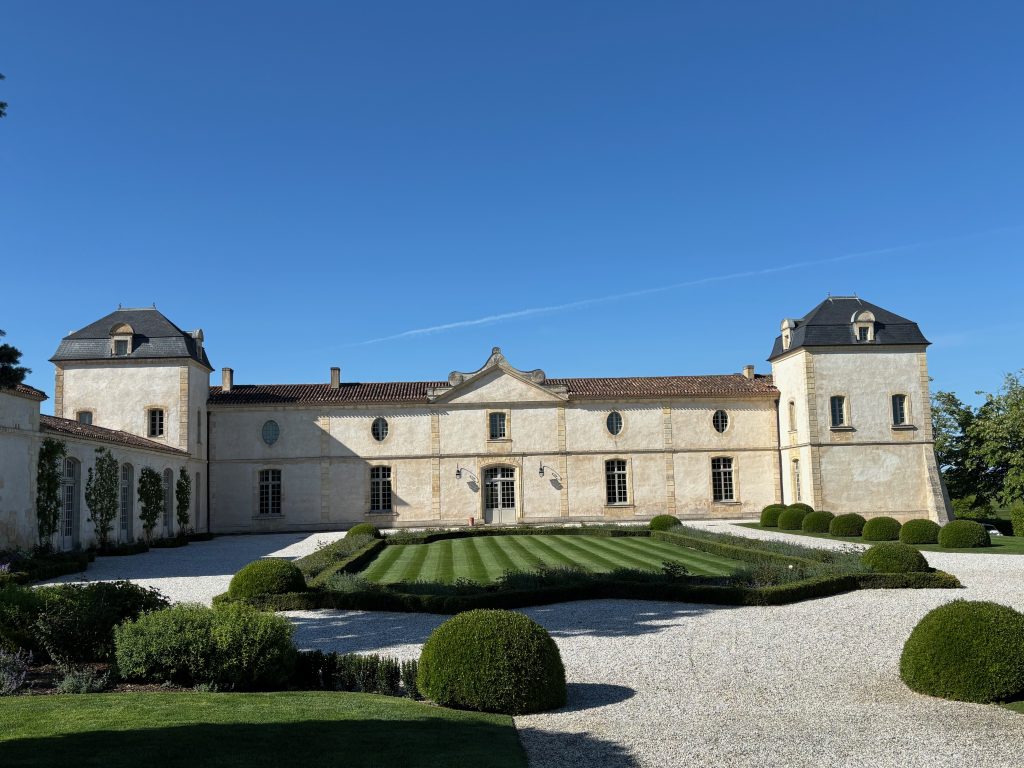
Saint-Estèphe is not exactly far from Pauillac. A well-directed apple thrown from Lafite, admittedly by someone more talented than I in the art of projecting spherical objects over large distances, would have a decent chance of making it into the vineyard at Cos (though please don’t try it!). But it still seems like a long way – sometimes a long way from anywhere.
As the D2 rises and turns past Cos d’Estournel – and above all, if we take the little road that skirts the château buildings on the right towards Haut-Marbuzet and on to Meyney, Montrose and the river beyond – it feels like we’ve entered an altogether different landscape, an altogether different universe. And in a sense we have.
But in 2025, Saint-Estèphe feels more like it belongs with (if certainly not to) Pauillac than ever before. Both appellations thrill and sparkle in this vintage, Saint-Estèphe perhaps more so than in any other vintage I can recall.
The meteorological data hint at why, though they almost certainly paint a little too simplistic a picture. But, in essence, there was a little more rain up here and it had the rather good habit of arriving before serious hydric stress got established on the typically heavier, cooler and more clay-rich soils of the appellation. In short, what turned out badly elsewhere tended to turn out rather better this far up the Médoc.
The results are clear from the average annual appellation yields data shown in Table 1. Of all the leading Médoc appellations, Saint-Estèphe suffered the least, with overall yields above 35 hl/ha and (alongside Pauillac alone) higher than in 2024.
| 2020 | 2021 | 2022 | 2023 | 2024 | 2025 |
10-year average |
% Change | |
| Margaux | 36.3 | 38.6 | 31.3 | 37.7 | 33.1 | 28.8 | 39.2 | -26.5 |
| Saint-Julien | 34.3 | 35.2 | 34.3 | 50.3 | 32.5 | 26.4 | 36.3 | -27.3 |
| Pauillac | 37.4 | 35.1 | 34.8 | 47.1 | 29.5 | 30.2 | 40.2 | -24.9 |
| Saint-Estèphe | 41.2 | 40.7 | 31.5 | 51.6 | 33.6 | 36.8 | 44.4 | -17.1 |
| Pessac-Léognan | 34.6 | 30.7 | 35.7 | 38.1 | 39.0 | 31.0 | 35.6 | -12.9 |
| Saint-Emilion (GC) | 36.7 | 27.5 | 41.2 | 40.5 | 36.4 | 34.7 | 37.9 | -8.4 |
| Pomerol | 39.8 | 28.9 | 32.3 | 45.2 | 28.4 | 25.9 | 36.6 | -29.2 |
Table 1: Average vineyard yield by appellation (hl/ha)
Source: calculated from Duanes data compiled by the CIVB Service Economie et Etudes
As Table 2 shows, the story was largely the same for the most prestigious estates of the appellation, whose average yields come in at very close to that of the appellation as a whole.
Unremarkably, then, the proportion of Merlot and Cabernet in the final blends of their grands vins is very close to that of the 5-year average (for the vintages 2020-2024 inclusive).
Partner Content


| Wine | % Merlot | % Cabernet Sauvignon |
Yields (hl/ha) |
||||||||
| 2021 | 2022 | 2023 | 2024 | 2025 | 2021 | 2022 | 2023 | 2024 | 2025 | ||
| Calon Ségur | 7 | 24 | 15 | 9 | 17 | 81 | 70 | 72 | 82 | 80 | 35 |
| Cos d’Estournel | 30 | 37 | 33 | 38 | 39 | 64 | 61 | 65 | 60 | 60 | 39 |
| Montrose | 31 | 25 | 21 | 17 | 19 | 62 | 66 | 75 | 80 | 77 | 30 |
| Lafon-Rochet | 26 | 31 | 29 | 24 | 29 | 69 | 65 | 64 | 70 | 66 | 41 |
| Phélan Ségur | 21 | 56 | 38 | 30 | 30 | 75 | 40 | 60 | 68 | 65 | 29 |
| Average | 23 | 35 | 22 | 24 | 27 | 70 | 60 | 67 | 72 | 70 | 35 |
| 5-year average | 26.8 | 66.8 | |||||||||
Table 2: Percentage of Merlot & Cabernet Sauvignon in the grand vin, 2021-25, and final yield (hl/ha)
Yet, even given this, I am staggered by just how good and, indeed, how consistent the wines of Saint-Estèphe are in this, a vintage that I am the first to label uneven.
In Cos d’Estournel and Montrose we have two of the wines of the vintage and potential candidates for perfection. Tasting each was for me an emotional experience, not least as it was shared with the contemporary guardians of these exceptional and unique terroirs that in my view have never been expressed so well.
Calon Ségur is also back to its very top form, though there is nothing at all surprising in that.
What is surprising, perhaps the revelation of the appellation in 2025, is the utterly brilliant showing of Phélan Ségur, a wine that has charted a steep upward ascent over a number of vintages but which has shattered the glass ceiling for me in 2025. It is, by some distance, the best wine I have ever tasted from the property in over 30 vintages.
Lafon-Rochet, Cos Labory (reborn in its new incarnation) and de Pez all also deserve special mention. But so do so many others. Of all my appellation profiles, I suspect this is the one that warrants the closest and most detailed inspection.
Highlights in 2025
Best of the appellation:
- Château Cos d’Estournel 98-100
- Château Montrose 98-100
Greatest successes:
- Château Calon Ségur 94-96+
- Château Phélan Ségur 94-96+
- Château Lafon-Rochet 93-95+
- Château Cos Labory 93-95
- Château de Pez 93-95
- La Dame de Montrose 93-95
- Château Meyney 93-95
Value picks:
- Château Phélan Ségur 94-96+
- Château Cos Labory 93-95+
- Château de Pez 93-95
- Château Le Boscq 92-94+
Tasting Notes
Please click here for the 2025 tasting notes, which can be searched by château and by appellation.
For full appellation-by-appellation reviews as they are published, click: Margaux, Saint-Julien, Pauillac, Saint-Estèphe, Haut-Médoc & Left Bank satellite appellations (Listrac-Médoc, Médoc, & Moulis-en-Médoc), Pomerol, Saint-Émilion, ‘satellite’ Right Bank appellations (Fronsac, Lalande & Castillon), Pessac-Léognan & Graves red, Pessac-Léognan & Graves white, Medoc & Bordeaux including Vin de France (white) and Sauternes & Barsac.
Related news
Bordeaux 2025: some additional tasting notes
Bordeaux 2025 en primeur: star picks from the Right Bank 'satellites'
Bordeaux 2025 en primeur: Sauternes & Barsac ‘very rich, very powerful’


