



Bordeaux 2025 en primeur: Margaux sees ‘a vintage in which tiny details make big differences’
Db’s Bordeaux correspondent Colin Hay’s whistle-stop tour of the Médoc’s en primeur offerings starts this year in the south, in Margaux, it’s largest appellation.
Last year my appellation profile of Margaux started by noting that, alongside St Julien, it seemed to have coped better than most with the considerable challenges of the growing season in 2024 and that, in so doing, its wines seemed to have retained much of their customary character, charm and typicity.
That is not quite my conclusion this year. The 2025 vintage is just a little different. For although, as my detailed tasting notes and ratings show very clearly, Margaux has again performed exceptionally well – with an average rating well exceeding that of 2024 or 2023, and pretty much level with that of 2022 – my sense is that things were rather more difficult here than they were further north (above all in Pauillac and St-Estèphe). My sense, too, is that Margaux in 2025 is a little less characteristically ‘Margellais’ as a consequence, for the first time since probably 2018.
But it is important to retain a wider sense of perspective here. 2025 is an excellent vintage, on both the Left Bank and the Right Bank alike, and Margaux is definitively no exception to the generalisation. The wines that it has produced – at all points in the classification and beyond it and at all price points, pretty much regardless of property – are significantly better than those produced since 2022.
But, in my judgement at least, those wines taken together are a little more heterogeneous and less expressive of their appellation typicity when compared to the other leading appellations of the Médoc.
That we typically expect because, first, Margaux is the largest and the most diverse of the leading appellations of the Médoc and, second, because it is customary to think of it as exhibiting the greatest stylistic and qualitative range in its viticulture. But that is not what I think is going on here at all. This is not, for me, a story of the other appellations of the Médoc coping better with the challenges of 2025 but, rather more simply, a story of those challenges proving to be just a little more challenging in the southern Médoc than further north.
This is a vintage in which tiny details make big differences – above all when it comes to the timing, the volume and the capacity of a terroir to absorb available rainfall and the consequences for the maturity of the fruit itself at harvest. And that I think is what is going on here. Hydric stress varied between sectors within the appellation and, indeed, between individual terroirs and parcels within sectors. And it did so more in Margaux than elsewhere (not least, but not only, because of the sheer territorial range of the appellation).
The result are wines that were forged in a variety of more or less challenging conditions by properties with varying degrees of access to the resources requires to mitigate the associated risks of those challenges (whether that be the capacity to pick a vineyard very quickly, the capacity to vinify sub-plots separately, or the access to the densimetric sorting often necessary fully to eliminate desiccated grapes). We see this in the finished wines.
What we also see are rather different strategies for coping with the challenges of 2025, in the vineyard but also in the chai.
Château Margaux is a case in point. With all his experience in California, Philippe Bascaules waited and waited for the resumption of the maturation of his Cabernet Sauvignon after the rainfall at the end of August. The brilliance of his wine, somewhat unique in the context of the vintage at nearly 14 degrees of alcohol, comes from the fact that even the first bunches of the old-vine Cabernet at its core were picked after all of his neighbours had put away their secateurs for the season.
But what this hints at is that at least some of those who picked earlier were not picking fruit at perfect phenolic maturity. That was much less the case further north.
The wines themselves (as table 1 shows), are not so very different in their composition from those produced in the very different conditions of 2023 and 2024. There is a little more Cabernet Sauvignon in the final blends of the grands vins of the leading estates in 2025 relative to 2024 but no less Merlot.
Partner Content
| Wine | % Cabernet Sauvignon | % Merlot | Yields (hl/ha) | ||||||
| 2023 | 2024 | 2025 | 2023 | 2024 | 2025 | 2023 | 2024 | 2025 | |
| Brane-Cantenac | 70 | 77 | 80 | 20 | 22 | 18 | 46 | 47 | 32 |
| Durfort-Vivens | 92 | 94 | 91 | 8 | 6 | 9 | 35 | 37 | 28 |
| D’Issan | 70 | 65 | 64 | 25 | 30 | 30 | 30 | 40 | 30 |
| Lascombes | 60 | 65 | 60 | 37 | 30 | 35 | 35 | 38 | 25 |
| Margaux | 89 | 93 | 89 | 5 | 5 | 6 | 41 | 30 | 22 |
| Palmer | 50 | 59 | 41 | 46 | 41 | 55 | 32 | 22 | 20 |
| Rauzan-Ségla | 85 | 64 | 65 | 14 | 34 | 33 | 30 | 29 | 29 |
| Average | 74 | 64 | 70 | 22 | 24 | 27 | 36 | 35 | 27 |
| 10-year appellation average | 40 | 39 | |||||||
Table 1: Percentage of Merlot & Cabernet Sauvignon in the grands vins and final yield (hl/ha)
But what is more striking – and alarming, above all considering the quality of the vintage – is the decline in yields. As Edouard Miailhe observes in his introduction to the Syndicat du Viticole de Margaux’s vintage report, at 29 hl/ha, the average appellation yield is the lowest ever recorded for a vintage without frost damage. It is also over a quarter down on a 10-year average that has for the first time itself dropped below 40 hl/ha, as figure 2 shows.
| 2019 | 2020 | 2021 | 2022 | 2023 | 2024 | 2025 | 10-year average | Relative to 10-year average (% change) | |
| Margaux | 49.2 | 36.3 | 38.6 | 31.3 | 37.7 | 33.1 | 28.8 | 39.2 | -26.5 |
| Saint-Julien | 45.5 | 34.3 | 35.2 | 34.3 | 50.3 | 32.5 | 26.4 | 36.3 | -27.3 |
| Pauillac | 46.7 | 37.4 | 35.1 | 34.8 | 47.1 | 29.5 | 30.2 | 40.2 | -24.9 |
| Saint-Estèphe | 49.7 | 41.2 | 40.7 | 31.5 | 51.6 | 33.6 | 36.8 | 44.4 | -17.1 |
| Pessac-Léognan rouge | 47.2 | 34.6 | 30.7 | 35.7 | 38.1 | 39.0 | 31.0 | 35.6 | -12.9 |
| Saint-Émilion (GC) | 43.0 | 36.7 | 27.5 | 41.2 | 40.5 | 36.4 | 34.7 | 37.9 | -8.4 |
| Pomerol | 43.0 | 39.8 | 28.9 | 32.3 | 45.2 | 28.4 | 25.9 | 36.6 | -29.2 |
Table 2: Average vineyard yield by appellation (hl/ha)
Source: calculated from Duanes data compiled by the CIVB Service Economie et Etudes
There are many highlights in the appellation in the vintage. At the heights of the plateau in this high plateau vintage are, unsurprisingly, Margaux itself, very closely followed by an exuberant Palmer and a very different, more classical and poised, Rauzan-Ségla.
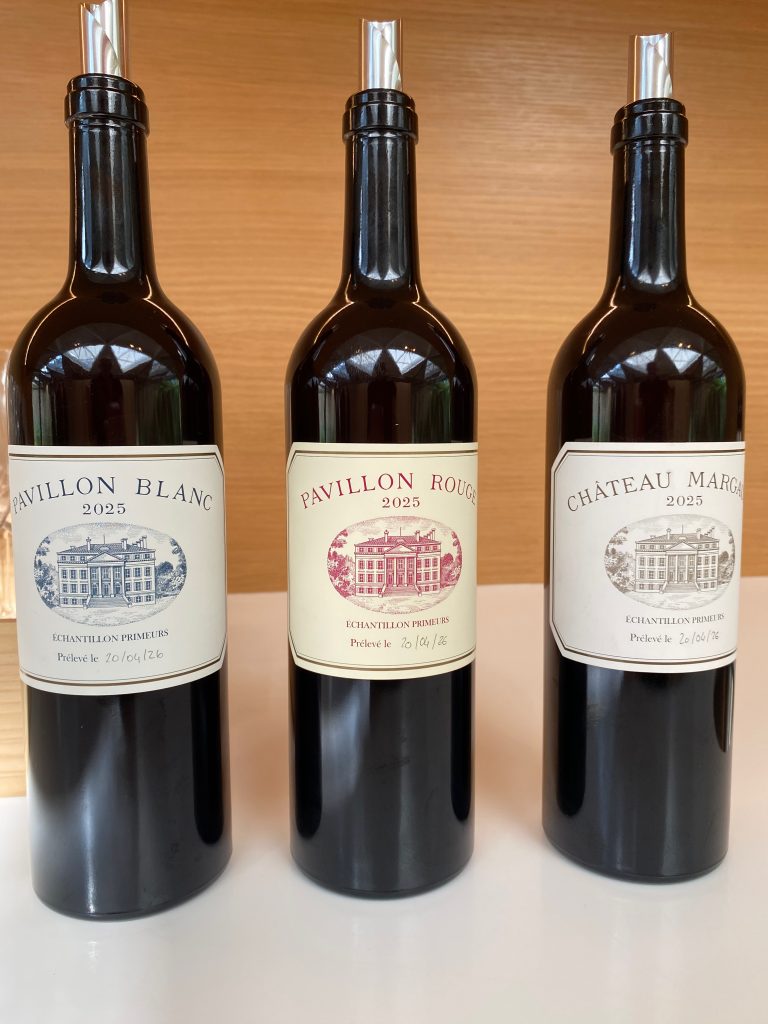
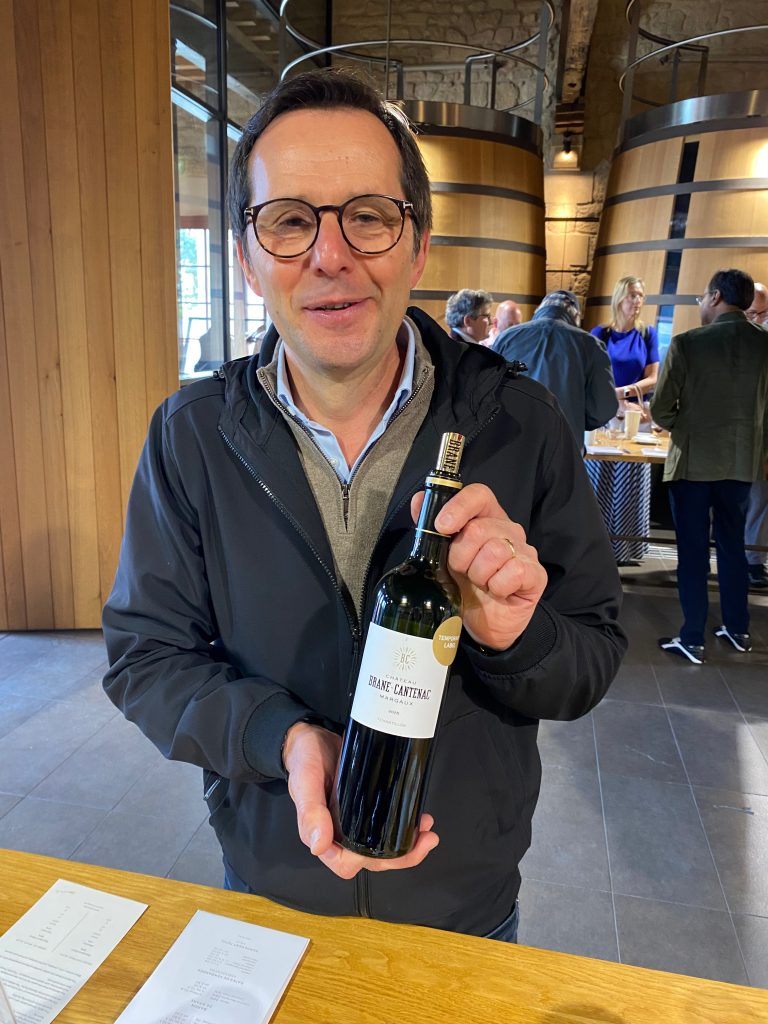
Brane Cantenac, Durfort-Vivens, Lascombes and Giscours also deserve special mention – not least for wines that achieve both a staggering quality but also that so seamlessly and eloquently express both their respective identities and the sheer quality of the terroirs from which they come.
Finally, it would be remiss not to conclude by highlighting once again the considerable value to be found in wines like du Tertre, Ferrière, Siran and the utterly charming Le Côteau.
Highlights in 2025
Best of the appellation:
- Margaux 97-99
Greatest successes:
- Palmer 96-98+
- Rauzan-Ségla 96-98+
- Brane-Cantenac 96-98
- Durfort-Vivens 96-98
- Lascombes 96-98
- Giscours 95-97
Value picks:
- du Terte 93-95+
- Ferrière 93-95
- Siran 93-95
- Le Côteau 92-94
Tasting Notes
Please click here for the 2025 tasting notes, which can be searched by chateaux and by appellation.
For full appellation-by-appellation reviews as they are published, click: Margaux, Saint-Julien, Pauillac, Saint-Estèphe, Haut-Médoc & Left Bank satellite appellations (Listrac-Médoc, Médoc, & Moulis-en-Médoc), Pomerol, Saint-Émilion, ‘satellite’ Right Bank appellations (Fronsac, Lalande & Castillon), Pessac-Léognan & Graves red, Pessac-Léognan & Graves white, Medoc & Bordeaux including Vin de France (white) and Sauternes & Barsac.
Related news
Bordeaux 2025: some additional tasting notes
Bordeaux 2025 en primeur: star picks from the Right Bank 'satellites'
Bordeaux 2025 en primeur: Sauternes & Barsac ‘very rich, very powerful’


