



Bordeaux 2025 en primeur: Pessac-Léognan & Graves reds ‘something of a revelation’
db Bordeaux correspondent Colin Hay continues his tour of the 2025 en primeur offerings by heading to Pessac-Léognan and the Graves, where his anxieties are largely dispelled.
When I think of the impact of climate change on the vineyards of Bordeaux, as I do more and more frequently, I worry. And, if I am honest, I worry perhaps most about Pessac-Léognan and the Graves.
True, climate change is much more than just the combination of extreme heat and extreme drought. But it is typically precisely such conditions that one conjures first when one thinks about it abstractly and prospectively. And when one does so – or at least when I do – it is the plight of Pessac-Léognan and the Graves that is the most immediate focus of my anxiety. I picture gently rolling expanses of sun-baked vineyards on well-draining gravel soils south of Bordeaux, and the insufficiently replenished water tables on which they rely below.
So, as the summer of 2025 unfolded and it seemed, not for the first time, that some of my nightmares were starting to be realised, it is perhaps unremarkable that I became more and more anxious about what I might find when it came to the en primeur tastings in April 2026 in Pessac, in Léognan and the Graves.
It turns out that I was wrong, but really only in the geographical targeting of my fears.
For, yes, Bordeaux came very close to the limits of viticultural sustainability in 2025. But Pessac-Léognan and the Graves more generally were, in the end, relatively spared.
Table 1 goes some way to indicating how. It shows total rainfall volumes for a number of weather stations around the region during and immediately before the growing season.
|
Pre-budburst (November-March) |
Budburst to harvest (April-September) |
Annual total (calendar year) |
|
| Pessac-Léognan (Canéjan) | 384 (-12.5%) | 399 (-1.5%) | 949 (+12.4%) |
| Saint-Emilion | 258 (-41.2%) | 311 (-23.2%) | 670 (-23.0%) |
| Pauillac | 287 (-53.0%) | 373 (-7.9%) | 864 (+2.4%) |
| 30-year average* | 439 | 405 | 844 |
Table 3: Rainfall (mm) during the vintage, relative to 30-year average.
Source: https://www.infoclimat.fr/climatologie/ (*Bordeaux-Mérignac alone).
What it demonstrates is that Pessac-Léognan (and the Graves, more generally) received rather more rainfall over the winter before the vegetative cycle commenced and during the growing season than either the Médoc or the Right Bank.
Partner Content
The result of that is clear to see in Table 2, which shows that overall yields held up better in Pessac-Léognan, relative to the 10-year average, than in any other appellation except Saint-Émilion.
| 2020 | 2021 | 2022 | 2023 | 2024 | 2025 |
10-year average |
% Change | |
| Pessac-Léognan | 34.6 | 30.7 | 35.7 | 38.1 | 39.0 | 31.0 | 35.6 | -12.9 |
| Pomerol | 39.8 | 28.9 | 32.3 | 45.2 | 28.4 | 25.9 | 36.6 | -29.2 |
| Saint-Émilion (GC) | 36.7 | 27.5 | 41.2 | 40.5 | 36.4 | 34.7 | 37.9 | -8.4 |
| Margaux | 36.3 | 38.6 | 31.3 | 37.7 | 33.1 | 28.8 | 39.2 | -26.5 |
| Saint-Julien | 34.3 | 35.2 | 34.3 | 50.3 | 32.5 | 26.4 | 36.3 | -27.3 |
| Pauillac | 37.4 | 35.1 | 34.8 | 47.1 | 29.5 | 30.2 | 40.2 | -24.9 |
| Saint-Estèphe | 41.2 | 40.7 | 31.5 | 51.6 | 33.6 | 36.8 | 44.4 | -17.1 |
Table 2: Average vineyard yield by appellation (hl/ha)
Source: calculated from Duanes data compiled by the CIVB Service Economie et Etudes
Thankfully, that is what we find in the wines too, at least the reds (we will return to the whites in a separate appellation profile). For while, as Table 3 shows, the yields of the leading estates were far from generous (averaging just 30 hl/ha) they had little impact on the final varietal composition of the blends, with the proportion of Merlot returning to something close to its 10-year average after the ravages of mildew in 2024.
| Wine | % Merlot | % Cabernet (S & F) | Yields (hl/ha) | ||||||
| 2023 | 2024 | 2025 | 2023 | 2024 | 2025 | 2023 | 2024 | 2025 | |
| Carmes Haut-Brion | 20 | 23 | 17 | 80 | 67 | 83 | 50 | 24 | 38 |
| Domaine de Chevalier | 25 | 30 | 30 | 70 | 65 | 65 | 30 | 48 | 34 |
| Haut Bailly | 34 | 40 | 36 | 62 | 60 | 60 | 40 | 30 | 28 |
| Haut-Brion | 52 | 38 | 60 | 48 | 62 | 40 | 50 | 26 | 26 |
| La Mission Haut-Brion | 53 | 47 | 58 | 48 | 54 | 42 | 50 | 26 | 26 |
| Pape-Clément | 50 | 45 | 45 | 45 | 54 | 54 | 35 | 42 | 29 |
| Smith Haut Lafitte | 23 | 27 | 27 | 76 | 72 | 72 | 26 | 21 | 28 |
| Average | 37 | 36 | 39 | 61 | 62 | 59 | 40 | 31 | 30 |
| 10-year appellation average | 36.1 | 35.6 | |||||||
Table 2: Percentage of Merlot & Cabernet Franc in the grands vins and final yield (hl/ha), 2023, 2024 & 2025
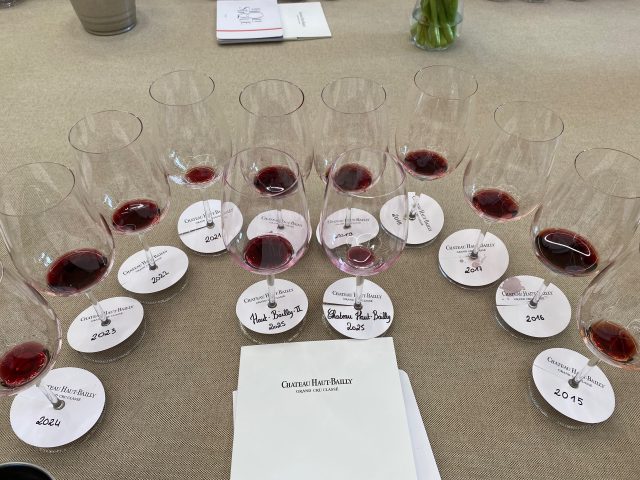
The wines, then, are something of a revelation. Fresh, bright, crisp, low in alcohol and high in terroir typicity, character and, indeed, ageability.
The stars of the appellation are, as ever, Haut-Brion and La Mission Haut-Brion, very closely followed by a supremely stylish and elegant Carmes Haut-Brion.
Haut Bailly, too, is on absolutely top form and Pape Clément deserves a special mention for having produced what I regard to be the best wine I have ever tasted from the estate in 15 years of en primeur tastings.
Bouscaut and Larrivet Haut-Brion both also seem to have raised their games to an unprecedented level.
 Highlights in 2025
Wines of the appellation:
- Château Haut-Brion 97-99
- Château La Mission Haut-Brion 97-99
Truly exceptional:
- Château Carmes Haut-Brion 96-98+
- Château Haut-Bailly 96-98+
- Château Pape Clément 96-98
- Château Smith Haut Lafitte 96-98
- Domaine de Chevalier 95-97+
- Château de Fieuzal 95-97
- Château Malartic Lagravière 94-96
Value picks:
- Château Larrivet Haut-Brion 93-95+
- Château Latour-Martillac 93-95+
- Château Bouscaut 93-95
- C de Carmes Haut-Brion 93-95
- Château Couhins 93-95
- Château Couhins Lurton 93-95
Tasting Notes
Please click here for the 2025 tasting notes, which can be searched by château and by appellation.
For full appellation-by-appellation reviews as they are published, click: Margaux, Saint-Julien, Pauillac, Saint-Estèphe, Haut-Médoc & Left Bank satellite appellations (Listrac-Médoc, Médoc, & Moulis-en-Médoc), Pomerol, Saint-Émilion, ‘satellite’ Right Bank appellations (Fronsac, Lalande & Castillon), Pessac-Léognan & Graves red, Pessac-Léognan & Graves white, Medoc & Bordeaux including Vin de France (white) and Sauternes & Barsac.
Related news
Bordeaux 2025: some additional tasting notes
Bordeaux 2025 en primeur: star picks from the Right Bank 'satellites'
Bordeaux 2025 en primeur: Sauternes & Barsac ‘very rich, very powerful’


