



Bordeaux 2025 vintage profile: Quality over quantity
As the Bordeaux 2025 en primeur tastings get underway, db’s Bordeaux correspondent, Colin Hay, reflects on the meteorological conditions that have shaped a small but potentially exceptional vintage.
Bordeaux 2025 is another record-breaking vintage. But despite its qualities, the record that it most clearly breaks is not a good one and one that forms part of a worrying series. For it enters the annals as the smallest vintage in total production since 1991. Indeed, it is the second vintage in a row to do so, with 2024 having been the previous smallest crop since 1991.
But any comparison with 2024 ends there. For unlike its predecessor, it is likely to be seen as an exceptional vintage. For that, of course, we need to wait until the en primeur tastings to come. But what is already clear is that, exceptional or not, it is exceptionally small. And in that respect it marks the continuation of an alarming trend. Even ostensibly great vintages no longer seem to come with volume.
But the production statistics are deceptive in a way. This is not just a question of yields. For 2025 also continues another alarming trend – the further reduction in the total area in the Bordeaux region that is under vine and in production. The effect, as Gavin Quinney has recently observed, is that Bordeaux produced twice as many bottles of the 2016 vintage as it did have done so in 2025.
The data, and the trends they outline over time, are stark – as Figures 1 (for production) and 2 (for yield) show clearly.
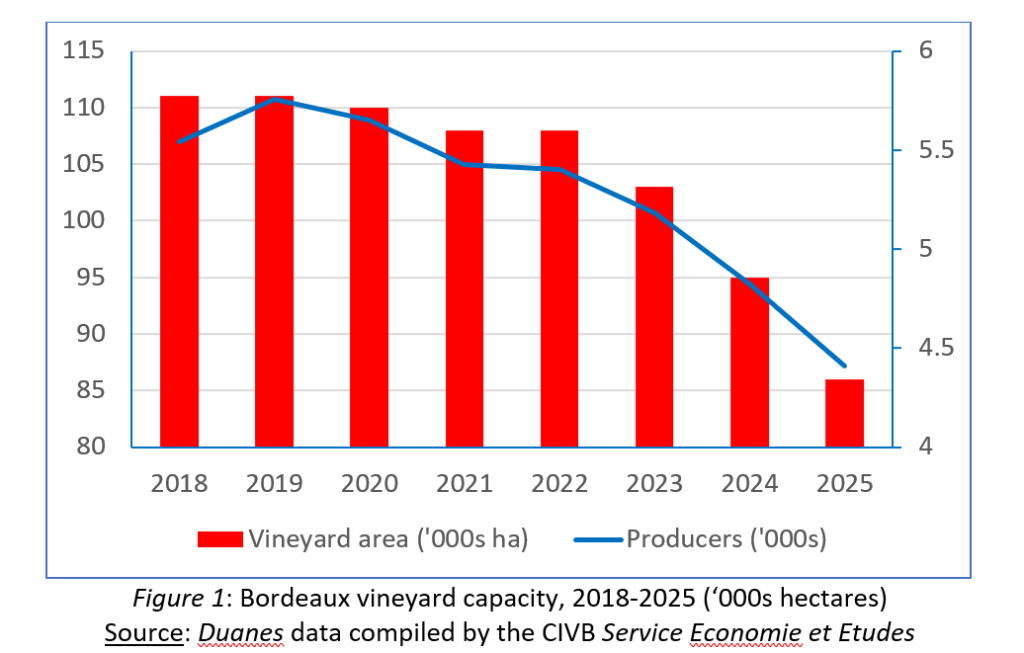
Source: Duanes data compiled by the CIVB Service Economie et Etudes
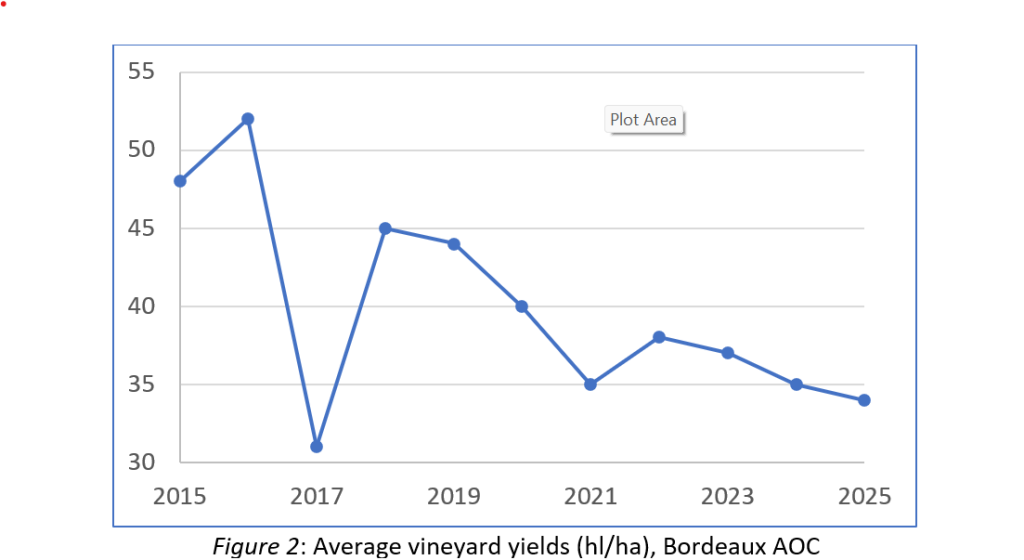
Source: replotted from Gavin Quinney (2026) Bordeaux 2025 weather and harvest report, https://gavinquinney.com/2025/02/28/bordeaux-2024-weather-and-crop-report/; Duanes data compiled by the CIVB Service Economie et Etudes
The vintage in a nutshell: hot, dry and largely hail-, frost- and mildew-free
It was for a long time conventional, in summarising the meteorological factors contributing to the success or failure of any given vintage, to point to the five pre-conditions for a great vintage. But we need to do so today with a little caution. For in a context of dérèglement climatique (climate weirding) these conditions are now rarely met. More importantly, with improvements in viticultural and oenological techniques as well as the intensity of extreme climatic events, they neither guarantee greatness just as they are no longer necessary conditions of it.
But it is still useful to reflect on what they are to give us a shorthand overview of the vintage. So let me start simply by listing them, in a formulation that draws closely on that used by Axel Marchal and his colleagues at the University of Bordeaux.
- Quick and even flowering and fruit set;
- Late spring and early summer conditions sufficiently dry and warm to facilitate even pollination and to encourage even ripening;
- A gradual rise in hydric stress over the summer (with, above all, a warm and dry July), slowing and ultimately stopping vine growth before véraison (colour change);
- Ripe grapes with optimum photosynthesis continuing up until harvest (without any significant resumption in vegetative growth);
- Dry and medium-warm weather during the harvest itself (ideally, with good temperature variation between night and day), allowing picking at optimal ripeness (and freshness).
To these we might add a sixth: the absence of significant losses during the entirety of the growing season from hail, frost or mildew damage, either individually or in combination.
None of these conditions were present in 2021 and, since then, there have only been two vintages in which they were all present – 2022 and, indeed, 2025.
The headline news is good, then. But, as ever in Bordeaux, the devil of any vintage lies in the detail.
That detail I have sought to reconstruct from a variety of sources. These include the first-hand witness testimony of those who responded to 2025’s challenges and from the exhaustive vintage reports produced, respectively, by Axel Marchal and his co-authors from the University of Bordeaux’s Institut des Sciences de la Vigne and du Vin (ISVV), by Sovivins at the end of the harvest itself, by Gavin Quinney and by a number of consultant oenologists either for their clients or for a wider and more public audience.+ In addition, I would like to thank Axel Marchal from the ISVV, Gavin Quinney, and colleagues from the Conseil Interprofessionnel de Vins de Bordeaux (CIVB) for their help in compiling, sharing, checking and making sense of some of the data.
An overview of the growing season
- The growing season was hotter than all recent vintages bar 2022 on average, hotter even than 2003.
| Temperature (°C) | 2018 | 2019 | 2020 | 2021 | 2022 | 2023 | 2024 | 2025 |
| Average (April-Sept) | 19.0 | 18.2 | 18.9 | 17.7 | 19.8 | 19.4 | 17.8 | 20.2 |
| relative to 10-year mean | +.5 | -.3 | +.4 | -.8 | +1.3 | +.9 | -.7 | +1.7 |
Table 1: Average growing season temperatures in the Bordeaux region 2017-25
Source: calculated from Gavin Quinney’s Bordeaux 2025 weather and harvest report, David Pernet at al.’s 2025 vintage report for Sovivins and from https://www.infoclimat.fr/climatologie/.
- It was also extremely dry. But, crucially, it saw more rainfall than both 2003 and 202. Indeed, in terms of overall rainfall during the growing season, its closest comparators are 2019 and 1990.
| Rainfall (mm) | 2018 | 2019 | 2020 | 2021 | 2022 | 2023 | 2024 | 2025 |
| March-Sept | 443 | 399 | 560 | 469 | 278 | 428 | 649 | 364 |
| relative to 10-year mean (%) | +3 | -7 | +31 | +9 | -35 | = | +52 | -15 |
| Annual* | 785 | 998 | 1157 | 885 | 639 | 1219 | 1017 | 840 |
| relative to 20-year mean (%) | -15 | +8 | +26 | -4 | -31 | +32 | +10 | -9 |
Table 2: Average rainfall in the Bordeaux region 2017-25
Source: calculated from Gavin Quinney’s Bordeaux 2025 weather and harvest report and https://www.infoclimat.fr/climatologie/ (* for Bordeaux-Mérignac alone)
- The winter had been predominantly dry – with 212mm less rainfall between 1st October 2024 and 31st March 2025 than the 10-year average. But despite this, given the deluge conditions of the previous winter, this was more than enough to replenish the water table before the growing season. There was, then, no hydric stress entering the vegetative cycle for what would become the 2025 vintage. Conditions were propitious for a successful budbreak and flowering.
- Winter months were marginally below the 10-year average after an extremely mild autumn (with temperatures over 1.5 degrees warmer than normal).
- As is the recent trend, however, spring came early, with temperatures rising rapidly in the second half of February. But, thankfully, a short cold snap in mid-March held back what was threatening to be a dangerously early bud-break.
- Budburst (débourrement) took place in excellent (mild and dry) conditions from the 25th of March (just 5-6 days in advance of the 25-year average). It passed off evenly and largely without incident (and with a relatively high proportion of double buds), giving good potential for production from the outset in stark comparison to 2024.
- The favourable and largely dry conditions also prevented any repetition of the spread of mildew that had plagued the vineyards of Bordeaux a year earlier.
- After an extremely wet Easter the trend for the vintage was established with the weather turning dry and hot (as Table 3 suggests). Yet the 70-80mm of rain that fell then were very important for what was the follow, helping the favourable unfolding of the vegetative cycle and rendering more accessible to the plant the nutrients, above all nitrogen, on which it would later rely. Thankfully, however, the rainfall did not precipitate any significant mildew episode other than in the southern parts of the Graves (with the total volumes of mildew treatments deployed much lower than in recent vintages, notably 2024).
|
Pre-budburst (November-March) |
Budburst to harvest (April-September) |
Annual total (calendar year) |
|
| Pessac-Léognan (Canéjan) | 384 (-12.5%) | 399 (-1.5%) | 949 (+12.4%) |
| St Emilion | 258 (-41.2%) | 311 (-23.2%) | 670 (-23.0%) |
| Pauillac | 287 (-53.0%) | 373 (-7.9%) | 864 (+2.4%) |
| 30-year average* | 439 | 405 | 844 |
Table 3: Rainfall during the vintage (relative to 30-year average)
Partner Content
Source: https://www.infoclimat.fr/climatologie/ (* Bordeaux-Mérignac alone).
May
- Flowering (floraison) commenced around a week earlier than normal (13-14 May) and progressed rapidity and, crucially, evenly (as in 2005).
- The result was a good and generous fruit-set. This went some way to compensate for the low fertility of the shoots and the smaller number of bunches per plant that was a legacy of the compound challenges of 2024 (and, ultimately, the greatest single factor reducing vineyard yields in 2025).
- The hot and dry conditions continued into mid-June with hydric stress established very early in the vineyard cycle – before the closing of the bunches in many places. The effect of this, before the changing in the colour of the grapes (véraison), led to an increase in the plant’s synthesis of skin polyphenols (with a thickening of the skins to protect the plant from the sun and desiccation). This tendency was reinforced by the vine’s limited uptake of nitrogen in a particularly dry spring. It is this that is largely responsible for the high ratio of pips and skins to juice in the musts from which the wines were ultimately produced. In short, it is a key (if, as we shall see, not the only) determinant of the high tannic levels of the final wines. The hydric stress already present in the vineyard at this stage also contributed to the small size of the grapes themselves.
- Véraison was early (starting around 7-8 July for the Merlot, 2 days earlier than for the precocious 2022 vintage, with mid-véraison attained a full three weeks earlier than in 2024). But it was then slowed by the prevailing dry conditions, ending, very evenly, at the end of the month after the accelerating effect of rainfall on the 19 and 21st of July. Despite this just 75mm of total rainfall was recorded in the region between mid-May and the end of July (with only 65mm in St Julien and St Emilion). The effect was to limit growth in the size of the grapes (though with a fair degree of inter-appellation variation, with total rainfall levels varying significantly between sectors).
- The first two weeks of August were extremely hot (with 10 days over 35 degrees and an average maximum daily temperature of almost 36 degrees over the 2-week period). This makes 2025 the vintage with the second highest number of days recorded above 35 degrees – just below 2003 and just above 2022. This accelerated maturation with an accelerated and very early fall in malolactic acid in the grapes, leading to concerns that the vintage would be characterised by high alcohol and low total acidity.
- Hydric stress became pronounced precipitating a rapid ripening of skins and, indeed, pips.
- Crucially, night-time temperatures remained much closer to the 10-year average and the consequently large diurnal range during this period reduced the damage to the foliage to the plant that would otherwise have been expected.
- Thankfully the weather broke at the end of the month, with significant if variable amounts of rainfall between the 28th of August and the 2nd of September as the tail-end of Hurricane Erin passed through the region. Up to 70mm of rain fell in the north of the Médoc, but just 25mm on the plateau of Pomerol. In general, the effects were positive – increasing the potential yield (with the grapes swelling by around 10 per cent on average), preventing over-maturation, helping accelerate the final ripening of the skins and suppressing potential alcohol levels that had been rising steeply. With the tannic density and aromatic intensity of the vintage already in place this was almost entirely positive with the average size of the grapes remaining almost unprecedentedly small. The return of the rain also reduced acidity and boosted pH levels in the final wines (to levels, at harvest, around the 5-year average).
- A significant proportion of the dry whites were picked before the rain episode at the end of August. They are, for the most part, wines of great aromatic complexity and with a good equilibrium despite the elevated temperatures in the second half of August. But the final yields are extremely low. The early pickings dates were crucial for the retention of both acidity and aromatic complexity in the final wines.
- The early aromatic development and rapid attainment of phenolic ripeness for the Merlot led to historically early picking dates with the first bunches harvested during the first week of September. The Cabernet, whose aromatical development was slower, were picked from mid-September.
- Overall, 2025 Is one of the three most precocious vintages in Bordeaux’s recent history, alongside 2003 and 2022 and on a par with 1989. Indeed, the evenness of floraison and véraison, the low yields and the acceleration of the ripening of the skins following the rain at the end of August all contributed to the start of the harvesting of the grapes three days before the 2022 vintage.
The impact of the growing season on the character of the wines
- Temperatures were above the 10-year average during almost all of the vegetative cycle and record levels of hydric deficit during the ripening period itself help us to understand the extremely precocious nature of the vintage.
- Significant hydric stress limited photosynthesis during the ripening period and this, combined with the rain at the end of August, moderated sugar accumulation and hence potential (and actual) alcohol levels in the final wines produced, even for Merlot.
- Total acidity levels are low and pH levels high (though both vary considerably), largely the effect of the rainfall at the end of August.
- Tannin levels are high due to the thickness of the skins, the small size of the grapes themselves, the cumulative effect of sustained hydric stress and hence the high ratio of physical matter to juice at harvest. This we see clearly in Table 4, which presents data from the ISVV’s sample vineyard plots across the region.
|
Weight per 100 grapes (g) |
Sugar (g/L) |
Total acidity (g/L) |
|
| Merlot 2025 | 116 | 228 | 3.1 |
| Merlot 2024 | 172 | 213 | 3.1 |
| Merlot 2023 | 154 | 222 | 3.3 |
| Merlot 2022 | 122 | 241 | 2.4 |
| Merlot 2021 | 176 | 205 | 3.3 |
| Merlot (2018-20) | 140 | 235 | 2.6 |
| Cabernet Sauvignon 2025 | 96 | 216 | 3.9 |
| Cabernet Sauvignon 2024 | 107 | 205 | 4.6 |
| Cabernet Sauvignon 2023 | 113 | 222 | 3.1 |
| Cabernet Sauvignon 2022 | 95 | 232 | 3.0 |
| Cabernet Sauvignon 2021 | 138 | 205 | 4.0 |
| Cabernet Sauvignon (2018-20) | 110 | 233 | 3.2 |
Table 4: Characteristics of the grapes at harvest
Source: calculated from https://bordeauxraisins.fr/suivi-de-maturite-2025.html with the historical data drawn from Marchal et al. (2023)¡; 2025 data collected in the final three weeks of September for Merlot and the final week of September and the first two weeks of October for the Cabernet Sauvignon in the ISVV’s sample vineyards
- On parcels exhibiting hydric stress and despite the short hang-times, the pips are fully ripe with no astringency.
- The concentration of anthocyanins is a little above the normal (more so for Cabernet Sauvignon if a little less so for Merlot), but the ratio of tannins to anthocyanins is higher still.
- A potential danger point is the rapid maturation and associated reduction in freshness and aromatic brilliance of Merlot on soils characterised by a low capacity for water retention.
- Yet on more water retaining soils there is an inverse risk, that of picking before full phenolic and tannic maturity with resulting astringency and austerity in the final wine.
- As this suggests, there is likely to be a clear advantage for well-established and correspondingly deep-rooted old vines, even if the low fertility of the plants themselves may result in particularly low yields from such plots.
- Due to the significant hydric stress – and above all for young vines – it was necessary to manage potential yields and to thin the potential copy so as to avoid the shutdown of the plant.
- Access to clay subsoils was a significant advantage in 2025. The accumulation over the past two years of winter rainfall in the water table and its recharging in April gave vines with access to such subsoils the water resources to draw upon. This sustained them through the excesses of the summer and protected them, in the process, against blockages in maturity whilst allowing them to maintain a canopy capable of protecting the fruit itself to full ripeness.
- The whites are rich but have managed to retain good balance and harmony despite the heat and dryness of the vintage conditions. Where (as generally) they were picked before the late August rainfall they have not suffered from the rise in pH (as Table 5 shows) and their principal weakness is just their scarcity. There is, however, a risk. With the high levels of tannins in the skins, macerations needed to be managed very carefully due to the greater risk of oxidation.
|
Potential alcohol (%) |
Total acidity (g/L) |
pH
|
|
| 2025 | 13.4 | 4.8 | 3.10 |
| 10-year average | 13.3 | 4.5 | 3.21 |
| 2024 | 12.3 | 5.4 | 3.10 |
| 2023 | 13.2 | 4.4 | 3.20 |
| 2022 | 13.8 | 3.5 | 3.30 |
| 2021 | 12.9 | 5.0 | 3.23 |
| 2020 | 13.9 | 4.3 | 3.28 |
| 2019 | 13.0 | 4.3 | 3.27 |
Table 5: Characteristics of the Sauvignon Blanc at harvest
Source: calculated from Gény et al. (2026) drawing on ISVV data from a
single reference parcel in the Graves
- In Sauternes and Barsac, conditions for the development of botrytis were excellent, following the rainfall at the end of August. The subsequent return to dry conditions in September allowed for its concentration. The grapes were picked in ideal conditions in successive ‘tries’ from the 20th of September. Potential quality is high and final yields are likely to exceed recent averages.
Appellation yields
Finally, we come to overall appellation yields. It is tempting to imagine that, in a vintage which saw the region harvest the smallest crop since 1991, they are vanishingly small. That is indeed the broad picture shown in Tables 6 and 7. But once again, the devil lies in the detail.
| 2022 | 2023 | 2024 | 2025 | Change | |
| All AOP Bordeaux rouge & rose | 38.3 | 36.1 | 34.1 | 33.3 | -2.9% |
| … AOC Bordeaux rouge | 39.7 | 33.3 | 37.3 | 35.8 | -4.0% |
| … Left-bank (Médoc & Graves) | 34.5 | 40.0 | 30.8 | 30.6 | -0.5% |
| … Right-bank | 42.2 | 42.6 | 34.4 | 32.3 | -6.4% |
Table 6: Average vineyard yield by appellation group (hl/ha)
Source: calculated from Duanes data compiled by the CIVB Service Economie et Etudes
In Table 6, it is the contrast with 2024 that is particularly striking. As I noted last year, in the challenging 2024 vintage yields in the Bordeaux rouge appellation were actually quite significantly above those of 2023 (though still below the 10-year average), whilst those in the more illustrious parts of the region – the Médoc, the Graves and the right-bank were significantly down. This I attributed to three factors: (i) the simple fact that lower yielding vineyards producing Bordeaux rouge have tended to be grubbed up or simply abandoned in recent years; (ii) the much lower proportion of vineyards practicing organic viticulture in the Bordeaux rouge appellation than in the Médoc, the Graves and in St Emilion and Pomerol and the greater difficulty in managing mildew pressure organically; and (iii) because more of the potential crop was left on the vines in the most prestigious appellations. Yet in 2025, yields are suppressed everywhere and lower even than 2024. That is because of the general absence of mildew pressure and also because the loss in yields impacted directly the quantity of what was produced rather than both quality and quantity. In the top appellations very little fruit was left unpicked.
Table 7 presents a more fine-grained picture of yields, appellation-by-appellation, for the left and right-banks. It too makes for interesting reading and I will return to much of the detail it provides in the appellation-by-appellation profiles of the vintage that I will publish once I return from Bordeaux.
| 2019 | 2020 | 2021 | 2022 | 2023 | 2024 | 2025 | 10-year average | Relative to 10-year average (% change) | |
| Margaux | 49.2 | 36.3 | 38.6 | 31.3 | 37.7 | 33.1 | 28.8 | 39.2 | -26.5 |
| St Julien | 45.5 | 34.3 | 35.2 | 34.3 | 50.3 | 32.5 | 26.4 | 36.3 | -27.3 |
| Pauillac | 46.7 | 37.4 | 35.1 | 34.8 | 47.1 | 29.5 | 30.2 | 40.2 | -24.9 |
| St Estèphe | 49.7 | 41.2 | 40.7 | 31.5 | 51.6 | 33.6 | 36.8 | 44.4 | -17.1 |
| Pessac-Léognan rouge | 47.2 | 34.6 | 30.7 | 35.7 | 38.1 | 39.0 | 31.0 | 35.6 | -12.9 |
| St Emilion (GC) | 43.0 | 36.7 | 27.5 | 41.2 | 40.5 | 36.4 | 34.7 | 37.9 | -8.4 |
| Pomerol | 43.0 | 39.8 | 28.9 | 32.3 | 45.2 | 28.4 | 25.9 | 36.6 | -29.2 |
| Pessac-Léognan blanc | 46.3 | 38.6 | 30.7 | 31.6 | 50.3 | 42.3 | 27.0 | 37.3 | -27.6 |
| Sauternes/Barsac | 13.6 | 12.3 | 3.5 | 14.1 | 12.2 | 12.7 | 12.5 | 13.7 | -8.8 |
Table 7: Average vineyard yield by appellation (hl/ha)
Source: calculated from Duanes data compiled by the CIVB Service Economie et Etudes
What it shows is universally low yields but a fair degree of diversity in average appellation yields. Pomerol suffered the most, with both the lowest overall average yield and the greatest loss in yield relative to the 10-year average. But the appellations of Margaux, St Julien, Pomerol and, perhaps most strikingly, Pessac-Léognan (blanc) all saw yields below 30 hl/ha. In what is a potentially exceptional vintage in each appellation that is a remarkable – and clearly alarming – statistic.
Footnotes
+ Laurence Gény, Elodie Guittard, Valérie Lavigne & Axel Marchal (2026) Le Millésime 2025 à Bordeaux. Bordeaux: Institute of Vine and Wine Sciences of the University of Bordeaux, Oenological Research Unit; David Pernet et al. (2025) Millésime 2025 à Bordeaux: le retour d’un “big five”! Sovivins: Martillac; Gavin Quinney (2026) Bordeaux 2025 weather and harvest report, https://gavinquinney.com/2025/02/28/bordeaux-2024-weather-and-crop-report/.
¡ Axel Marchal, Valérie Lavigne, Elodie Guittard & Laurence Gény (2023) Des conditions climatiques inédites pour des vins hors norme mais parfaitement équilibrés, les paradoxes du millésime 2022. Bordeaux: Institute of Vine and Wine Sciences of the University of Bordeaux, Oenological Research Unit
Related news
Bordeaux 2025: some additional tasting notes
Bordeaux 2025 en primeur: star picks from the Right Bank 'satellites'
Bordeaux 2025 en primeur: Sauternes & Barsac ‘very rich, very powerful’


