



‘I don’t want people to buy Palestinian wines because they feel bad about Palestine’
James Bayley meets Franco-Palestinian chef Fadi Kattan and sommelier Anna Patrowicz to explore a wine region older than Burgundy, where producers navigate military checkpoints and water rationed to once every 40 days to make bottles they hope will be judged purely on what’s in the glass.

Fadi Kattan, the Franco-Palestinian chef behind akub, London’s first modern Palestinian restaurant, has spent enough time defending the idea of Palestinian terroir to know that pity is the wrong currency. Alongside sommelier Anna Patrowicz, with whom he runs the wine and spirits merchant Nabeeth, he represents four producers, Ashkar, Cremisan, Jascala and Taybeh, making their London Wine Fair debut at Olympia this week. The wines will have to speak for themselves. That is precisely the point.
A region older than Bordeaux
The vines were here before the classic regions of Europe had a name – viticulture in the Jericho valley dates to around 4,500 BC. By the Byzantine period, Gaza wine, the vinum Gazentum, was the most prized in the Mediterranean. On the Empire podcast last September, historian William Dalrymple described the sweet Gazan white as the Château d’Yquem of its day and the probable ancestor of Commandaria, the Cypriot dessert wine the Crusaders later refined. The monasteries financing this trade were highly commercialised enterprises.
Kattan knows this better than most. Speaking from his family home in Bethlehem, he tells db: “Grapes had a history before they reached what today is known as the classic regions of Europe. And that history came from the Middle East.”
His smile is almost audible before he adds, “As a Frenchman, it pains me sometimes.”
Kattan ran his Bethlehem restaurant for eleven years before akub arrived in Notting Hill in January 2023. For a stretch, the wine list carried a single bottle – Taybeh’s Cabernet Sauvignon reserve 2014.
His old Parisian oenology professor Claude Bursin had been clear: when you cook in a country, serve its wines first.
The great-uncle in the Fresco

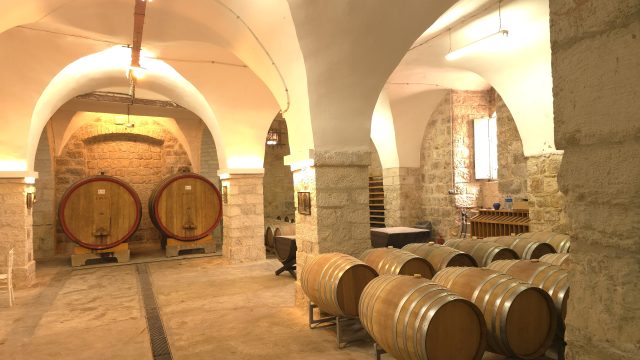
Of the four producers Nabeeth represents, it is Cremisan that Kattan feels most personally connected to. The winery sits in a valley three miles from Bethlehem and eight from Jerusalem, founded in 1863 by the Italian missionary priest Antonio Belloni. Kattan’s ancestors were among Belloni’s earliest supporters, and the relationship shaped everything that followed. In 1885 Belloni added a winery to finance the orphanage, buying grapes from local farmers and, in flush years, purchasing everyone’s harvest rather than leaving growers without a buyer, turning the surplus into juice
His grandfather served as the priests’ doctor through the 1960s, 70s and 80s, and Kattan grew up in a house where Cremisan was always on the table. “Sometimes good and sometimes terrible.”
More than any bottle, though, it is the fresco inside the Church of the Salesians that stays with him – it depicts Don Bosco, founder of the Salesian order, surrounded by children drawn as angels. One of them is a great-uncle of Kattan’s.
The donkey at the border

Patrowicz tells db the story of Taybeh. The winery was founded in 2013 by the Khoury family, whose roots in the town stretch back 600 years. Canaan Khoury returned from studying in the United States to open what became the only boutique winery in the West Bank. The family also runs the Taybeh Brewing Company, whose head brewer is Madees Khoury, the only female Muslim brewer in the region.
“She is incredibly resilient and resourceful and passionate,” Patrowicz says. “And her brother Canaan is very poised, very meticulous. He’s kind of the genius of the family. And Madees has this raw power of energy, of determination.” Six centuries of surviving whatever the region has thrown at them, and still going.
Then there is the story of the donkey. A recent shipment had all the correct legal documentation to cross into Israel. Cars, however, were not permitted. “So he strapped the beer and wine to a donkey and carried it across hills,” Kattan tells db.

What the occupation does to wine
Palestinian winemaking divides into two geographies. Wineries on the West Bank operate under one set of pressures; those in Galilee under another. “We use the words ‘Palestinian terroirs’,” Kattan tells db. “We don’t say ‘Palestine’ for all of them, because the ones in Galilee are not in Palestine. Technically, they are Palestinian lands owned by Palestinian families who identify as Palestinian.”
The conditions each producer faces are different, but occupation is the common denominator. Ashkar, a small winery in the hills of Galilee, buys its grapes from Israelis farming on land confiscated from the winery’s own founding village. Jascala, a family winery perched on a hilltop between Lebanon and Israel, makes wine where debris from missiles lands on its vineyards.
Taybeh has been the most attacked village in the West Bank by settlers over the past two years; Kattan describes armed settlers burning cars, land and confiscating olives. Cremisan sits enclosed on two sides by Israeli settlements, the third controlled by a military gate connecting it to the neighbouring village of Al Walaja.
Partner Content


Water runs through all of it. “Palestinians are given much less water than Israeli settlers,” Kattan tells db, “even though the aquifers are technically owned by Palestinians but have been seized by Israel in the West Bank since ’67. We’re given running water once every 40 days in the West Bank. While an Israeli settler has access to running water, 24 hours a day, seven days a week.”
Growing grapes in a climate already pushing 32 degrees Celsius in May is challenging enough. Global warming has pulled every season out of shape. Doing all of this while rationing water over a 40-day cycle is a different order of farming altogether.
Patrowicz tells db the occupation reaches into every part of the process. “Winemaking is always cyclical and is based on long-term planning. It’s hard to plan long-term when you don’t know how secure your immediate future is, and when your personal safety is threatened every day on the West Bank. You don’t have the luxuries other winemakers do, who can choose exactly when they would like to harvest, night or day, the grapes picked at optimum condition. Here, you need to employ different tools to manage everything else.” Before a farmer can ask which grapes are ready, they have to work out whether they can reach the vineyard safely and whether it will still be intact.
Order a book online and you set a chain of events in motion without thinking about it. A warehouse operative picks it, a driver loads it, a courier drops it at your door. You may not think about any of them. The whole thing is so seamless it barely registers as a transaction at all.
Exporting wine from the West Bank is not seamless. Wine is a living thing, shaped by a terroir that existed long before the borders defining the current conflict, and getting it to a consumer requires risk at every step. Shipments need an official appointment to cross a checkpoint. The last consignment Kattan describes was held for three weeks when Iran-Israel tensions flared. Wine cannot sit on open pallets in full sun at a crossing for a fortnight. When a shipment does move, it goes back-to-back, truck-to-truck, offloaded and security-checked before continuing to Ashdod port (just outside of Tel Aviv). Within the West Bank, up to a thousand flying checkpoints can operate on any given day.
Even samples are an undertaking. “You drive to my house in Bethlehem,” Kattan tells db. “You give me the samples. So you’ve already driven through potentially a couple of checkpoints. I pack them. I carry them across the land border to Jordan, grab a flight, and reach London.”
‘Oh, but I thought Muslims don’t drink?’
Trade reception has been, by and large, curious and welcoming. Patrowicz describes buyers who cannot yet offer a listing but want to taste anyway, simply because they do not know these wines. “Half of England wants to try the wines, but they can’t stock them anywhere.” The predicament of the small importer.
Misconceptions persist all the same. Kattan tells db: “We still get the odd person who will look at you and say, ‘Oh, but I thought Muslims don’t drink. How come Palestinians make wine?” His answer involves the Magi arriving in Bethlehem, a family’s swift conversion to Christianity on spotting the commercial potential and a profitable sideline in myrrh, frankincense and gold.
What’s in the glass?
None of this would matter if the wines were not worth drinking.
Patrowicz tells db that the native varieties are central to the case. In a market saturated with internationally consulted Chardonnays that could come from anywhere, Palestinian wines, made from varieties that exist nowhere else, fill a page that has been blank for too long. “This is very important,” she says, “in completing that picture of the wine world.”
At the London Wine Fair this week, the questions will come about geopolitics, logistics and how the wine actually gets here. The answer to the last of those is via LCB, recently shortlisted again for best storage and logistics. The wines arrive in good condition, which matters enormously when you are asking someone to judge what is in the glass on its own merits.
“Palestine just deserves to be recognised as a terroir,” Kattan says, “just like all the rest of the world.”
He has carried samples across borders, navigated checkpoints and watched a separation wall rise through the city where he grew up. What’s in the glass has earned its place there. The rest is up to whoever is holding it.
Nabeeth makes its debut at the London Wine Fair, Olympia London, 19-21 May 2026. The portfolio features Ashkar, Cremisan, Jascala and Taybeh wineries.
Related news


