



Drappier unveils Éclose 2012: The oak egg reshaping Champagne in the Côte des Bar
Leona De Pasquale attends the monumental hatch of Champagne Drappier’s Éclose 2012 – an egg-shaped oak barrel containing a wine that until today has been kept top secret.
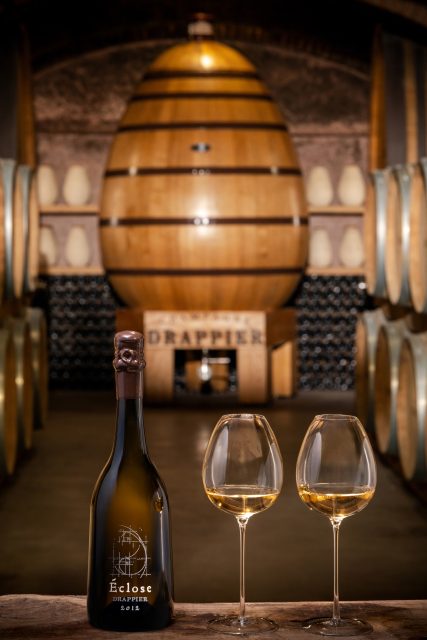
There is an egg in the cellars of Champagne Drappier that has been quietly at work since 2010. Not a metaphor, but a barrel, oak-staved and curved without a single angle, in which the house’s most closely guarded wine has been slowly moving, breathing and becoming.
In March, before just 20 international journalists, Drappier finally unveiled what had been “incubating” inside: Éclose 2012.
The egg-shaped oak barrel is the heart of the project. Éclose, meaning “to hatch”, is at once conceptual and literal. Drappier acquired three of these wooden eggs from 2010 onwards, becoming the first house in Champagne to do so.
As Michel Drappier, seventh-generation head of the family house, explains: “We’ve been working on this cuvée for almost 16 years. We were thinking about releasing it three or four years ago, but it simply wasn’t ready. Now, we feel that it is.”
Top secret
The project was kept secret for so long, under the codename “Ovum”, that even at the launch Michel momentarily caught himself, still adjusting to speaking openly about a wine that, until now, had been kept firmly under wraps.
One could argue that egg-shaped vessels are no longer uncommon in winemaking, yet here it is the precise combination of shape, material and underlying science that sets the project apart.
The wooden egg is not merely there for ageing, as Hugo Drappier, representing the eighth generation, adds: “We transferred the wine with the fine lees, so the malolactic fermentation was done in the egg, because we want the reaction between the wine, the oak and the lees at this critical stage.”
Internal circulation
The defining feature, however, lies in the movement within the vessel. “The perpetual movement you get inside is all about contact,” Hugo continues, “contact with the lees, with the wine, with the oak, and with the oxygen from outside. That’s what we are looking for with this vessel shape.”
The egg’s continuously curved geometry promotes natural convection currents. As slight temperature differences develop between the top and bottom of the vessel, warmer wine rises while cooler wine sinks, creating a slow but constant internal circulation.
Without angles or corners, there are no points of stagnation. The wine, lees and oak therefore interact evenly throughout the entire volume, delivering bâtonnage without intervention.
This continuous movement keeps the lees in suspension and encourages the gradual release of mannoproteins. The result is added texture, while preserving a reductive environment for aromatic development.
Viticultural physics
For the Drappiers, the effect is both visual and conceptual. “We found that the voyage of the wine inside the barrel resembles a Fibonacci spiral,” Michel notes. “Lees distribution follows this same dynamic: it’s thicker at the bottom, thinner on the sides, and visible in all directions inside the barrel.”
Crucially, this movement remains gentle and continuous. “It’s permanent, but very slow. It takes three years,” Michel adds. “It’s very discreet, and in the end you get something that is oaky, but not too oaky. For me, it’s a fantastic experience.”
Partner Content
The Fibonacci spiral is such a key concept that it appears on both the label and the plaque de muselet.
Oak, rather than an inert material, adds a further dimension: gentle micro-oxygenation, subtle tannin integration, and a form of passive élevage in which the wine works on itself, echoing the house’s low-intervention philosophy.
‘Grande Sendrée, plus, plus, plus’
As Alex Hunt MW, Purchasing Director of Berkmann Wine Cellars and Drappier’s long-term UK partner, describes it, the concentration of the wine is “Grande Sendrée, plus, plus, plus”, a more amplified and expansive expression of both the house style and its flagship vineyard.
Like traditional barrels, the original egg in which Éclose was aged was secured with external hoops. Subsequent egg barrels, however, moved towards a purer, sculptural form, with internal “corset-like” tension replacing visible supports. Michel declines to disclose the cost, noting only that each barrel is “comparable to a top-end Tesla”, such is the complexity of their construction.
The house has worked with three such barrels to date. The original 2010 wooden egg remains in use, though it will soon be retired as the impact of the oak diminishes. A 2019 version failed under pressure after developing leaks and was returned, while a third, more recent prototype is currently under close technical monitoring.
Each requires careful management over three years of largely untouched élevage, with only minimal intervention such as topping up to offset evaporation. Despite the risks, Drappier maintains at least two in rotation, convinced of the egg’s benefits.
Attention to detail extends to dosage. Drappier is known for keeping a “Liqueurthèque”, an extensive library of dosage liqueurs, some dating back to 1947. Stored at high sugar concentrations for stability, these components are anything but standard, and sometimes, as Hugo admits, “we are spoiled for choice.”
Finer details
Éclose 2012 is a blend of 60% Pinot Noir and 40% Chardonnay. Only juice from the first pressing was used, vinified by gravity with natural settling. The wine has undergone malolactic conversion, is unfiltered, with low sulphite and four grams per litre of dosage; the liqueur itself was aged for 25 years in wood.
Poured into a bespoke egg-shaped glass designed for the cuvée, Éclose 2012 opens with a reductive veil that gradually lifts to reveal honey, toasted nuts, yellow plum and wild strawberries. The texture is velvety, with a rounded mouthfeel shaped by its unusual élevage.
Only 574 bottles were released, disgorged in April 2025.
Technical innovation meets green stamp
Underlying the project is a philosophy that combines technical innovation with environmental responsibility. Drappier was the first Champagne house to achieve carbon-neutral status and continues to push towards energy autonomy. “We are about 75% self-sufficient in electricity. The aim is to get to 100% next year,” says Hugo.
As Hunt notes, the commercial impact of such green credentials may not be immediate: “As a buying cue at the point of purchase, the effect is probably minimal. But what Drappier has done is take a leadership stance that helps shift the conversation. Sustainability today is far more complex than it was 15 years ago, and by acting across multiple fronts, they’ve helped redefine what matters.”
Perhaps the oak egg does not change the world. But for a family-owned Champagne house in the Côte des Bar, Éclose feels less like a product launch and more like something hatching, an idea that has been quietly taking shape for sixteen years, and has only now broken through.
Related news
Italian icon wines strike 'landmark partnership' with Fells in UK
Château Cheval Blanc CFO appointed estate director at Domaine Beauséjour


