



Pirates loved rum: fact or yo ho hoax?
You would be hard-pressed to find another alcoholic beverage as synonymous with a specific historic group as rum. How much rum did pirates really drink, or has the drink’s history been mythologised over time?
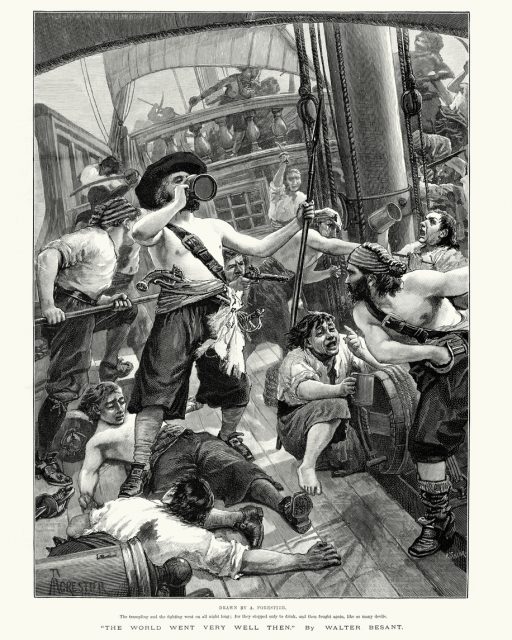
“Such a day, rum all out: – Our company somewhat sober: – A damned confusion among us!”
No, this is not the talk of a university fresher, but rather an excerpt from infamous pirate Blackbeard’s ship log.
For centuries, pirates and rum have gone hand in hand. Stevenson’s Treasure Island (1883) (Yo ho ho and a bottle of rum!), and, more recently, the Pirates of the Caribbean franchise mean that you can’t mention the former without the latter. But how much of this is fact, and how much is the doing of humanity’s tendency to hyperbolise and fabricate across the annals of time?
Sweet Beginnings
During the early 17th century, just on the cusp of the Golden Age of Piracy, sugar plantations in the Caribbean began distilling excess molasses into alcohol. The result, rum, soon became rife on merchant ships, and thus rife in the hands of pirates who raided them.
Before long, the spirit became central to a pirate’s starter kit. Plank, extravagant eyeliner, rum. Rum became the ideal shipmate for a life at sea because not only was it in plentiful supply, but its high alcohol content gave it a long shelf life. Pirates even became active participants in the rum trade in their own right, targeting merchant ships that carried it, before then selling and trading it in pirate-friendly ports.
It’s nice to think of the connection between pirates and rum as a result of a bunch of bearded blokes sat around waxing lyrical about its distinctive flavour profile that they preferred to its competitors, but realistically, the connection is a case of right place, right time.
The original bartenders
We happily conjure images of manic-eyed madmen stumbling uncontrollably around ships, fully intoxicated on the stuff. I hate to ruin all of the fun, but this is perhaps a tad reductive. The truth is that pirates were known to include penalties for excessive drinking, as it could lead to poor decision-making and conflicts among crew members.
Pirate historian Rebecca Simon tells db “Every single time I’ve read a case of a group of pirates being really drunk, it’s always been at the time they were captured.”
When they were drinking, they were often not drinking the stuff neat. “Water wasn’t always in the best condition, being at sea in wooden casks, so often pirates would mix it with rum to make it more palatable”, says Simon.
I’ve always said that what often goes overlooked in pirate discourse is their mixological prowess. Grog, for instance, a pirating staple, was a mixture of rum, water, sugar, and lime juice first introduced by the British Royal Navy. A DIY Daiquiri, if you will. Tasty, and an effective scurvy ailment.
The master mixologist was Blackbeard himself. While the British Royal Navy were experimenting with juices and water, Edward Teach was messing about with explosives. Badass. He is said to have added gunpowder to his rum, which, when it was set on fire, would sizzle, flame and pop. What a showman.
Captain Morgan’s Madeira
The big man himself. Mr Rum. Well, despite being perhaps the most famous name associated with the spirit, you would be far more likely to catch Captain Henry Morgan drinking wine or brandy than rum.
Partner Content
The Welsh privateer targeted Spanish ships, and, thanks to lobbying in Spain by wine and brandy producers, the production and sale of cheap colonial rum was not encouraged by the Spanish.
Who’d have thought the sword-wielding gent on those bottles would have a drink taste more akin to an elderly woman than a maverick bad boy? Fancy that.
Mr Morgan wasn’t the only pirate with a penchant for Iberian booze. “Madeira wine was the drink everyone wanted. It was highly desirable and very expensive”, says Simon.
She adds: “There’s a case of the pirate Jack Rackham managing to have a pretty decent success robbing a merchant ship that included a big case of Madeira wine. To celebrate, he and the crew decided to get drunk on the wine.”
Legacy
There’s a famous quote from the 1962 film The Man Who Shot Liberty Valance:
“When the legend becomes fact, print the legend.”
Is the rum-sloshing pirate image passed down the generations yet another example of this?
Well, I’m happy to report, not really, no! It is, however, important to preface all of this rum/pirate discourse with the acknowledgement that the relationship was as much a matter of convenience and geography as anything else.
If the pirates that have been most famously historicised and glorified happened to be the Iberian privateers, then we would far more likely associate them with wine than with rum.
Blackbeard’s ship log, not long after bemoaning the crew’s rum scarcity, details them sacking a ship carrying:
“A great deal of liquor on board, I kept the company hot, damned hot; then all things went well again.”
For pirates, rum was so much more than just a drink. It was a social lubricant, an economic tool, and an ailment. Like booze still remains in many fraught households at family Christmastime, rum was just about the only glue keeping crews of pirates together.
Related news
Trump hits Canada with 50% tariffs over US alcohol ban


