



From impressionists to ‘black magic’: making wine like an artist
Born from the fusion of art and winemaking, Artiste Winery begins every project with the artwork on the label. Founder and winemaker Bion Rice tells db how the unusual creative process impacts every stage of production.
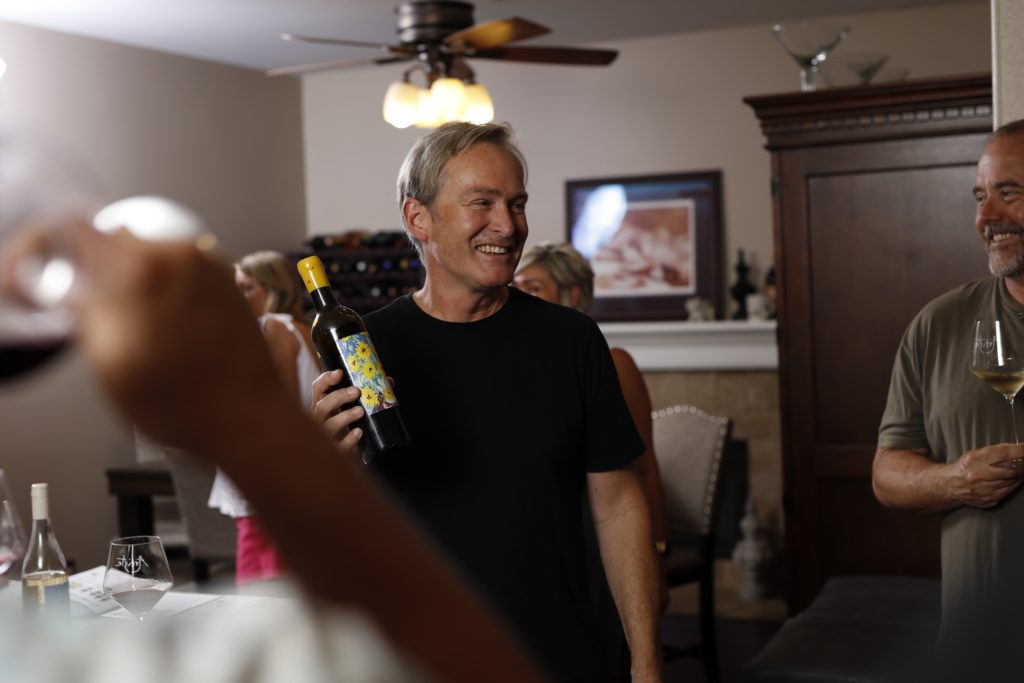
The wines of Artiste Winery, Bion Rice’s Californian project, wear their identity on their sleeve. Almost literally, in fact.
His wines are inspired by the artworks adorning the labels, taking up the prime space on the front that many would use to display winemaking details or brand touchstones. It is a bold approach, putting the personal response ahead of the usual oenological information.
Artiste’s success – a story that stretches back to 1999 – proves that it has been a canny branding move. Yet the winery’s distinctive approach is not a cynical marketing ploy. Rice’s endeavour has been to create a winery where art is always at the centre of the business.
Art as inspiration
As a fifth-generation winemaker, you might think Rice was predestined for the industry. His passions, however, almost drew him elsewhere.
Having studied art and film at college, he fell in love with the world of art. Impressionism was a particular passion from the off. Considering how he might keep that spark of artistic joy nurtured, he imagined he might end up being a teacher.
One question, he says, niggled him: “How could I fuse these two passions together?” In the late 90s, having trained in winemaking under Daniel Gehrs at Sunstone Winery, he found his answer.
James-Paul Brown, an artist Rice had met in 1994, provided the artwork and, as a result, the inspiration for Eros. This was the proof of concept for Rice: although made while he was still working at Sunstone Winery, it pioneered Artiste’s signature approach. Artworks, he realised, could inspire the winemaking process.
It was an immediate hit. “People loved artwork on a wine,” he says. “I thought: ‘If this is so successful as a concept, I might split from the family business.’”
Artiste Winery itself was then born. It launched with the 1999 vintage, a Côte Rôtie-styled wine available in a limited run of 200 magnums.
In his fundamental approach, Rice has not deviated. The wines still put artists front and centre, with their creations inspiring Rice’s work in the winery.
Moreover, the approach dictated other arms of the business as well. The tasting room at Artiste Winery – a speciality of California’s wine scene – became the Tasting Gallery, taking inspiration from artists’ processes.
“It’s very atypical compared to other tasting rooms,” Rice explains. “It’s like walking into an artist’s living room.”
Winemaking as art
Using art as inspiration for his wines has not been an abstract exercise in translating image to conventional winemaking. Rice’s knowledge of art and its processes has directly affected his winemaking regime.
Every project begins with the artwork. He studies its imagery, symbolism, color palette, and emotional tone to inform the winemaking; the artwork itself is his brief as the oenologist.
Rice is, by his own admission, idiosyncratic. But at Artiste Winery, it is seen as part of a long-tradition of art outside the establishment. “After all,” he says, “the impressionists weren’t exhibiting at the Louvre.”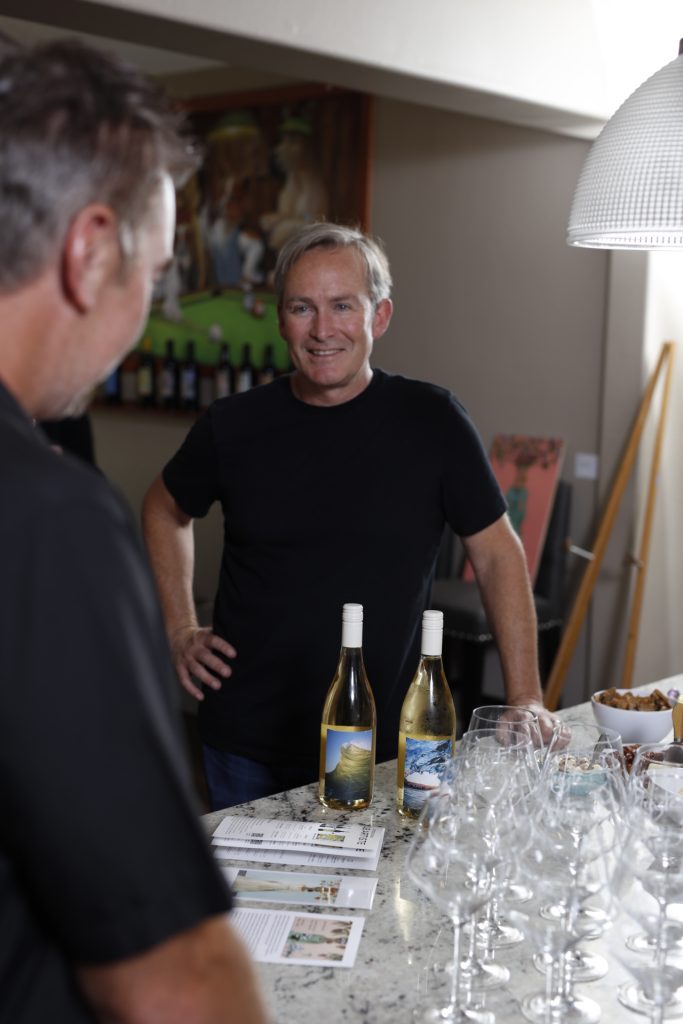
For instance, he is known for producing multi-vintage wines, a process rarely seen outside the worlds of sparkling and fortified wines. According to Rice, it is “the black magic of winemaking”.
As an example, he says he might bring together the “aged complexity” of a wine that has developed for more than two years with “vital, fresh” nine-month-old wine. As in art, combining contrasting elements is no barrier to overall harmony.
The approach even leads him to import techniques seldom seen in California, such as his “love affair for soleras”.
Likewise, Rice has a quietly radical approach to blending. Though multi-varietal blends are commonplace in the wine world, you are more likely to see it with certain varieties than others. At Artiste Winery, there is no such stricture.
Unsurprisingly, Rice’s analogy is an artistic one. Thinking of working with just one variety, he likens it to a process of painting.
“I always wondered what it would be like if I were an artist and I only had the colour yellow,” he says, “but I needed to express myself more than that.”
Thus, although he respects the work of single varietal winemaking, his approach is generally to combine varieties. Working with more than 20 growers, he has access to a wide palette: as well as being planted with different varieties, sites might vary in their warmth or their soils, influencing the overall character.
Much like an artist’s research, it allows him to head down rabbit holes. An Italian phase might lead to him to add Nebbiolo or Teroldego from Los Alamos or Ballard Canyon; a Spanish one could introduce Mencia from Happy Canyon or the Los Olivos District.
Pinot Noir is the clearest example of this. Although commonly seen as a single variety wine, Rice is confident in its ability to work with other grapes. Indeed, two of his Pinot Noir-led wines won Gold medals in The Global Pinot Noir Masters 2026.
“I love blending Pinot Noir because it is such a soft, graceful variety,” he explains. “By adding even 1–3% of another varietal into it, it dramatically changes it. So it’s very complementary.”
Breaking down barriers
Once the bottles have left Artiste Winery, Rice cannot, of course, determine precisely how people will consume them. He does, however, want to guide them to a less conventional tasting approach.
The wines are beautiful in their art-bedecked packaging, but they are also scant on detail at first glance. That is a deliberate choice.
“We’ve done a disservice to the customer to try to put everything in a box,” Rice says. As he sees it, customers will arrive with too many preconceptions based on the wine’s headline stats if they are prominent on the label.
Though he accepts that you have to classify wines somehow, Rice sees it as a fool’s errand to assume that an information-led label will accurately describe the wine.
“If you’re making varietal wines, you’re able to compare your varietal to another person’s varietal, and that gives you a frame of reference,” he reasons, “but terroir throws that out because every site tastes different.”
Instead, Rice wants the drinker to access the wine on its own terms, with the label serving as a gateway to that conversation. When visitors come to Artiste Winery’s Tasting Gallery, the tasting begins with each label, discussing it on an emotional level. The Winery’s tagline is ‘What’s Your Impression?’ and that dictates the conversation, with discussions of what they think about the artwork coming before any tasting notes or winemaking minutiae.
Despite his winemaker expertise, Rice is therefore letting the drinker find their own response to the wine: “My goal is not to tell them what they should be tasting,” he comments.
Rather like the art that he adores, he is keen that the wines inspire a feeling or sensation. Although you could analyse each and every decision that goes into the bottle, the aim is much more human than that.
“Art evokes emotion,” he concludes. “You don’t need to know every detail.”
Related news
Will Modelo and Corona brewing move from Mexico to the US?


