



Bruichladdich anniversary release sells out at launch
Bruichladdich’s latest whisky sold out before its London launch event had finished. Guests were handed empty gift bags, “which may have been an oversight, a triumph or the most honest luxury activation yet devised”, writes Douglas Blyde.
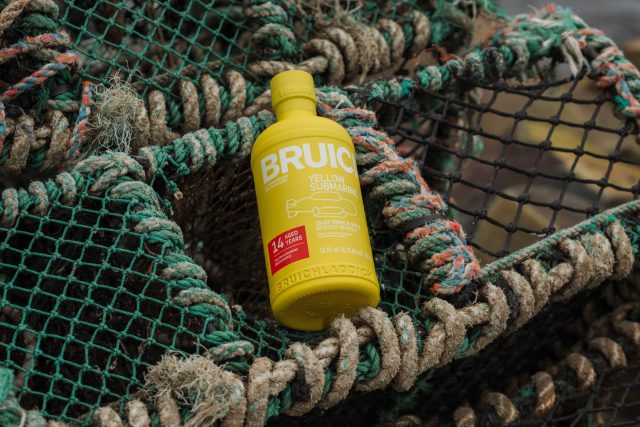
At Milroy’s of Soho, 3 Greek Street, a yellow submarine surfaced again – though not in any way which would help the Navy. The original object had already earned its keep years earlier, bobbing off Islay, confusing the Ministry of Defence, pleasing Bruichladdich, and giving Scotch whisky one of its better gags. This time it arrived as Yellow Submarine III, a 14-year-old unpeated single malt launched on the day of release. Before the tasting had ended, the whisky had sold out.
Priced at £100 and released via bruichladdich.com and specialist retailers, Yellow Submarine III is bottled at 54.2% ABV and drawn from 25% first-fill bourbon barrels and 75% first and second-fill French red wine casks. It forms part of Bruichladdich’s 25th anniversary celebrations, marking the Islay distillery’s reopening in 2001.
The gift bags made the point with brutal efficiency. Journalists were handed empty ones to take home, which may have been an oversight, a triumph, or the most honest luxury activation yet devised. There was no bottle because there were no bottles. Scarcity was not hinted at. It was issued with handles. In a category which often discusses allocation as if disclosing troop movements, Bruichladdich had simplified the matter beautifully: here is your bag, inside it is the whisky you can buy, please enjoy the air.
The address gave the launch its second charge. Long before Bruichladdich became shorthand for barley arguments, Islay provenance, peating numbers and bottles not designed to pass unseen, Mark Reynier walked into Milroy’s to collect a prize. He had been at a thinly attended London Wine Fair at Olympia when Jack Milroy asked him to enter a draw. Reynier won a bottle worth £1,000, came to Greek Street to claim it, and, out of politeness, nosed a few whiskies. Most left him cold: peat, iodine, swagger, the usual Highland sales patter in liquid form. Then came Bruichladdich. It had balance, lift, and the manners of wine without being ashamed of whisky. Reynier left with the most expensive thing in drinks: an idea.
That idea followed him to Islay. In 1989, cycling with his brother and carrying golf clubs, Reynier reached Bruichladdich expecting, if not open arms, then at least mild gratitude from a distillery whose whisky he had helped sell in London. Instead, he found a closed site, shut gates, neglect, and a sign reading: “PLANT CLOSED. NO VISITORS.” A figure in the courtyard, when addressed, reportedly supplied an even shorter visitor policy. Most men would have returned to the ferry and filed the trip under Scottish disappointment. Reynier began trying to buy the site. Obsession, usefully, does not take hints.
By December 2000, he had done it. Bruichladdich was not revived by a brand refresh, nor by consultancy slides showing “premiumisation opportunities” over a photograph of barley. It was hauled back by an unlikely crew: Reynier, the wine merchant who believed whisky had forgotten its raw material; Simon Coughlin, who helped keep the deal standing; Jim McEwan, the Bowmore legend whose personality could have restarted a silent wash still by proximity; and Duncan McGillivray, the engineer who made romance submit to spanners. On 29 May 2001, at 8.26am, a new spirit ran again from a Victorian distillery which the industry had largely allowed to expire.
Twenty-five years later, the anniversary launch returned to the site of Reynier’s first Bruichladdich conversion. The tasting was led by Murray Campbell, who has been with the distillery for more than a decade and knows the material in the way of someone who has met warehouses, ferries, casks, weather and people who ask difficult questions at the fourth dram. More importantly, he is the nephew of Duncan McGillivray. Campbell was not simply pouring a commemorative whisky. He was standing in Soho, in the room where the spark first caught, telling the story of his uncle’s work and of a company which has spent twenty-five years proving whisky can carry labour, wit, farming, weather and stubbornness without being flattened into lifestyle copy.
The people are the plot. Reynier smuggled terroir into Scotch and made parts of the industry wish he would stop using the word. McEwan gave the revival blaze and conviction. McGillivray made tired metal and limited money obey a deadline. Adam Hannett, Islay-born, moved from tour guide to mashman, stillman, warehouseman, blender, and eventually Master Blender, though with enough self-awareness to look uncomfortable beside the word “master”. And now Campbell, the nephew, brought the tale back to Greek Street. At Milroy’s, time had a human face: Duncan McGillivray’s nephew, standing in the room where Reynier’s obsession began, telling the story of the man who helped bring the distillery back.
Partner Content


Hannett once gave me the sentence which unlocks the whole business: “In whisky you’re dealing in time travel.” He meant it plainly. A cask is filled by one set of hands and interpreted by another. Spirit laid down for one purpose may emerge years later with a different duty. Whisky made when somebody was on his way to primary school can become, thirty years on, evidence of what a distillery chose not to lose.
Whisky of Mass Distinction
The Yellow Submarine story belongs to the lean early years, when Bruichladdich had little money and far too many ideas, which is usually when companies become interesting or insolvent. There were webcams in the still house, equipment arriving by sea, and an email from a US defence agency suggesting that, with a few tweaks, whisky-making kit might have some remote kinship with chemical weapons. A less amusing distillery might have called lawyers. Bruichladdich bottled WMD: Whisky of Mass Distinction.
Then, in 2005, came the first Yellow Submarine release, following the discovery of a yellow Ministry of Defence submarine detector near Port Ellen. A fisherman found it in the water; official denial gave way, eventually, to sheepish recovery; and the distillery ran towards the joke as if it had been waiting for it all along.
Yellow Submarine III is therefore not only a gag with alcohol attached. The recipe looks back to the wine-trade imagination of the revival years without feeling like a famous barrel name stapled to a press release. In the glass it has cereal sweetness, orchard fruit, spice, orange lift and a coastal pull. Yet tasting notes are not the real story. A whisky called Yellow Submarine was never going to stand or fall on whether somebody detected pear, praline or sea salt. Its force lies in the argument beneath.
That argument, as ever with Bruichladdich, begins with barley. In 2004, the distillery asked Islay farmers to grow for it. One said yes. The rest were not fools. Islay is wet, windy, agriculturally awkward and regularly visited by geese with the appetite of a hostile takeover. Today, Campbell said, 19 farmers grow for Bruichladdich. The distillery has also bought land for its own trials, moving the risk of failed experiments away from farmers and back onto itself. This is where the romance meets the invoice and finds the invoice is winning.
The reason for tolerating the difficulty is not convenience. It is connection. Campbell spoke of Islay barley giving creaminess, viscosity, a different feel in the mouth. Hannett has said that when you make whisky, you are in agriculture whether you like it or not. Bruichladdich’s work with Islay-grown grain, organic barley, biodynamic growers and Bere barley is not a decorative aside. It is the plot, the invoice, the trouble and the point.
There is, inevitably, a price for being interesting. Bruichladdich can be hard to explain. It makes unpeated Bruichladdich, peated Port Charlotte and heavily peated Octomore under one roof. It talks like a wine grower, experiments like a chef left alone after closing, bottles at strengths which favour texture over ease, and then seems surprised when consumers find the family tree difficult. Yet this difficulty is also proof of life. A distillery which never confuses anyone is usually one which has already explained itself to death.
At the end, Greek Street continued, unimpressed as only Soho can be. Inside Milroy’s, the circle had closed with suspicious neatness. The wine merchant’s discovery had returned to the site. The dead distillery had become an anniversary. The engineer’s nephew had told the tale. The tour guide had become Master Blender. The whisky had sold out before the launch finished.
Most whisky anniversaries celebrate endurance. Bruichladdich’s twenty-fifth celebrates something livelier: survival with poor manners. The distillery returned because a handful of people refused to accept closure as the natural end of a Victorian plant. Yellow Submarine III disappeared before the room had finished its drams, leaving journalists with empty bags and full notebooks. As Bruichladdich metaphors go, it is hard to better. The whisky was gone. The story, inconveniently for everyone else, was still pouring.
Related news
Why China is imperative to Bruichladdich's growth
Bruichladdich brings Islay spirit to New York with holiday pop-up
Bruichladdich's new master blender began his career as a tour guide


