



Wine List of the Week: Orrery by Pierre Minotti
Douglas Blyde visits newly relaunched Orrery, where Pierre Minotti’s Michelin ambitions and Julio Serra’s expansive wine programme signal a confident new chapter for the Marylebone institution.
For nearly three decades, Orrery has held its position above Marylebone High Street, opening in 1997 under Sir Terence Conran within his influential constellation of dining rooms and retail. It later passed through D&D before arriving at its current iteration under Evolv Collection, led by Martin Williams, whose role in steadying legacy addresses is well established – and whose speed of reply to e-mails suggests a level of direct oversight not always found at this tier.
The name was never accidental. An orrery – a mechanical model of the solar system – suggests order and controlled movement, each element held in relation to the next. That sense of measured relation now extends to the room itself, where the spacing between tables is genuinely lavish, and the deep pile of River Café blue carpet absorbs both sound and urgency, lending the dining room a composed, almost insulated rhythm.
Such balance has not always been maintained. A Michelin star, secured under Chris Galvin in 1999, slipped away in 2008. The latest recalibration signals intent to reclaim, and add to it, centring on Jura-raised Pierre Minotti, whose appointment was framed bluntly by The Caterer as a poaching from the two-star Alex Dilling at Hotel Café Royal. Dilling has since visited, appearing to enjoy his meal, which softens that initial framing. Early responses divide cleanly between plate and room: The Nudge notes it “never drops the ball. Not once” while Andy Lynes questions the move away from Conran’s original “timeless, seamless and harmonious” design.
Drinks
The wine programme is led by blazing head sommelier for Evolv, Julio Serra, originally from Alicante, whose route runs from Akelarre to Launceston Place before arriving here in 2017. Framed as “A Celestial Journey Through France”, the list is anchored in Burgundy and Champagne, with Italy, Spain, Germany, England, and the US in supporting roles. For the relaunch, Serra expanded the cellar from 350 to 900 bins, with a marked emphasis on large formats. “I’m a small guy, but I love big bottles,” he says, ahead of four incoming three-litre Bouchard Meursaults.
At the centre of the room, a marble wine altar functions as stage, positioned beside VIP table nine, where large formats are manoeuvred with lifting apparatus, and smaller bottles cradled in a VinSling – a late-night find Serra sent to Williams at 3am. Labels are chosen with personality as well as pedigree, including Catena’s phylloxera edition, where Phylloxera is personified as the death of Malbec in the Old World. Beyond, a crimson cellar lounge above the Épicerie where Serra’s wife works, swaps former windows for Swisscaves and a EuroCave carousel. “We got the green light to do what we wanted,” he says.
Around 100 wines are poured, from house bottlings such as Lafage Centenaire to a serious Coravin offering, including Meursault from Henri Boillot, Corton Grand Cru from Maillard Père et Fils, Ganevat’s Les Survivants, and Roagna’s Timorasso Montemarzino. The pairing flights reinforce the point, drawing on producers such as Nicolas Joly, François Cotat, Emilio Rojo and Didier Dagueneau. Service might begin with Egly-Ouriet followed by a chaser of 1982 González Byass Palo Cortado. “You don’t have to try all 100,” quipped sharp-suited passing operations manager, Ming.
The sweet and fortified section is a strength: Sauternes from Château Garonelles and Suduiraut, Vouvray from Benoît Gautier and Huet, Tokaji from Disznókö, alongside Madeira and Port including 1994 Quinta do Vesuvio and 2000 Sandeman, supported by VORS and VOS sherries. A quietly striking inclusion is 1996 Fondillón from Monóvar, rarely seen on London lists, and a pointed nod to Serra’s origins.
Bottle pricing begins at around £50 – Picpoul de Pinet Réserve from Roquemolière, Weissburgunder from Messmer, Godello from Merayo – which is fair for this level and avoids filler, while the top end stretches to La Tâche 2001 at £12,000, alongside mature Bordeaux and prestige champagne, including 1983 Château Haut-Brion and 1989 Krug Collection. There is no 1997, Orrery’s opening year – a light vintage; the restaurant has aged better.
Dishes
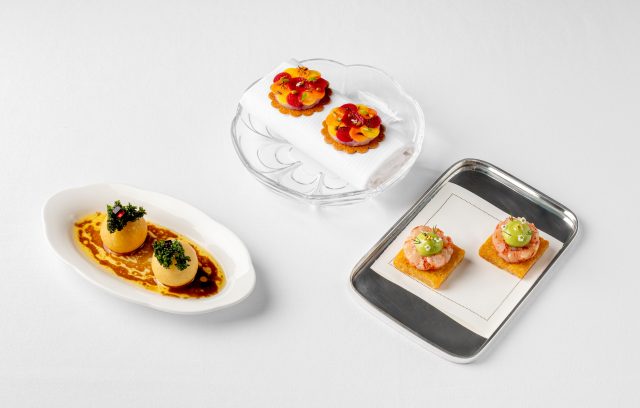
The sequence of canapés sets the tone: technical, layered, and at points overworked. A sea bream and fennel sandwich drew comment from our guest, David Moore, for its “21 touches”, though the more persuasive moment came in a simpler-seeming doughnut of braised ox cheek, bone marrow and fried kale, its richness carrying further than expected.
Partner Content
Caviar Oscietra with Devon smoked eel, cured sea bass and potato avoided the predictable route of sparkling or vodka, instead meeting subtle Sancerre from Vacheron 2024 – a decision which paid off, the wine’s tension working against oil, sal,t and smoke. The following galette bretonne, built around morel “farci” with wild garlic and buckwheat, was deeper, more grounded. Serra framed the pairing as “the twins”, pouring Tissot’s 2015 layered Arbois Chardonnay “La Mailloche”, initially unyielding then unfolding, alongside a generous 2018 Trousseau from Domaine du Pélican.
Mid-meal, action shifts to the horseshoe marble counter for the Chartreuse celebration, where green and yellow are dispensed from jeroboams into herb-led sorbets – lovage, and respectively, elderflower or lemon balm – with antique jelly spoons sourced from Notting Hill, before a pour of VEP pushes things further, prompting a prolonged coughing fit from Moore.
Minotti’s Pyrenean quail, sourced exclusively from Monsieur Duplantier, is handled with tenderness, served with green asparagus – white might have offered more interest – chestnut gnocchi and a vin jaune sauce which binds rather than dominates. The alternative, aged Creedy Carver duck with black pudding, onion grelot and deliberately forceful Manuka honey, leans darker and more direct. Serra, noting your correspondent’s birth year, poured 1980 Bertani Amarone, its alcohol now fully absorbed into the whole.
Cheese is tight – Montgomery and Brillat-Savarin – with tomato topped, toast-like baby gem which momentarily outpaced the selection, paired with 1981 Blandy’s concentrated Malmsey. Dessert led to Gariguette strawberry with elderflower and meringue, paired lightly with the ten-year-old Les Jardins de Babylone, Dagueneau’s Petit Manseng from Jurançon, its honeyed intensity held in check by precise acidity, chosen, as Serra put it, “not to go over the dish.”
Last Sip
There is room for refinement. A slice of chocolat de la maison Nicolas Berger with almond tipped a little too far towards coffee and felt dense, albeit well met by Peller Cabernet Franc. Elsewhere, the restaurant asks for small corrections: original works would sit better than off-the-peg Seurat; the spotlight on the elevated magnum of Louis XIII burns with unnecessary intensity; the sound system remains faintly tinny; wet towels arrive outsized; and the loo lids close with undue force.
These are, however, adjustments rather than faults. Much of the team remains in place from the January closure through to the March reopening, lending continuity where others might have reset entirely. More significantly, the wine programme under Serra stands as a serious asset – confident, expressive, and given unusual freedom to operate. With that foundation, Orrery by Pierre Minotti feels not simply revived, but properly recalibrated.
Best for:
- Serra
- Wine and cocktail (including non-alcoholic) flights, and Chartreuse experience
- Terrace, currently supported by Renais gin
Value: 93, Size: 97, Range: 96, Originality: 97, Experience: 98; Total: 96.2
Orrery by Pierre Minotti – 55 Marylebone High St, London W1U 5RB; 020 7616 8000; [email protected]; orrery-restaurant.co.uk
Related news


