



Two Drifters founders: ‘If CO₂ had a colour, you’d turn it off’
Russ and Gemma Wakeham, the co-founders of Two Drifters Distillery in Devon explain why carbon is treated as a cost, not a campaign – and why sustainability was never optional.
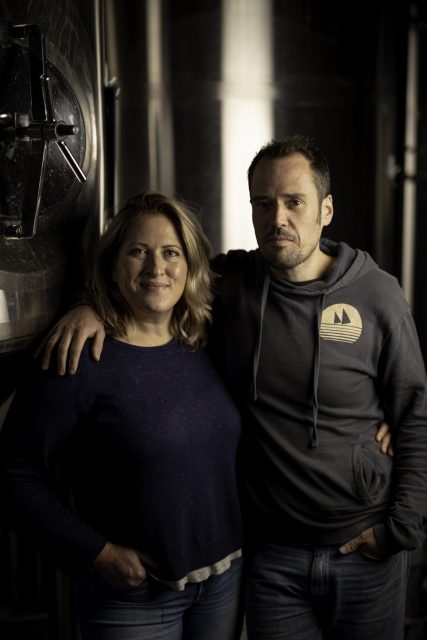
For Russ and Gemma Wakeham, founders of Two Drifters Distillery, sustainability was never a bolt-on. It was built into the business from the outset.
“Not being sustainable was never an option,” said Gemma. “That’s not really a marketing tool or a reason to choose Two Drifters. That’s just because it’s not going to be our business that hurts the planet.”
The husband-and-wife team founded the Devon-based distillery in 2019 after conceiving the idea while living in Vancouver, before returning to the UK to build something together. Their shared love of rum – sparked on their first date – sat alongside Russ’s background in chemistry and carbon capture, which would go on to shape the business.
“We knew that it would come with an environmental cost, because the sugar cane that you have to make rum from doesn’t grow nearby,” Russ said.
Rather than compromise, the pair designed the distillery around reducing emissions from day one. “We didn’t buy or order anything without thinking we’ve got to reduce our carbon footprint,” Gemma explained. “It’s not retrofitted. It’s designed around the fact that why on earth should we have a business that hurts the planet?”
Carbon as a business decision
At the core of Two Drifters’ model is a simple principle: treat carbon like money.
“We essentially tax ourselves carbon emissions,” Gemma said. “Therefore it’s in our best interest to constantly be looking for better alternatives, so then we pay less carbon tax.”
This, she argued, is what will ultimately drive wider change across the industry. “It’s a straight up business decision, which I think the only way it’s gonna work for other businesses is it’s like any other cost.”
To make the concept tangible, she pointed to the invisibility of emissions. “If carbon dioxide had a colour, and you saw it seep out, you’d turn that thing off, wouldn’t you, because you’d know it was costing you.”
Designing out emissions
The Wakehams’ approach centres on making different choices at every stage of production.
“You just don’t choose the cheapest of everything,” said Gemma. “You have to choose sometimes the closest, sometimes the better business.”
That philosophy extends to raw materials. Two Drifters produces 100% molasses-based rum, sourcing molasses shipped into Bristol from North Africa. While some producers might exclude parts of that footprint, the pair take full responsibility.
“It’s easy to go ‘that’s not our responsibility’… but that’s not how we work,” Gemma said.
The distillery itself is fully electric and powered by renewable energy, cutting emissions at source, while every stage of production – from fermentation through to bottling – takes place on-site.
Partner Content


The challenges beyond the distillery
Despite tight control over production, external factors are where some challenges lie.
“The difficulties come with things that we can’t control,” Russ said. “Everything outside of the distillery we can’t control, other than choosing the right partner.”
Transport is one such issue, particularly for international shipments. Packaging is another. While lighter alternatives are often proposed, the Wakehams remain committed to glass.
“Glass is fundamentally 100% and infinitely recyclable,” Russ said, arguing that long-term decarbonisation of glass production and transport will unlock greater gains than switching to materials that end up in landfill.
Gemma added: “The thing they’re offering as the alternative goes to landfill.”
Marketing without contradiction
Communicating sustainability presents its own tension. For Two Drifters, marketing activity must align with its environmental stance.
“I can’t sit here and say how sustainable we are and then print my story in 1,000 magazines or billboards, because it just negates everything we do,” Gemma said.
As a result, the business has had to be selective. “I just have to say no to so much… people think it’s just, oh, but you can – if no one knows about it. It’s like, no.”
Quality at the forefront, sustainability as the backbone
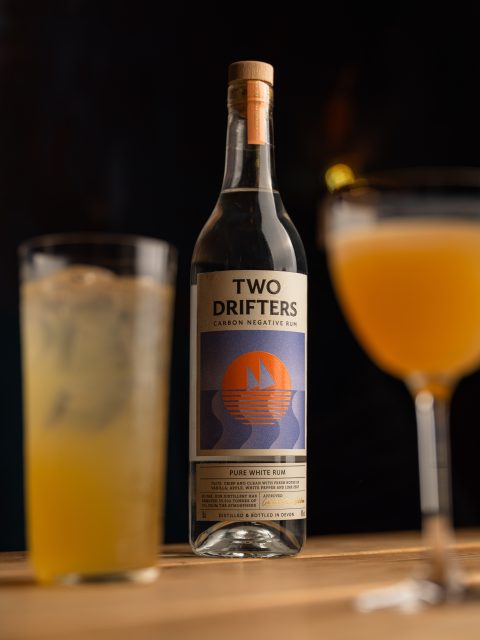
Despite growing industry emphasis on sustainability, the founders acknowledge that, naturally, consumers are still led by taste profile and authenticity.
“The end consumer cares the least,” Russ said.
Instead, drinkers respond to quality and provenance. “Their priority for us is about the quality of the rum and the fact that we make it,” he explained.
Gemma agreed: “We make amazing rum from scratch here in the UK… that’s what we lead with.”
Sustainability, she added, is simply embedded in how the business operates.
Related news
BrewDog surrenders carbon negative claim
Carbon negative beer launched by Gipsy Hill
Stem & Glory commits to becoming carbon negative by end of 2021


