



The Big Interview: James Halliday
At the age of 87, James Halliday, Australia’s most influential wine critic, has one final book to his name – a testament to five decades of extraordinary bottles and lifelong friendships. Nimmi Malhotra reports.
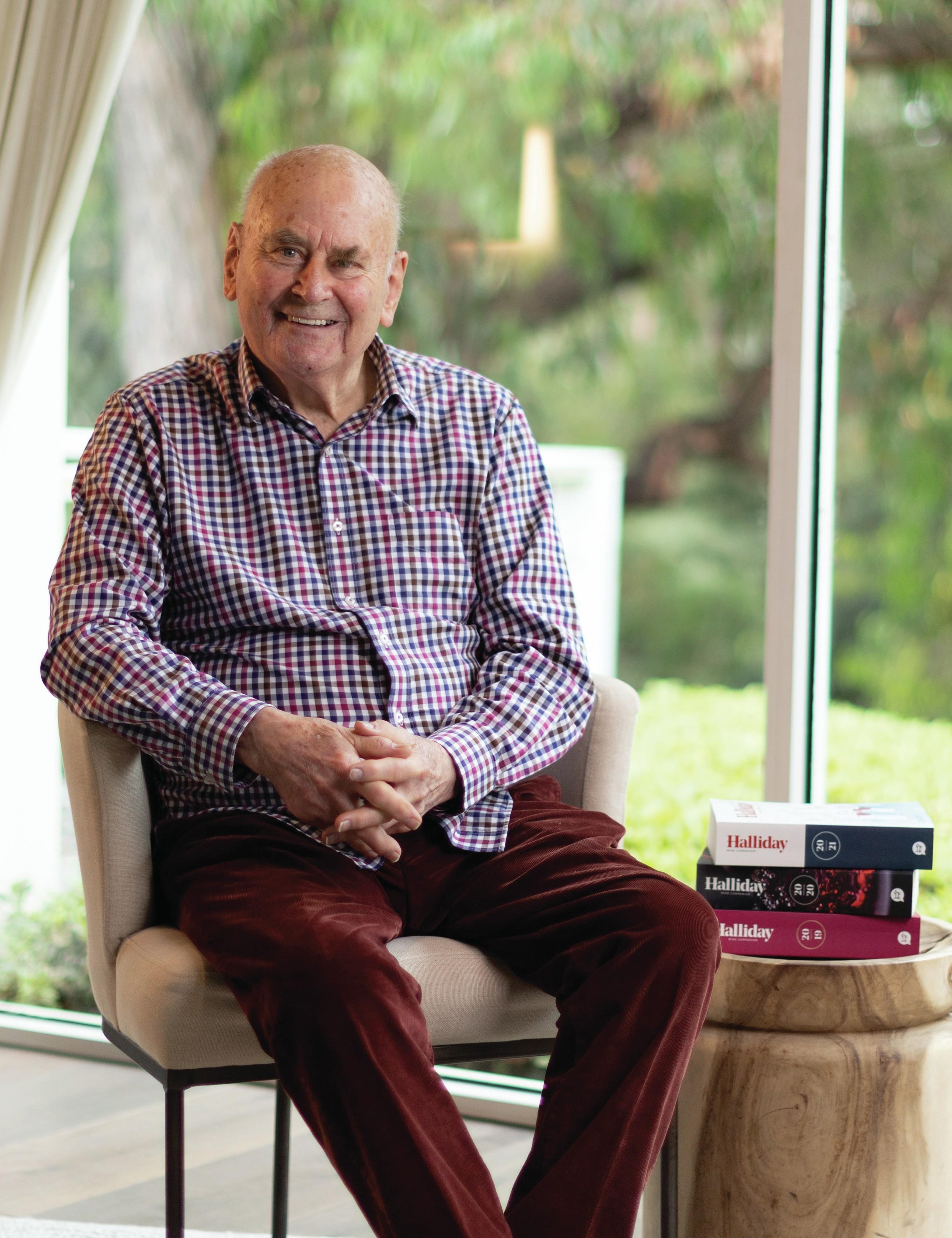
“Great wines are meant to be shared,” says James Halliday, speaking to db on the release of his new book, 50 Years of Great Wine Dinners. “I never once sat alone with a bottle of Domaine de la Romanée-Conti or first growth Bordeaux to drink by myself. The real joy is opening these bottles with others and hoping they see what you see in the glass.” James Halliday AM, arguably Australia’s most important wine critic, needs little introduction.
A lawyer-turned-winemaker, critic, author and judge, he is the founder of the Halliday Wine Companion, launched in 1968. His commitment to the industry earned him national recognition in 2010 when he was appointed to the Order of Australia, before being granted the Lifetime Achievement Award by the Institute of Masters of Wine in 2025.
Two years on from his retirement in 2024, Halliday has delivered his swansong project: 50 Years of Great Wine Dinners. This 430-page hardback book documents wine dinners dedicated to the world’s greatest wines from 1970 through the ensuing five decades. Among them, Halliday lists grand cru Burgundies, classed growth Bordeaux and top Australian bottles, shared with wine luminaries and Prime Ministers.
“It was a leisurely project,” he says on a Zoom call. At 87, his recollections remain sharp as he talks about his work and answers the questions I emailed over a day before. I had been told he doesn’t much care for video interviews, and that I shouldn’t expect more than 30 minutes before he breaks off. We spoke for 90 minutes that morning, and Halliday held court with remarkable ease.
The era that shaped a critic
The new book chronicles 140 dinners, and to read them in sequence is to travel back to a very different Australia. Most of the wines are French greats – Halliday declared his admiration for classic French wines early on in his life – followed by the best of Australian wines. “The late 1960s was a time when first growth Bordeaux and grand cru Burgundies were little known or understood in Australia,” says Halliday, prefacing how the dinners came to be. “Initially, the dinners were just wine tastings with food. It was really two people, Len Evans and I, and we took on different roles for these dinners.”
Len Evans AO OBE, Halliday’s mentor and friend, introduced him and much of Australia to the world of fine wine at a time when Australians were typically sipping on fortified expressions. Also awarded with national honours and an enduring legacy, Evans was a formidable presence on the global wine scene, and Halliday pays tribute to him throughout the book.
The mechanics, he explains, were deliberately informal. Evans would send a note to the group – a core gathering of about 20 “dreadful snobs” – to see who wanted to attend. “The total cost of buying wines, sourcing them, sometimes from auctions or from my own cellar, and paying the restaurant was divided among those present.” Over time, the dinners gained momentum and sophistication, yet the wines remained the primary focus. What made them endure for decades was multiple formats such as the ‘options’ game and single-bottle dinners – and a shared insistence on the unrepeatable. “We never restaged a dinner just because it was very good,” Halliday says.
The famous cellar
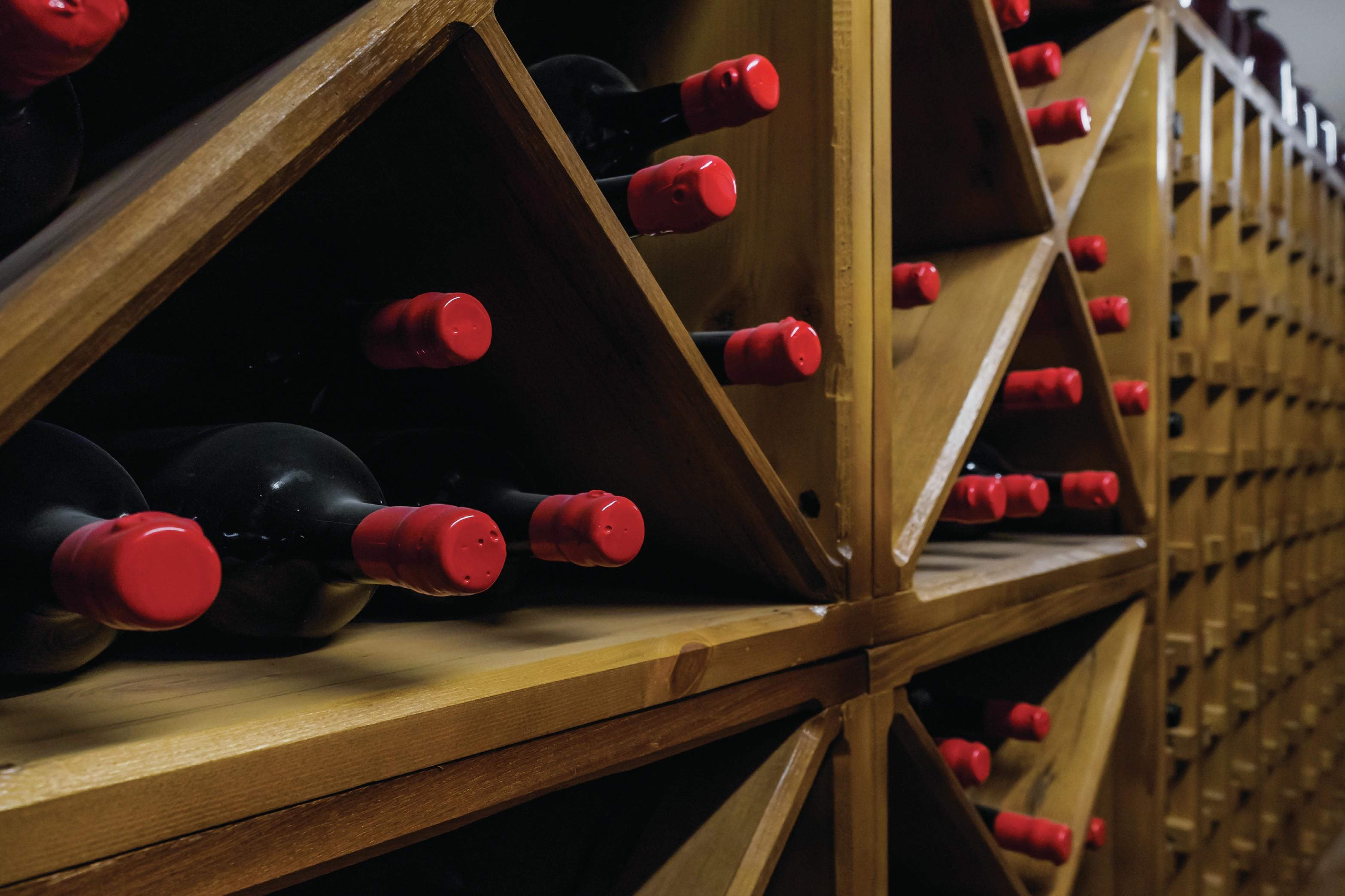
Sourcing wines of this calibre – 187 vintages of Domaine de la Romanée-Conti (DRC), 22 vintages of Château Lafite and 77 vintages of Château Latour, to name just a select few among the total 2,200 wines listed – in the early decades of Australia’s wine awakening required resourcefulness.
Halliday turned to auction house Christie’s as his preferred source and hand-carried select bottles directly from the wine estates, building one of the finest private cellars in the country. The dinners benefitted far more from Halliday’s cellar than the book lets on. “Quite a large number of the wines came from my personal cellar,” he reveals, a detail he left out of the book entirely. “The group tended to get very friendly prices, well below what I might have received had I decided to sell them.”
At its peak, Halliday’s cellar held around 11,000 bottles – among them several thousand from DRC. “It wasn’t 11,000 bottles of DRC,” he clarifies with a dry smile, “but I did have several thousand bottles of DRC and others.”
The sweet spot
Halliday’s fondness for Domaine de la Romanée-Conti is well documented, but it’s quite a clear-eyed affinity, rather than a reverential one.
“DRC produces the greatest Burgundies,” he says, “but they are not flawless. There are difficult vintages and eternal issues of bottle variation with cork. I’ve seen bottles rejected at classification tastings for not being up to scratch.” It is that imperfection that holds his interest. “The tension between the purity of expression and the reality of cork is part of what fascinates me.”
His relationship with DRC went beyond the cellar. “I became good friends with Aubert de Villaine and visited him every year. I tasted there and sometimes dined at his house,” he recalls. He participated in the in-house classification tastings once with Michel Bettane, and recalls a memorable tasting of 15 vintages of Romanée-Conti in one sitting. His notes even feature in the French edition of de Villaine’s book.
If DRC represents Halliday’s greatest vinous love, Len Evans represents his greatest friendship. Evans looms large throughout the book and, in Halliday’s telling, the frequency of his appearances is simply a matter of history. “We were great mates; there was a kind of masculine love there.” Evans’ fierce belief, Halliday states, was that we must always try to make better wine and never be complacent, and he referred to Evans as “Socrates dissatisfied”, always seeking the highest expression in wine. When Evans died, the dinners did not stop. “The memorial dinners continued,” Halliday says, “not as a shrine to his exact preferences, but as a continuation of the tradition we built together.”
The evolution of tasting notes
Across five decades of dinners, Halliday’s tasting notes trace an evolution of their own – from the deliberate musings of a self-described amateur to the succinct three-word observations of his later years. Halliday is firmly in the English school of notes, rather than the florid model popularised by Robert Parker. “The English school – Hugh Johnson, Michael Broadbent and others – tended to write shorter notes, with more emphasis on texture and structure, and less on chasing exotic aromas,” he says. “That’s closer to my temperament.”
Parker’s arrival, Halliday argues, changed everything, and not entirely for the better. “His tasting notes were long, detailed and full of descriptions no-one had previously used.” He does not dismiss the achievement, but would like to have it put to the test. “The real test, to my mind, is where you can write that same elaborate note twice, blind, at different times, without knowing it’s the same wine. If you can do that consistently, then your palate is extraordinary.”
The question of what constitutes an honest tasting note has only grown more complicated since then. Technology has crept into the process, with critics recording notes on a laptop mid-tasting.
“My concern is that if you can always see what you wrote last time, you’re inevitably influenced by it. And then there is AI. “I am quite sure AI will be able to generate ‘modern’-style tasting notes soon enough.” It’s not a comforting thought. Still, Halliday remains an advocate of handwritten notes and has kept his own style unchanged. “Clarity and honesty in notes are what I’ve tried to hold on to,” he says.
However, he wasn’t entirely on board with having those handwritten notes reproduced in the book. “Had I been fully on deck, I might have demurred on having my handwritten tasting notes reproduced, literally,” he comments when I ask him if he’s happy with the production. Little does he know: they are the book’s most endearing feature.
Pricing the priceless
On the question of pricing the wines in the book, he is part philosophical, part pragmatic. “It was difficult to price the wine in real time, and I wondered about the relevance. But it doesn’t stop you from doing it,” he says. It was an invitation, of sorts, and so I took up the gauntlet. While the dinners are a priceless moment in Halliday’s history, listing rare vintages no longer available in the market, I found some that yielded more readily to a valuation. A Petrus vertical dinner from September 1980 lists 20 vintages from 1919 to 1976. If the vertical were staged today, the wines would cost close to £93,000. Another dinner from 2010, comprising a mixed bag of vintage Burgundies, including DRC and Rousseau (1987-1999 vintages), plus Dr Loosen, vintage Tokaji and Ports, would roughly cost £18,700.
Retirement has not dimmed the ritual; only the scale of it. “I am certainly not off wine,” he says. “I drink with my daughter Caroline and my grandchildren most nights.” He pauses, reflects. “My capacity isn’t what it once was. A bottle a night was nothing before. That’s no longer feasible for me.” The cellar that once held 11,000 bottles is considerably diminished now, partly by choice, partly by circumstance. “Life is full of twists and turns,” Halliday says with detectable regret. “I had to sell significant parts of my cellar.”
A part of his cellar treasures, including 252 bottles of his favoured Domaine de la Romanée-Conti – the largest single collection of DRC in Australia – was sold in 2020. Langton’s, the auction house, expected the sale to fetch close to AU$1 million. In 2025, Halliday sold the last of it: 1,800 bottles of select Burgundies including Rousseau, Clos-de-Bèze and Clos Saint-Jacques.
He is not without consolation. “I expect a dozen or so bottles from Rousseau, Chambertin Clos-de-Bèze and some fine Champagne will make their way back to me.” How? He won’t say. Ask him to name the greatest wines he has ever drunk, and he doesn’t hesitate for long. “If forced to choose, I always tend to come back to two: 1929 Romanée Conti and a magnum of 1865 Lafite.”
The Bordeaux, perhaps surprisingly, edges it. “I think the Lafite was the greatest wine I’ve ever drunk,” he says, well aware of what the admission reveals. “While Burgundy has my heart, I am not blind to Bordeaux’s greatness.”
Halliday sits with that for a moment before adding: “Sadly, with age, I’ve lost a fair bit of my sense of smell – anosmia comes with the territory for an 87-year-old. But when I do encounter a truly beautiful wine, it can still cut through the mists and speak to me.”
Related news
The Big Interview: Honore Comfort


