



First 5,000 bottles produced from Pope’s vineyard
Pope Leo XIV gave thanks for the inaugural vintage made from the two-hectare vineyard located inside his summer residence and farmed by migrant workers.
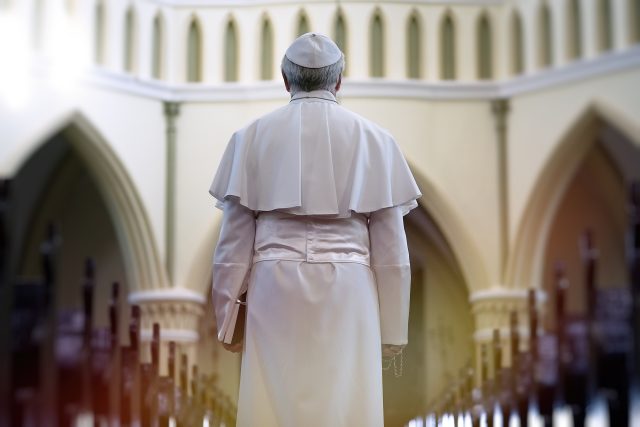
Pope Leo XIV formally opened Borgo Laudato Si, a 55-acre sustainable farming operation, last September. Located within the grounds of the papal summer retreat in Castel Gandolfo, Lazio, the project also includes a 2ha organic vineyard planted exclusively to Cabernet Sauvignon.
This week it was revealed that the vineyard’s first vintage has produced 5,000 bottles of wine, with Pope Leo XIV visiting to bless the site, and even raising a glass of red in honour of the occasion.
It is hoped that in future, the annual production of Borgo Laudato Si could reach 15,000 litres (around 20,000 75cl bottles).
Regenerative agriculture
The focus of Borgo Laudato Si is on organic farming and regenerative agriculture, with ‘smart’ irrigation systems installed throughout, which use AI to administer only the necessary amount of water to avoid wastage. Olive oil, herbal tea and cheese are all be produced on-site and are sold to visiting members of the public (often school groups), with wine production also forming part of the equation.
Help came from the University of Udine in Friuli, which specifically designed the vineyard to be resistant to pests and diseases in order to help limit the use of pesticides. And according to Borgo Laudato Si’s director Cardinal Fabio Baggio “all production goes through “a short supply chain system, well below the traditional zero kilometre.”
Approximately 8,000 vines in the papal vineyard are tended and harvested by refugee workers as part of a programme that trains migrants and unaccompanied minors in the skills of sustainable agriculture, livestock care, and hospitality. Former prisoners are also welcomed into the winegrowing initiative, which aims to train more than 1,000 people per year.
Once grapes are harvested, winemaking is led by the esteemed Riccardo Cotarella, one of Italy’s most famous consulting winemakers, with the 100% Cabernet Sauvignon expressions aged in oak barrels and thought to be sold within the Vatican as well as “shared with visitors to the Borgo Laudato Si’,” Cardinal Baggio told global Catholic news outlet Aleteia.
Duty-free
As db reported, Vatican City is a duty-free zone, meaning that bottles of wine are substantially cheaper to buy there than in the city of Rome. This has been the case since 1929, when the Lateran Treaty recognised the Vatican as an independent state. Within the Vatican, there are two shops selling wine; the Annona store, which is open to all, while the second is housed within an old railway station and only accessible by membership card holders.
Partner Content


Despite its relatively small size (just 0.44 square kilometres), Vatican City is the world’s top wine importer per capita, with Italian wine ruling supreme. According to trade data from the World Integrated Trade Solution (WITS), Italian bottles accounted for 96.3% of Vatican’s wine imports in 2021, with Austria representing 3.6%, and all other countries combined making up just 30 litres.
Zero impact
Speaking last year at the opening ceremony of Borgo Laudato Si, Pope Leo XIV said: “This privilege comes with a great responsibility: that of caring for all other creatures, in accordance with the creator’s plan. Care for creation, therefore, represents a true vocation for every human being, a commitment to be carried out within creation itself, without ever forgetting that we are creatures among creatures, and not creators.”
Calling the site “a zero-impact space”, Fr. Manuel Dorantes, managing director of Borgo Laudato Si, added that it had been created “for the welcome of all and the support of the most vulnerable.”
Pope-endorsed whiskies
It is not only wine that the Vatican has had a hand in. In December 2024, Sotheby’s prayers were answered when two rare Bourbons signed by the late Pope Francis achieved a combined US$27,500 at auction, with proceeds going to faith-led charities.
Each of the whisky’s had been produced to mark a holy occasion. The first bottle by Willett Distillery in Kentucky commemorated the 10th anniversary of Pope Francis’ papacy, while the second bottle made by the same distillery celebrated the 2025 Jubilee Year, ‘Pilgrims of Hope.’
“These bottles are not just collector’s items—they are symbols of hope and compassion, created to do good in the world,” said Father Jim Sichko, Diocesan Evangelist and Papal Missionary of Mercy.
Related news
Vinitaly becomes stage for Meloni’s defence of Pope Leo after Trump criticism


