



Collery’s reworked blanc de blancs is ‘a tribute to Pinot’
Having got its hands on a rare supply of Pinot Blanc, a grape that makes up less than 0.3% of Champagne’s vineyards, Champagne Collery redesigned its blanc de blancs as a two-variety blend.
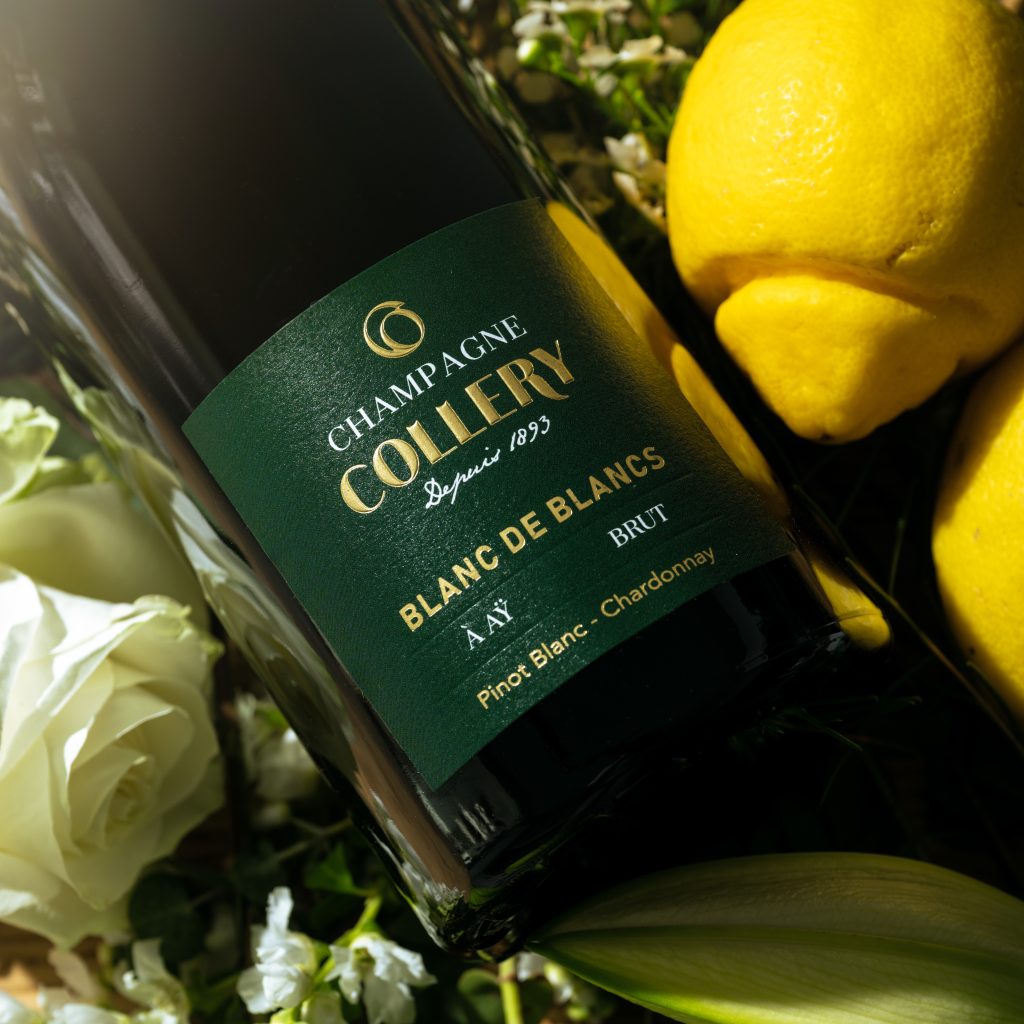
Champagne has many famed viticultural gems: mineralic Chardonnay from Cramant, for instance, or the rich Pinot Noirs of Aÿ. Yet some of its greatest resources have a lower profile, as Champagne Collery discovered when, in 2020, it was offered just under a hectare’s Pinot Blanc by a grower partner.
Pinot Blanc may not have the fame of those grand cru sites, but it is actually far rarer. While they can cover hundreds of hectares, Pinot Blanc plantings in the entire Champagne region amount to around 100ha. While the likes of Alsace, Burgenland and Alto Adige have made Pinot Blanc a star, in Champagne it is largely forgotten, accounting for less than 0.3% of the vineyard area.
For Romain Levecque, director of the house, it was an opportunity not to be missed. Champagne Collery is based in Aÿ, one of the great villages for Pinot Noir production. Pinot Blanc is, after all, its close cousin; why not introduce it to the house’s blanc de blancs blend?
“It’s a tribute to Pinot,” Levecque explains, “bringing the Pinot family to the blanc de blancs world.”
It came with a trade-off. The house’s blanc de blancs had previously been 100% grand cru; with the addition of this Pinot Blanc from the Côte des Bars, it would no longer be. Still, Levecque feels that, as a house built on Pinot Noir, it makes sense. “I have the latitude to think outside the box with the blanc de blancs, since the core of the house is Pinot Noir,” he says.
Rebuilding a cuvée
Labelling concerns were not the only barrier, however. In dealing with one of Champagne’s rare grape varieties, Levecque had to rely on intuition and embrace different styles of winemaking.
“For those rarities, if you want to get references, they are almost impossible to find,” he comments. “The few examples you can find cannot be used as references – they’re the product of one specific vineyard or one specific winemaker.”
Instead, he had to taste widely, piecing together the grape’s potential from its outré expressions. He also made use of Champagne Collery’s perpetual reserve. While most of the wine was sealed in bottle, this provided key information on how the Pinot Blanc was evolving.
What he found was a just-ripe fruit character – yellow lemon in particular – that kept its definition even with ageing. This informed the winemaking: freshness and elegance were to be the defining principles, with no oak, minimal agitation and nothing that would destroy the fruit.
It also informed the blend. The new wine is 50% Pinot Blanc and 50% grand cru Chardonnay, the latter lending minerality and weight. With bottle age, it also adds honey aromas for a classic flavour combination: honey and lemon.
Certainly, choosing Pinot Blanc over a grand cru wine is not without risks, but Levecque sees its potential. It aligns with the house’s own narrative as a Pinot Noir specialist and offers sommeliers and buyers a unique reason to be excited. Most importantly, however, Levecque believes it justifies the risk in its profile.
“It’s not just here to be original,” he concludes. “I want to show that a little Pinot Blanc can bring the blanc de blancs to the next level.”
Related news
10 reasons why Moldovan wine should be on your radar


