



FX Pichler unveils Pinot ‘passion project’
Top Austrian producer FX Pichler has made an historic shift into red wine with the launch of its first ever Pinot Noir, reports Gabriel Stone.
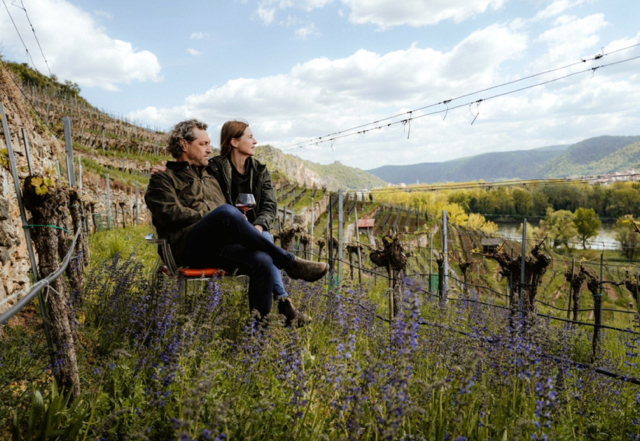
Launching the wine at VieVinum 2026, owner and winemaker Lucas Pichler drew a parallel between Pinot Noir and one of the white grapes on which his Wachau family estate has built its reputation. “For me it’s actually the red Riesling, if you will,” he remarked; “because for me Riesling is the grape variety that embodies the terroir.”
Although it was the great wines of Burgundy that provided inspiration for this “passion project”, the source for Pichler’s plant material was Austria. In January 2020, Pichler cut scions from Axel Stiegelmar’s Juris estate in Burgenland, which was home to the sort of high-quality Burgundian Pinot Noir clones he wanted.
Major hurdle
The project hit its first major hurdle when Covid-related travel restrictions meant that the Corsican grafting experts were unable to get to work until June 2020. With only just over half the grafts taking successfully as a result, Pichler carried out a second round of grafts in spring 2021, which enjoyed a far better survival rate.
Four vineyard sites, representing a combined 0.55 hectares of Pichler’s 20ha estate, have so far been used for this venture. At Dürnsteiner Liebenberg Pichler initially regrafted some 40-year-old Grüner Veltliner in 2020 before acquiring two additional terraces in 2025, which he has replanted with Pinot Noir. At Loibner Burgstall 0.2ha of Riesling were grafted over, at Loibner Mühlpoint half the Grüner Veltliner was replanted with Pinot Noir, and at Loibner Rothenhof Pinot Noir has been grafted onto well-established Sauvignon Blanc vines.
“When I selected the vineyard sites I was naturally influenced a bit by Burgundy, knowing that Pinot Noir needs a higher lime content,” explained Pichler. “The Liebenberg is probably the most interesting, or probably the best site for Pinot Noir in our estate,” he suggested, pointing to the high levels of limestone here alongside amphibolite, a form of crystalline schist.
Old vine assistance
Around 20% of the final wine is based on grapes that Pichler buys from the Weissenkirchner Seiberberg vineyard, currently managed by Weingut Tegernseehof, where Pinot Noir was planted in 2005. “In the beginning our wines were obviously far too young,” he explained. “And I also needed grapes from old vines to get some structure into it.”
Once vinified, fruit from each of these vineyards is blended to create a wine labelled as Wachauer Pinot Noir, since current DAC regulations restrict this variety to a regional wine classification.
Returning to his Riesling comparison, Pichler observed that Pinot Noir required similar attention to timing at harvest. “You just have to find the perfect window,” he insisted. “It must have reached physiological maturity in order for the tannins to ripen, but it must never be overripe.”
In addition, noted Pichler, “Because these Burgundy clones are very, very small, compact grapes there is a risk they will begin to fall apart or dry out, and that means it’s no longer a typical Pinot Noir.”
The wood effect
When it came to the winemaking element, Pichler’s expertise with Riesling and Grüner Veltliner only took him so far. “I had never vinified red wine before,” he admitted. “I didn’t know how much wood I could allow. It was always important to me to work with wood to create that rather austere style of Pinot Noir.”
As of 2025, fermentation – one third of it using whole-bunches – takes place in the 500-litre French barrels previously used for the estate’s top tier Unendlich Grüner Veltliner. The wine then spends around nine months in 228-litre barrels, two thirds of which are new and – with the exception of a single Austrian-made barrel – all made by Burgundian coopers.
“Pinot Noir needs new oak for structure,” insisted Pichler. Once malolactic fermentation has taken place, the wine is blended and left to mature for a further 15-18 months in barrel.
Partner Content


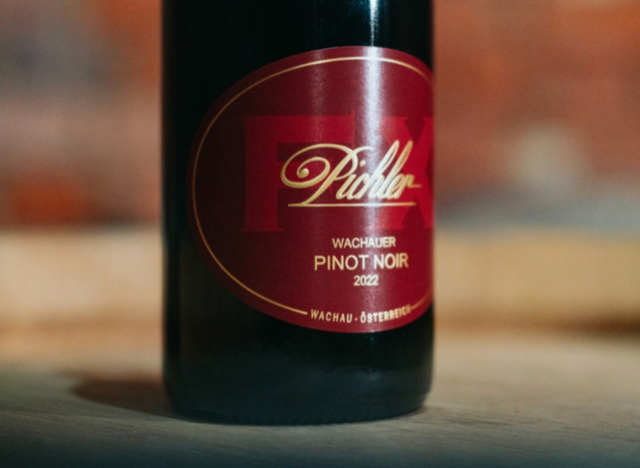
Presenting his first handful of Pinot Noir vintages together, Pichler suggested that 2022 “is perhaps a little too delicate” and 2023 “might be a little too opulent for what I would like”. Although the 2024 was only tasted as a barrel sample, he declared himself “optimistic” about this third attempt.
Despite the promising start to this project, Pichler insisted that the estate’s expansion into Pinot Noir should be regarded as a “logical continuation” rather than a major change in trajectory. “The focus, of course, remains on white wine,” Pichler stressed. “I think it will stay that way, at least for my generation.”
Limited availability
Nevertheless, this move into red wine comes at a time when the estate has brought forward its harvest date for white wines by roughly a month over the last 15 years, although the shift is partly for reasons of “philosophical reorientation” rather than climate change alone. In particular, noted Pichler, “We’re noticing there are growing challenges facing Grüner Veltliner. The pH levels are often higher than we’d like, particularly in south-facing vineyards.”
Based on current plantings, Pichler expects production volumes of his Pinot Noir to settle at “around 2,500 bottles depending on the vintage.” This limited availability is one factor that informed the estate’s decision about how to price its new portfolio addition.
“We really thought about that for a long time because of course we’ve invested a lot in it,” remarked Pichler. “Of course, the price is also an attempt to express something about where one wants to position oneself. It’s such a passion project for me, and of course the limited quantity is a factor.” He concluded with the suggestion that “it will be more expensive than Kellerberg,” a single vineyard wine which retails for around €100 per bottle, “but cheaper than Unendlich,” the estate’s top expression, whose most recent vintage retails for around €250 per bottle.
Six years into this project, Pichler remarked: “A certain sense of serenity is slowly settling in because I believe we have been fortunate enough to have gone in the right direction from the very beginning.” He concluded: “The difficult decision was having the courage to start it.”
Related news
Thai food meets Austrian wine at AngloThai
Under-the-radar red wine proves Austria's versatility
Austrian Wine goes after Gen Z with ‘rot weiss rosé’ rebrand


