



Why it’s hoped Taylor’s latest innovation will go unnoticed
As db is first to report, Taylor’s Port has developed a new, lighter bottle for its fine fortified wines. We find out why CEO Adrian Bridge is hoping that consumers won’t notice.
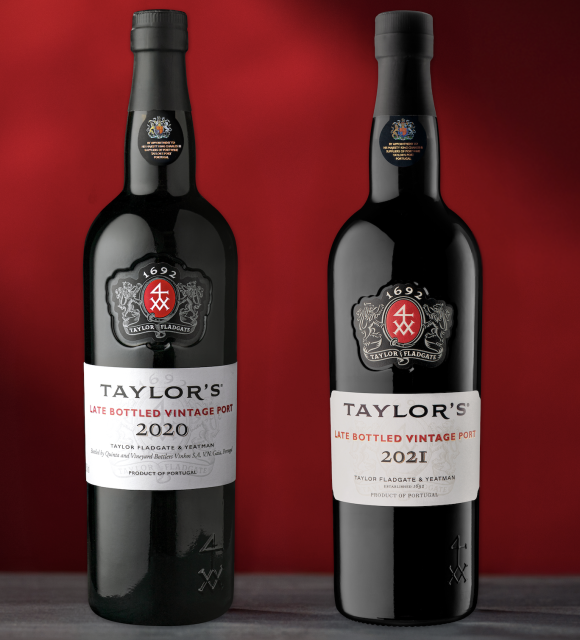
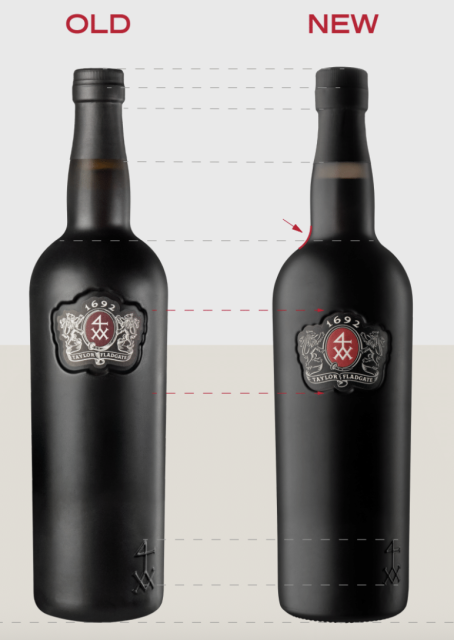
From 21 July, Taylor’s will begin rolling out a redesigned bottle that weighs just 440g, down from 580g – a 24% cut in glass weight for one of the most recognisable shapes in the Port category.
Across the brand’s annual production of more than 2.5 million bottles, the change is expected to save 350 tonnes of glass and 210 tonnes of CO2 a year, while shaving 84kg off the weight of every pallet shipped.
Work on the new bottle began in January 2024, and getting there took longer than Bridge had hoped. “We were trying to target 420g,” he admitted during a discussion with db on Friday 17 July. “We stopped at 440g after a lot of transit and bottling line tests to make sure that the integrity of the bottle was there,” he added.
The main obstacle was the debossed lettering on the bottle’s shoulder, a feature Bridge was not willing to sacrifice even though dropping it could have taken the bottle under 400g. “The debossing point is always a point of weakness,” he said. “Had we eliminated the debossing element, then in fact we would have been able to go even lighter… but we find that that is an important part of the Taylor bottle: it’s an iconic part of the packaging that was created back in the early 90s and has become well loved by consumers around the world.”
That heritage matters more today than it did when the shape was launched, Bridge pointed out, given how much the brand’s footprint has grown. “Back in the early 90s, when we launched this shape, we were probably only trading with about 40 markets in the world; today we trade in over 100.”
Rather than trumpet the change, Bridge is deliberately playing it down. “I’m not sure that going out there claiming to be the lightest bottle is what this is about,” he said. “If all companies get to a lightweight bottle, we’ll be making more of a difference. I’m not really interested in are we the lightest, are we the oldest, are we the most creative… The point is what are we actually doing, and what we are doing here is dropping 24% of the glass weight.”
For Bridge, the guiding principle is evolution rather than revolution – and keeping the shift as close to invisible as possible. Holding the old and new bottles side by side, he said the difference is barely perceptible. “For most consumers on a shelf, they won’t notice the difference. They might notice the reshaping of the label more than they’ll notice the actual bottle itself – it’s a little bit shorter, but seen in isolation, you wouldn’t notice that.”
He argued that’s often the point with genuine sustainability progress. “Perhaps some of the best environmental changes brands can make are where the end consumer doesn’t necessarily notice the important steps you’re taking,” he said – even though the move will help scope three measurements for Taylor’s customers by reducing carbon emissions.

Beyond the glass
The lightweighting push extends beyond the bottle itself. Taylor’s has also switched its stopper from a PET-based synthetic cork to a fully biodegradable, fibre-based alternative. “It’s a type of plastic – it’s a PEF (polyethylene furanoate), not a PET (polyethylene terephthalate),” Bridge explained. “So it’s actually made from fibre and therefore is fully degradable.”
Asked whether a wooden top might have been simpler, he told db: “Wood itself is not necessarily the answer… just making products that involve cutting down trees isn’t necessarily better.”
The group has taken a similar approach elsewhere, switching its 50-year-old Tawny presentation box from oak to bamboo. “Bamboo is one of the fastest growing wood fibre products,” he said, calling it “lighter and visually extremely attractive.”
The new Taylor’s bottle retains its punt and has relocated its spotting device from the base to the side, a change Bridge admitted was a technical detail few consumers would care about, but one that allowed the base to be made thinner.
“It’s the sort of technical stuff that most consumers wouldn’t even think about,” he said, referring to this shift, which sees the mold cavity identification mark move from its previous location on the bottom of the bottle.
Partner Content

“But these are the little things that you do that can help you to produce a bottle that is a lighter weight.”
On glass colour and furnace efficiency, Bridge noted that Taylor’s use of recycled ‘Euro-green’ glass allows furnaces to run at 100-110°C cooler than those firing virgin white flint glass.
He estimated that the new bottle, produced by Spanish manufacturer Vidrala at a plant in Portugal’s Marinha Grande, is around 85% recycled content.
Rolling it out
Taylor’s has already applied the same lightweighting process to sister brand Croft, and to a gift decanter produced for Marks & Spencer. Bridge said the approach would be extended further where possible and urged the wider industry – and larger-volume producers in particular – to follow suit. “You’ve got to go to the bigger moving lines,” he said. “That makes absolute sense… that’s the lower hanging fruit that’s going to make more of a difference.”
Bridge also pointed to progress on renewable energy at the group’s Portuguese operations, including two newly installed photovoltaic plants that bring the total to six, and a local energy-sharing arrangement with schools in Vila Nova de Gaia that will help push renewable output from 3,250 to more than 4,100 megawatt hours by 2032.
“This isn’t rocket science,” Bridge said. “But when brands – and particularly a brand like us – are doing it, it maybe encourages other people to go back and look at it too.”
Read more below
The big interview: Adrian Bridge
Cockburn’s unveils lighter Port bottle
Or watch via The Drinks Business Instagram here.
Related news
Taylor's launches first ever ‘Very Very Old White Port’
Taylor's Port partners with the Game and Wildlife Conservation Trust


