



Rother River wines move closer to PDO status
Producers in East Sussex are laying the foundations for a new terroir-led appellation centred on the Rother River. The move reflects a growing focus on sub-regional identity in English wine and could pave the way for a future PDO application.
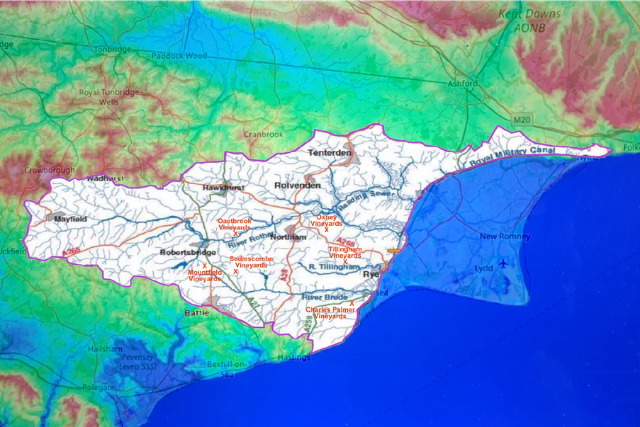
Talk of ‘Rother wines’ has taken a sharp turn along the banks of the Rother River, in East Sussex, where producers have mapped out a blueprint for a terroir-led appellation, which could rival the Crouch Valley.
The emerging Rother River wine region would encompass vineyards running along the river’s course, from Five Ashes near Rotherfield, the source of the river, to Rye Harbour located on the English Channel.
Home to several producers of single vineyard still and sparkling wines, the region is largely comprised of sandy loam soils and subsoils of Illite, Kaolinite and Marl, a rock composed of limestone and clay. It enjoys some of Britain’s highest number of yearly sunshine hours, according to research compiled by producers Charles Palmer and Tillingham.
“We’re on very low lying land, but we are very protected by the topography here. It’s very distinctive from the high chalky hills of West Sussex and the openness of the fields of Kent on the other side of river,” Kristin Syltevik, co-owner of Oxney Organic Estate, located three fields away from the Rother River, near Rye Harbour, tells db.
Producers unite behind terroir
Charles Palmer, a producer who has been making wine in the region for 20 years, said that Oastbrook Estates, Tillingham, Oxney Organic, Sedlescombe Organic and Mountfield Winery were working together to shape a new terroir-led narrative of English wine through the greater understanding of the uniqueness of specific sub-regional areas, as opposed to the county-led approach of the Sussex PDO, which has largely been ineffective in attracting producers.
“Terroir doesn’t follow county boundaries but is woven into the geography and geology and the climate and growers of the land,” Palmer tells db, who revealed that research into the Rother River wine region would be used as a basis for an eventual PDO application.
Oastbrook Estate owner Nick Brewer, who is shaping moves to create a Rother River PDO, tells db: “We’re very actively entering what I would describe as a pre-PDO stage. We’re learning about our soils and what we can produce here, because the exciting thing about English wines is that we get to experiment. We don’t have hidebound rules, which basically prevent us from experimenting with different grape varieties and different styles of wines.”
Following the Crouch Valley model
The terroir-led impetus from Rother River producers comes after Crouch Valley producers farming grapes grown on London Clay submitted a bid to obtain PDO status for Crouch Valley Wine in March 2023.
Partner Content


On 10 January, a spokesperson at the UK government agency Defra told the drinks business that approval for ‘The Crouch Valley’ appellation was currently subject to the reception of further information from the applicants.
Defra said it had not received an application from Kent wine producers, who are understood to be drawing plans to establish sub-regional areas based on specific vineyard soils. Wine Garden of England in Kent declined to comment but did not deny the plans.
Defining a regional style
Along the banks of the Rother River, some differences are to be found in vineyard soils: Charles Palmer vineyards feature Kimmeridge Clay; Oastbrook Estates sits on a sandstone ridge on the north bank of the river, near Bodiam Castle where vineyard plantings now stretch for more than 2km.
Producers consulted, however, said that the common conditions of climate, and similar soils of clay, sand and silt and human factors, were all influencing the emergence of typicity in the profile of Rother wines.
“We realise that, as we’ve been trying each other’s wines, there’s very much a pattern developing. There’s a thematic profile running across Chardonnay, Pinot Gris and Pinot Blanc wines, showing a richness of body and depth to the wines, that we’re not really seeing elsewhere. If you look at our Pinot Noirs, they’re not light red. They’ve got a lot of depth and body and structure,” says Nick Brewer.
Chantal Palmer, a manager at Charles Palmer Vineyards, said notable common characteristics were ‘salinity and minerality’, a view echoed by Kristin Syltevik of Oxney Organic Estate, who said typicity in ‘Rother River wines’ was starting to ‘speak for itself’.
Wine tourism gains momentum
The blueprint for a Rother River Wine region PDO appellation emerged on Monday during the launch party of this week’s annual non-profit Lewes Winelands festival which champions Sussex wines.
Related news
English wineries battle ‘severe’ frost
Silverhand champions 'more accessible, more local, more sustainable' English wines


