



The Big Interview: Gabriele Lechthaler
Gabriele Lechthaler, managing director of Cantina Riunite & CIV, tells Tom Bruce-Gardyne why the co-operative model is ideal for today’s wine industry.

Given all that’s going on in the world, it is not surprising if people seek comfort in earlier, less stressful times. According to Gabriele Lechthaler, managing director of Cantina Riunite & CIV: “There is currently this nostalgia for the 1980s, when Riunite was very popular. It was iconic.”
It certainly was in the US, where by the mid-1980s Riunite Lambrusco was selling a staggering 11.5 million cases a year. In fact, the Italian sparkler accounted for one in every three bottles of wine imported into the US.
Despite its runaway success Stateside, Riunite & CIV is relatively unknown in other markets, certainly in the UK. “It’s one of the largest wine co-operatives in Italy,” Lechthaler explains. “We were founded more than 75 years ago by small farmers in Emilia-Romagna, and today we export to more than 90 countries.”
He adds that it is now Italy’s biggest sparkling wine producer, and home to the world’s leading Lambrusco brand.
Number one player
But it’s much more than that, too. On acquiring its neighbouring Emilian co-op, CIV, along with the giant Gruppo Italiano Vini (GIV) in 2008, Riunite became the number one player in Italian wine. It is more than double the size of Antinori, and last year posted a group turnover of €635 million. About 60% of this came from GIV, with an empire stretching from Sicily to the Alps, and with wines such as Bolla, Chianti Melini and Fontana Candida, among many others.
It is not an obvious marriage, at first glance.
The two entities are run separately and present their wines very differently, Lechthaler acknowledges, but he says: “At the same time, we work together, sharing some management structures and we collaborate on key projects, especially in the supply chain. The idea is very simple – independent in front of the customer, but stronger together behind the scenes.”
Co-operative model
More than 55% of Italian wine comes from co-ops – a figure that rises to 90% in Emilia-Romagna. “I think the co-op model is still very important,” Lechthaler says. “Farmers face many challenges with higher costs, climate risks and market pressure. In this situation, the co-op gives stability and, what’s very important, it gives a long-term vision. Of course we have to evolve, but the core idea is still strong. Growing together and stability are the two key factors of being a successful co-op.”
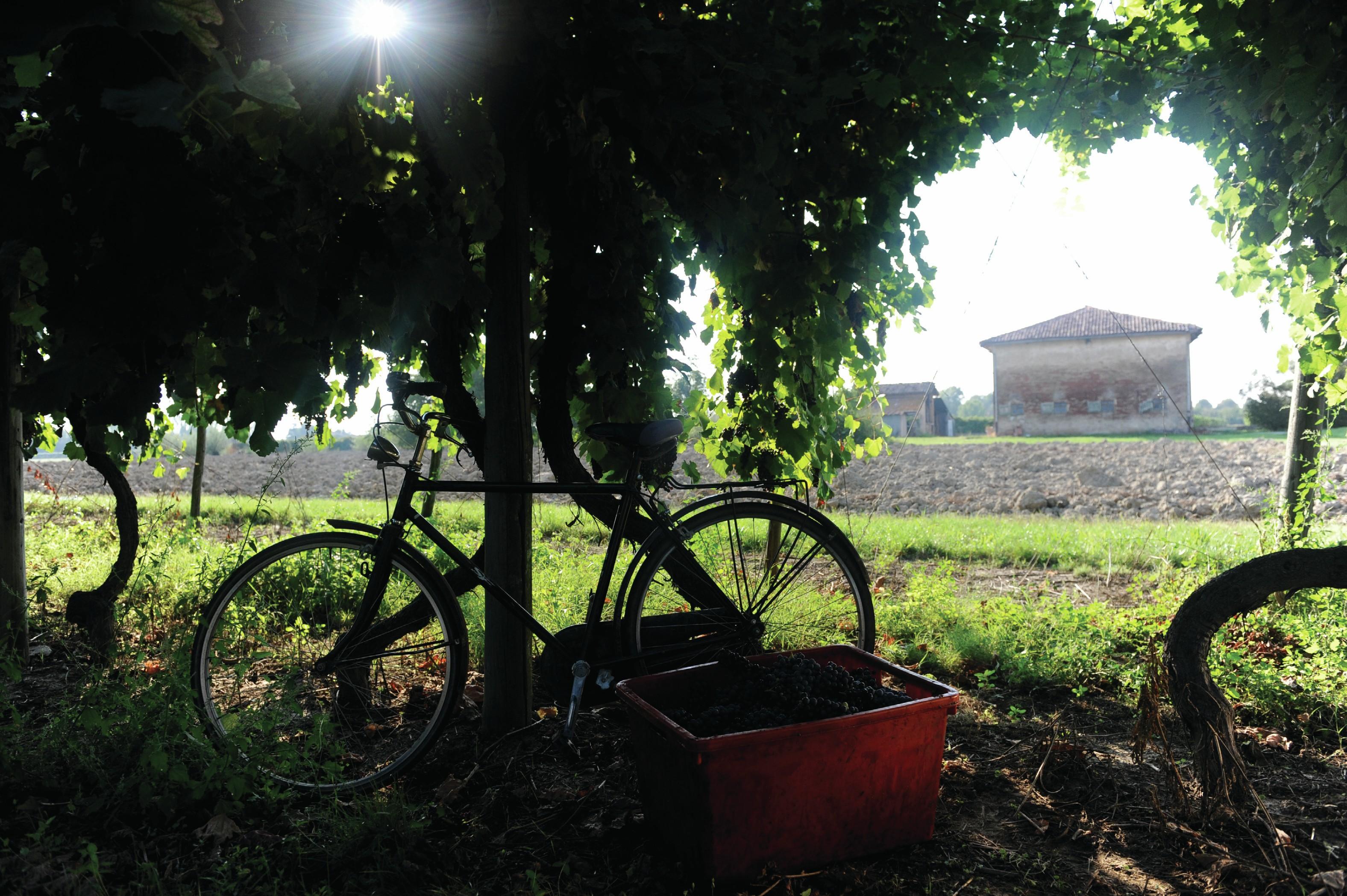
Riunite has 1,450 members and 4,450 hectares of vineyards, which means an average holding of 3ha – not enough to support a family but, according to Lechthaler, there will often be grain, an orchard or pigs, as well as grapes. It is hard work for not much pay, with a hectare of Lambrusco DOC earning its members around €9,000 in 2024.
“It’s my job to protect the members,” he says. “We’re really convinced the cooperative model is the best model to give the new generation opportunities to stay on the land, and to protect the land.”
If the young leave, Italy’s classic, centuries-old landscape of vineyards and olive groves will eventually disappear.
“Last year, we presented our Vision 2030 for a stronger co-op that must earn the revenue to ensure economic sustainability for all the farmers,” Lechthaler says. “For us it is crucial to have those under 40 on board, so we do many activities and meetings with them.”
Staying positive
“Today, the market is under pressure,” Lechthaler adds, “but we believe this is mainly a temporary situation, linked to what is happening in the world, with war, inflation and concern about rising prices. We see it as a cycle, not a crisis. The sun will shine again and people will come back to enjoying a good glass of Prosecco or Lambrusco. We must stay positive.”
Perhaps there is simply too much production in Italy, meaning that more vineyards will have to be uprooted to balance supply and demand? Lechthaler is unconvinced. “I don’t know; producing wine is becoming more difficult year on year. There is a lot of disease linked to climate change. For example, in this region there’s flavescenza dorata [flavescence dorée], with more than 10% of the vineyards affected. In Italy, the last three vintages have been 10%–20% less than the average of the last 10 years.”
Room for growth
For Riunite, Prosecco means Maschio, a top five brand with ambitions to join the top three. The category is still growing, albeit by a modest 1.1% last year, and Lechthaler is confident that the trend will continue. He points to increasing sales in Italy in the first quarter of this year, and says: “We believe there’s still a bit more space for growth. It’s growing in Mexico and the Far East, and in France.” The French are now the third-biggest importers of Prosecco.
Over in the US, where Italian wine shipments slumped 9.2% last year, Lechthaler concedes: “US tariffs have added pressure, especially on wines that can’t support higher prices like Lambrusco. Together with our importer, Frederick Wildman, we decided to temporarily absorb the tariffs.
“In the US, people have been drinking Riunite Lambrusco for more than 50 years, so we are one of the few brands in the world with such a success story. We want to respect and protect that relationship.”
Meanwhile, following the US Supreme Court ruling on import tariffs, there is the prospect of a refund. “We hope part of the duties paid may eventually be recovered,” he says.
Golden age
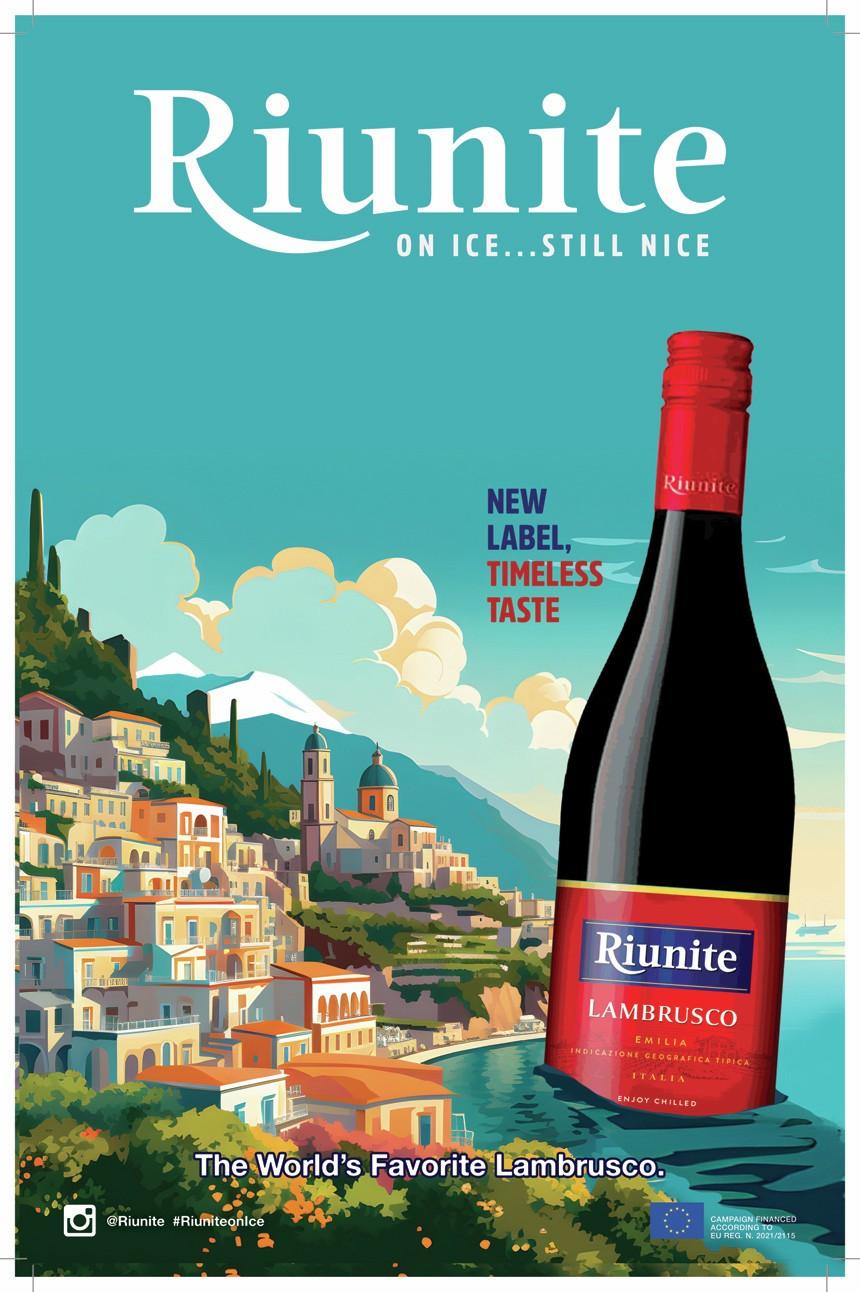
Lambrusco’s golden age in the US was thanks to Banfi Vintners, Riunite’s importer since 1967. Within a decade, it was the country’s top imported wine, a position it held for over 25 years. The brand was built through television and an endless series of adverts with the message: ‘Riunite on Ice, That’s Nice!’
Frederick Wildman, which is 85%-owned by GIV and thus Riunite, finally replaced Banfi in 2019.
Riunite Lambrusco is now number three among Italian wine imports into the US, with sales of just over 1m cases last year. It has been repackaged and promoted with a new campaign: ‘Riunite on Ice … Still Nice!’
Lechthaler believes that it is due for a comeback, and not just in the US. “We are truly convinced that Lambrusco, the style and the wine, is very well suited to the younger generation,” he says.
“Personally, I think in the past we explained wine too seriously. We used to always use very difficult words, talking about indigenous yeast and malolactic fermentation. We strongly believe you can add more value through emotion and story telling.”
And, given that too much malolactic mumbo-jumbo can be a turn-off, especially to new wine drinkers, he may well have a point.
As for the wine’s notorious sweetness that has often been likened to Coca-Cola, he says: “With 50g per litre of residual sugar, combined with the very high acidity of Lambrusco, it gives you a very balanced wine.”
Lambrusco styles
And, as he points out, there is not just one Lambrusco, but nine varieties in different styles. Among those in the Riunite stable is the Lambrusco dell’Emilia from Cantina Alinea Canali, and Lambrusco di Sorbara from Cavicchioli, a leading producer near Modena that was acquired in 2010. Last year its Vigne de Cristo won a ‘Tre Bicchiere’ from Gambero Rosso – the Italian wine equivalent of an Oscar.
Riunite & CIV makes every style of sparkling Lambrusco, from tank-fermented to bottle-fermented metodo classico.
“We are now working on something I like to call an Italian crémant,” says Lechthaler. “We want our bubbles to feel like they’re wearing a tuxedo.”
The mother brand is available in red, white and rosé, and the range now includes a Riunite Peach Moscato, a White Sangria, a Blackberry Merlot and a Riunite Zero which is doing well, apparently.
Overall, he says: “In traditional markets like Germany, the US and the UK we are slowing down a bit, and we are looking for new opportunities. Lambrusco Riunite is working very well in Mexico, and in South America, Asia and Africa.”
Campaign against wine
Meanwhile, there is the World Health Organization (WHO) and its crusade against the demon drink to contend with – something the famous Italian winemaker Riccardo Cotarella calls “this murderous campaign against wine”.
However, defending the industry is complicated, given its structure.
“The Italian wine sector is extremely fragmented,” says Lechthaler. “There are hundreds of thousands of growers, and tens of thousands of wineries and bottling companies across the country. Even the largest groups represent only a small part of the overall industry.”
Hopefully, most Italian politicians appreciate the drink’s cultural significance, as well as all the jobs and votes it represents. And hopefully they’d share Lechthaler’s sentiment that “wine should always be about conviviality and enjoying life together”.
Related news
The Big Interview: Costco's Chad Sokol


