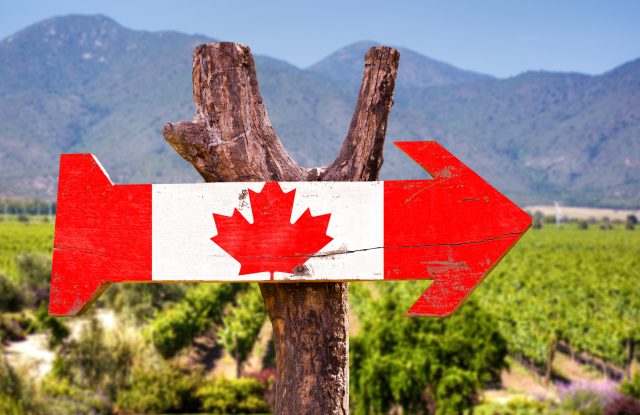
US ban an ‘act of consumer resistance’ by Canadians
By Sarah Neish
Canadian wine producers are in no rush for US-made alcohol to return to Canada’s shelves, describing the “tremendous” impact the ban is having on domestic sales. Sarah Neish reports.
“Why should we drop something that’s clearly working and having an effect?”, asked Wab Kinew, Premier for Canada’s Manitoba province, back in March.
His feelings appeared to be unanimously shared by Canadian wine producers showcasing their wares at Taste Canada in London’s Trafalgar Square yesterday. None could see an end to the ban for at least another one to three years, and nor were they in any hurry to see negotiations progress to that effect.
“I don’t think there’s any end in sight for the ban to be lifted,” Janet Dorozynski, sector lead for alcohol beverages for Canada’s trade commissioner, told the drinks business. Calling the ban “an ongoing small act of consumer resistance” she described its impact as having been “quite tremendous” for Canadian producers, who have seen domestic sales explode.
In Ontario, she explained, sales in the home market have risen by about 60% since the start of the ban, while in Quebec that number is smaller but no less impressive at +40%.
Committed to the cause
According to Dorozynski, the accelerating sales signal that consumers are “just as committed” to the ban as they were when it was first instigated on 4 February 2025.
“It’s really a case of ‘elbows up!’” she said. “It goes beyond alcohol to people also wanting to buy Canadian groceries, and travel within Canada rather than having vacations in the US… There are still a lot of trade irritants existing [between the US and Canada] so I don’t see it being absolved.”
As db has reported, the ban has wiped US$357 millon from US exports in just over a year in what the Wine Institute in California described as “the most severe single-year export disruption” in the history of the US wine trade.
California nightmare
Where many Canadian wine drinkers were regular buyers of Californian wine prior to the ban, “now they are discovering wines from Ontario, Quebec, British Columbia…and there is a sense that ‘if I can get this kind of quality here, maybe I don’t miss Californian wine as much as I thought I would’,” said Dorozynski.
Indeed, many Canadian consumers are still buying within the same price bracket but “finding better value in Canadian wine,” she said.
For Norman Hardie of Norman Hardie Winery in Prince Edward County, Ontario, “the timing could not have been better” for the ban to be imposed.
“If this had happened 15 years ago, the quality [of Canadian wine] was variable,” he said. However, due to the vast improvements made to elevate wine quality across the board, “when the ban does get lifted I don’t think we’ll see people migrating back to US wine”.
The great reshuffle: domestic Vs export
Speaking to db, Andrea Peters, senior PR manager for Wines of Ontario, revealed that many of the region’s producers “are truly focusing on domestic sales as there has been such a boom!”
Does this mean that wineries are scrambling to reallocate their stock away from export? Apparently not.
Dorozynski believes that export volumes will be maintained “irrespective of what’s happening domestically” and Peters underscored this, saying that those wineries with enough skin in the game to export their wines in the first place will be more than capable of meeting those commitments.
Hardie is one such exporter, explaining that he has built up his inventory over the years “so that when something like this happens we can jump on it!” He also keeps some stock back as an insurance policy in case of a harvest-decimating frost such as that experienced in the winter of 2015.
“More than anything it’s an opportunity for some of the smaller craft wineries to expand their distribution,” Peters said. “And another benefit for everyone is that producers have been able to expand their cellar door sales.”
Law change to allow inter-provincial sales
Things are set to look rosier still for Canada’s producers if an expected opening up of inter-provincial sales goes ahead under the Free Trade and Labour Mobility in Canada Act. Although the federal government missed its self-imposed deadline of 1 May, hopes remain high.
“We’re still waiting,” said Peters. “Nothing concrete has happened yet but there should be movement soon. Now that the deadline has passed there is more pressure”. When it happens, she added, the move will be “beneficial for everyone”.
Participating regions have signed Memorandums of Understanding (MOUs) allowing consumers to order wine, spirits, and beer directly from producers in other provinces for personal consumption. For example, Ontario, which is Canada’s biggest wine-producing region, accounting for about 62% of the nation’s total wine output, has signed up to allow reciprocal sales with eight other provinces.
It is estimated that the elimination of all interprovincial trade barriers could increase Canada’s GDP anywhere from CN$92 to CN$200 billion, according to a research paper by Macdonald-Laurier Institute.
Trump countdown
“I want to be clear. American alcohol will only go back on shelves when the US removes its tariffs,” Doug Ford, Premier of Ontario, explicitly stated on 22 April.
For Hardie, the US ban is unlikely to be lifted “until there has been a complete change in US Government”, and with 982 days left until President Trump’s term comes to an end, according to this live countdown, Canadian wineries could be toasting their change of fortune until at least 20 January 2029, if not permanently.
“It’s been great for us,” said Carolyn Hurst, president and co-founder of Westcott Vineyards in Ontario. “Our orders have increased six-fold since the higher US tariffs were announced.”
Westcott currently has four wines listed with the LCBO (the Ontario Liquor Board monopoly). “Once the US products had gone people started looking for alternatives and we had the high-end Chardonnays to replace Californian Chardonnays. Once people found us, they kept coming back and buying repeat bottles. Now we’ve got customers for life. Why would they switch back?”