



The battle of Canada’s frost control methods heats up
Wine producers in Ontario are backing two very different frost-fighting methods, making passionate arguments for each. Sarah Neish discovers why “hilling up” versus “geothermal teepees” is the debate we never knew we needed.
Speaking to producers at last week’s Taste Canada event in London, one of the more esoteric themes to emerge was how to safeguard vines from fatal frost. More specifically, which of two different methods is more labour and cost-efficient, and ultimately the future of the region.
The topic is a hot potato right now as late April to early May is when Canadian producers start to unclothe their vines from their choice of protective material after six months or so of hibernation to protect them from sub-zero temperatures. Growers are currently holding their breath to discover the condition of their plants, with one producer telling db: “It’s the most important time of the year”.
Irreparable damage
You will no doubt have seen headlines screaming that climate change has struck Canada hard in recent years. Temperatures consistently plummet to as low as -25°C in some Canadian regions, and stay there, often causing irreparable damage to grape harvests.
In 2024, Washington State stepped in to supply grapes to British Columbia after BC lost most of its harvest to a devastating “deep freeze”. Washington may be less than thrilled about that now that their wines have been banned from BC – and all Canadian – retail shelves due to tariff disputes with the US, but BC producers can hardly be held responsible for the broader political machinations.
Nonetheless, in light of the trade ban now in place between Canada and the US, Canadian producers may find themselves with fewer allies this year, escalating frost prevention techniques to the top of the priority list.
Team ‘hilling up’
In Prince Edward County, Ontario, many wine producers adopt an approach known as “hilling up”; a technique that sees vines completely buried beneath the soil for several months to avoid them being exposed to the freezing temperatures.
“We’ve reached -25°C for seven out of 10 years,” Norman Hardie of Norman Hardie Winery told the drinks business. “In 2015 we stayed at -15°C to -25°C for an entire month. And when the polar vortex blows in, temperatures can drop to as low as -35°C.”
The damage happens fast. “It takes the same amount of time to burn your hand if you take a steaming pot out of the oven without using oven mitts as it does for frost to kill a whole plant,” Hardie said.
Bitter experience has made Hardie, whose wines grace the lists of more than 40 Michelin-starred restaurants, an enthusiastic cheerleader for “hilling up”. It’s labour-intensive, and timing is “absolutely critical” but he still finds it preferable to the arguably more modern alternative (more on this below).
Initially used by those working in horticulture to protect rose bushes, hilling up requires vines to be buried underground before the soil gets too cold, usually around October time.
“Farmers are ingenious people,” Hardie said. “Now we have the method down pat.”
It wasn’t always so. He learned the hard way that starting early is key, and that success lies in meticulous soil preparation beforehand. Following completion of harvest in September time each year, “getting the soil nice and loose is crucial so that there are no air pockets and the soil freezes softly on the vines,” Hardie explained.
If he doesn’t cultivate his clay soils correctly, “we end up with concrete”.
Once the soils are ready, each individual plant is tied to a wire using four canes before the rows of vines are buried in knee-high mounds (or ‘hills’).
“In our vineyard we have 80,000 plants and each of them has four canes, so that’s about a third of a million canes we have to use,” said Hardie, who has just eight field workers to complete the task over a period of about four weeks. “It’s a lot of work but it’s worth the extra effort to safeguard our incredible terroir.”
The reverse “un-hilling” takes place at the end of April or beginning of May the following year. And it’s in this uncovering of the vines that the debate creeps in between whether or not hilling up is best for the plants.
Team ‘teepee’
While hilling up is undeniably effective for some Ontario producers, others have found that in heavier clay soils the clay tends to “clump” and stick to the buried canes, causing damage to the vines once they are unburied.
Because of this a smattering of wineries are starting to use geothermal “teepees” instead.
Partner Content


After being forced to replant a third of her vineyard following frost damage, Carolyn Hurst, co-founder and president of Niagara’s Westcott Vineyards, began using teepees in one particularly susceptible part of her vineyard.
She told db that despite owning two wind machines for fighting frost in the the vineyard, the prohibitively high cost of operating them means they scarcely get used. “A full tank of propane costs about CN$600 and you can go through a tank in a night,” she said.
The initial outlay of buying “geothermal blankets” is more financially manageable, and Hurst is seeing great results.
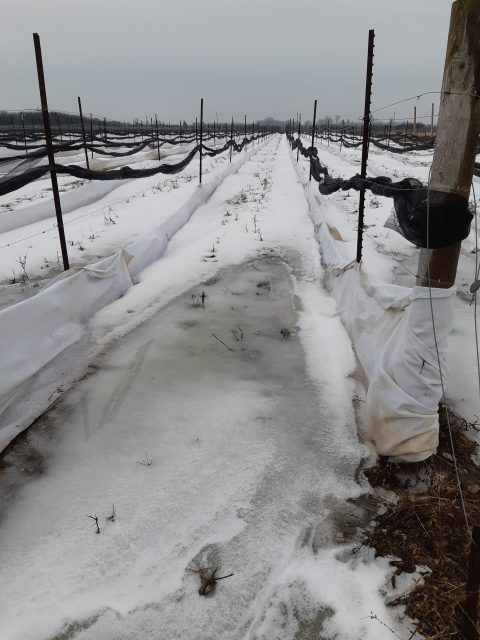
The blankets are made from ” a felt material with a bit of stretch to it, almost like a neoprene wetsuit-type fabric,” Hurst explained. “We prune in late November/December, tie the canes to the wire and ‘teepee’ the fabric over the plants in a tent shape, securing the bottom of the fabric using pegs until it’s all tapped down into the ground.”
The blankets go on before the end of December and the idea is that residual heat from the ground becomes trapped underneath the fabric, keeping the plants nice and snug.
“We’ve had zero bud loss since we started using the geothermal blankets,” Hurst revealed. “They paid for themselves within the first year”. She has been using them for five consecutive harvests “and we haven’t had to replace them yet”.
One key learning for Westcott has been that when the blankets are removed in late April/early May, the vines that were covered are “two to three weeks further ahead in development than the rest of the vineyard because they’ve been in a nice little greenhouse,” Hurst told db.
The upshot of this is that “it gives us more picking options when it comes to harvest time,” she said.
To till or not to till?
The decision on whether to hill up or use geothermals is often based on whether or not producers support the tilling of vineyard soils.
“We’ve been using geotextiles for about 10 years now to protect our Pinot Noir, Chardonnay, Riesling and Cabernet Franc from temperatures cold enough to kill them,” said Mackenzie Brisbois, vineyard manager of Trail Estate Winery, located a five-minute drive from Norman Hardie Winery.
“We use geotextile fabric because we did not want to till our soil. We have worked very hard to develop a complex cover crop system to improve soil health and the microbial activity beneath the soil.”
Soil compaction, such as the use of heavy tractors and “disturbances such as excessive tillage”, Brisbois added, “can eliminate important microenvironments in healthy soil and make it hard for plant roots to penetrate the soil, absorb water and nutrients, and interact with beneficial microbes.”
Some growers in Prince Edward County such as Sugarbush Winery will hill up using only a portion of soil from their rows. “They leave a permanent cover strip in the middle of their row to try and balance out the tillage. Others will apply compost or mulch in the spring to try and mitigate some of the tillage that they are doing and build up healthy microbial populations throughout the season.”
Risk appetite
Norm Hardie is aware of the growing use of teepees but says he “can’t risk going geothermal”, citing numerous reasons including wildlife getting in underneath the coverings and feasting on the plants.
“They have a party in there eating the buds which are full of carbs,” he said. However, Hurst insists she has not found animals “to be an issue”.
“I’m sticking with hilling up,” vowed Hardie. “I know it works, and I’d have to change my whole trellising structure to accommodate the [geothermal blanket] approach. I’m not going to risk 20-year-old vines dying under little tents!”
However, he concedes that in the future Ontario will likely see a mixture of both techniques being used as the Canadian province continues to battle plummeting temperatures. “When we get another winter like 2015, that will be the real test [between the two methods],” he said, referring to the worst winter Ontario has suffered in recent history.
Until then, producers continue to make challenging decisions, often at a moment’s notice, as to the best route to take to protect their crop.
Related news
American distillers bet on Singapore in wake of Canada ban
Canada wine ban wipes US$357m from US exports
US wine exports slashed by a third on back of Canada trade spat


