



Château Petit-Village unveils its new relationship with La Place de Bordeaux
The arrival of Lauren Laudrin as the new director general is not the only big change at Château Petit-Village in Pomerol – its relationship with La Place de Bordeaux has also seen a sea-chage, as db’s Bordeaux correspondent Colin Hay explores.
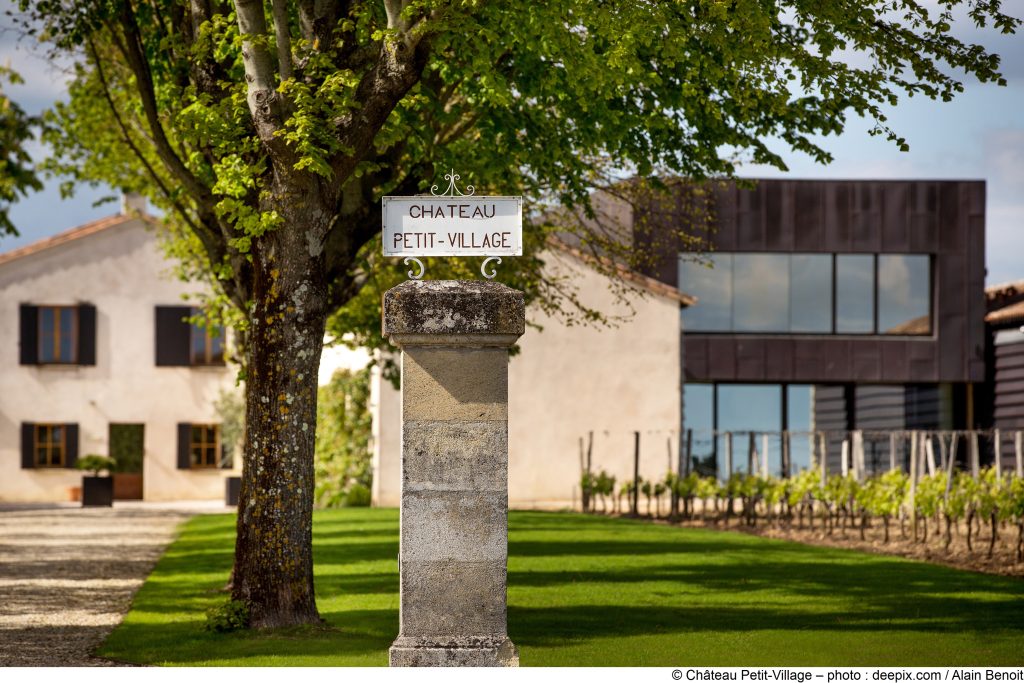
Strange though it might seem, when I think of Château Petit-Village I think first of Denis Durantou. For it was he who told me – towards the end of his life and as we walked through the vineyard of L’Eglise-Clinet – that if there were another grand terroir of the Pomerol plateau that he would love to have had the chance to vinify it was that of Château Petit-Village.
At the time his choice surprised me. But I should have known better then; and I certainly know better now.
Polishing the diamond in the golden triangle
Petit-Village was always something of a rough diamond, an under-appreciated jewel for a long time known largely only by association with the more famous (typically left-bank) properties with which it was co-owner (whether by Ginestet or AXA Millésimes).
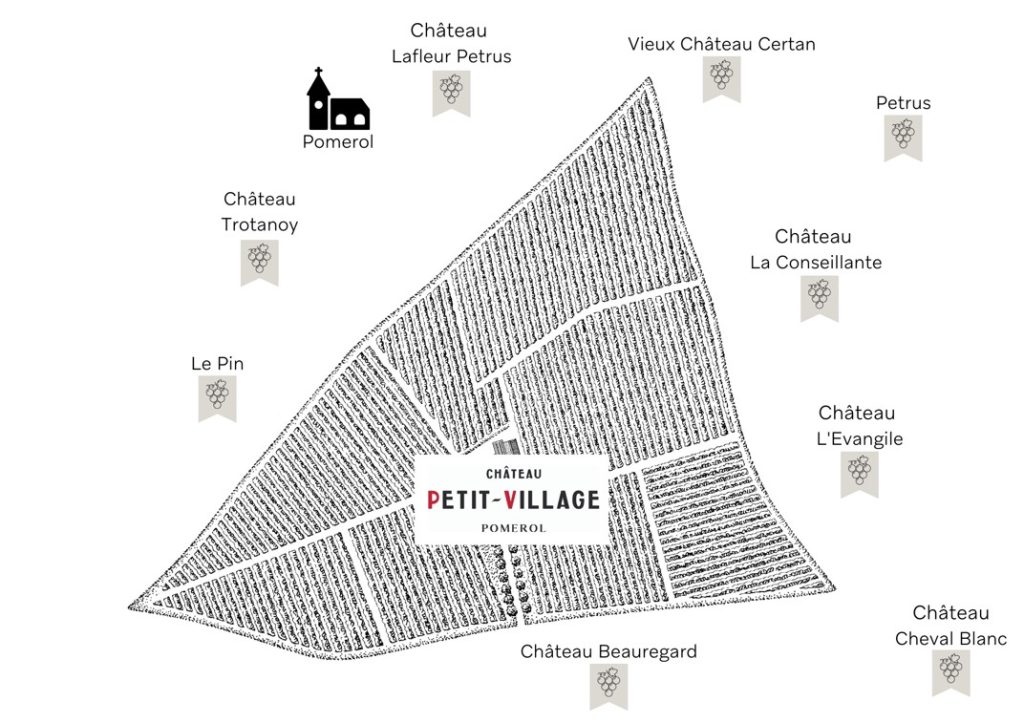
That changed in 2020 with the acquisition of the property from AXA Millésimes by the Moulin family, more famous for their ownership of Galeries Lafayette and, of course to Bordeaux aficionados, of Petit-Village’s neighbour, Château Beauregard.
Indeed, by that time things had already started to change, a process initiated by the investment in a new wine-making facility and accelerated by the arrival of, first, Marielle Cazaux in 2012 and then Diana Berrouet-Garcia in 2015 as consecutive general directors of the property.
It has continued since 2020 with the completion of its transition to organic viticulture and a significant restructuring and replanting of its historic, ‘golden triangle’ vineyard, with the youngest massal selection Cabernet Franc only now starting to make its way into the grand vin.
The appointment of Lauren Laudrin
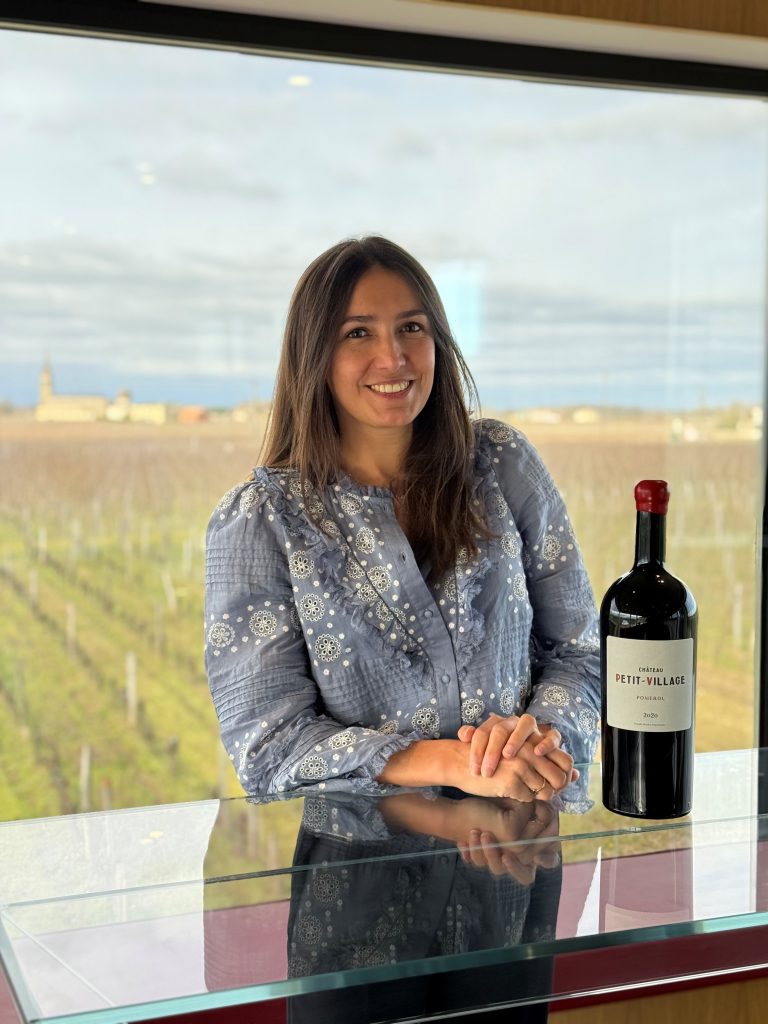
The more recent arrival of Lauren Laudrin as Petit-Village’s new general director in February 2025 completes over a decade of transformation.
Her appointment is a fascinating one, both conventional and radical at the same time. On the one hand she has all the skills and experience that one would expect of someone taking on such an august position. She is a professionally trained oenologist with hands-on experience at Beauregard itself, as well as at Pichon Comtesse de Lalande, de Lescours, Domaine de Chevalier and Domaines Ott in Provence. Yet no less significantly and rather more interestingly, she also brings an entirely different skillset to the role. It is one that is increasingly important in Bordeaux and, indeed beyond. But it is one that, until now at least, has not typically been associated with the general directors of the leading estates. For she also has nearly a decade’s experience as a courtier on La Place de Bordeaux, working alongside the eminent Laurent Quancard. She is, in other words, a Bordeaux market insider.
For all of these reasons (and quite possibly for some others too) we should take very seriously the most recent innovation at Petit-Village – the new project for the commercialisation on La Place of its wines.
Working differently with La Place
I was lucky enough to have the chance to speak to Lauren Laudrin briefly about this during my en primeur tasting at the property in early April and again, more recently and at greater length, in Bordeaux (with Augustin Belloy, representing the Moulin family, joining us on a video-link from Paris).
The project itself is simple enough and, in a way, it replicates what a number of small hors Bordeaux properties have done with their courtiers to better use the services of La Place.
In recent years Petit-Village has, like almost all of its neighbours, used a fairly conventionally comprised pool of négociants (here, just over twenty) for the commercialisation of its wines. But for the 2025 en primeur campaign onwards that pool is drastically reduced. From now on the property will use the services of a single courtier (logically enough, Laurent Quancard) and just four of La Place’s star négociants, each of them agreeing to take a quarter of the production (or at least a quarter of the proportion released to the market).
The négociants will all be well known to seasoned Bordeaux watchers: CVBG, Compagnie Médocaine, Duclot and Twins. They have been chosen, as Lauren Laudrin puts it, “for the quality of their portfolio of wines, the trust they have already placed in Petit Village, their existing strengths in both established and emerging markets and their investment in a shared vision and strategy for the property” (my translation from the French original).
Partner Content
In the longstanding traditions of La Place there is no formal contract between them and the property, just a more informal (but, in practice, no less binding) moral contract. Again, much like the négociant pools for small hors Bordeaux releases on La Place, this is viewed by all parties as a collaboration and a partnership. It is also a vote of confidence in La Place itself from the property and the Moulin family at a time when it has been much criticised (if, invariably, from those who deal with it from the outside).
As Lauren Laudrin explained to me, all options were considered and nothing was left off the table. But, ultimately, in the judgement of Petit-Village’s new chief strategist, La Place at its best offers a distribution system – above all for a small property – that cannot be matched.
Capillarity is the key, the capacity for flexibility over distance that allows the best négociants of La Place to put a bottle of the grand vin in the hands of anyone who wants one, wherever in the world that happens to be. In difficult market conditions it is the additional demand that such capillarity allows one to access that makes the difference between the wine selling through and languishing unsold in the property or negociant’s storage. The former gives the consumer the confidence to buy again; whilst the latter encourages the consumer to buy later only once the secondary market price has fallen.
Pros … and cons?
That is all well and good. But there’s no mistaking the implicit criticism of the current functioning of La Place here. Put bluntly, the decision to opt for a small and hand-picked négociant pool is a recognition that not all of the négociants of La Place today are as effective in their search for such capillarity – and that, above all when volumes are small, it is better not to spread allocations too thinly even where that means rejecting La Place’s famously open market system. Whilst there is a recognition of the limits of that system for a wine like Petit-Village, Lauren Laudrin is keen to emphasise that the property it is placing its trust in the La Place, just changing the way it is working with it. It is difficult not to see that as both a rather savvy choice and one that is likely to be followed.
Indeed, she is perhaps understandably rather sanguine about this. “Yes, others have probably thought of doing what we are doing even if they have not yet acted on it and others still will surely follow. That is fine. For what is clear to us is that it is better to be a leader here than a follower, not least when that gives you the chance to construct your own négociant pool”. Put slightly differently, it takes two (or more) to tango; arrive at the dance too late and there’s no one left to tango with!
There are other advantages, too, to this close way of working. The most significant perhaps is the capacity to share and evolve the strategy collectively and the greater agility, flexibility and adaptability that provides. Much of this is, of course, face-to-face but, intriguingly, there is also a dedicated WhatsApp group in which the directors of each négociant house, the courtier and Lauren Laudrin all participate. If an opportunity arises it is quickly seized on, if a challenge arises a solution is rapidly found and, on an almost day-to-day basis, information as to nature and distribution of market demand circulates between all the core stakeholders. Most properties would be deeply envious of the flexibility and adaptability this affords.
Increased stake
A further advantage is that the four négociants have much more of a stake and an interest in the promotion of the wine than they had in the days when their allocations were a much smaller share of the total production. This makes it much more credible to think that they will work both directly with the property and, more significantly still, together in the promotion of the wine, thereby solving one of the perennial problems for small producers like the leading estates of the Pomerol plateau.
This sounds great. But are there compensating downsides? The most obvious one is pricing. For a strategy of this kind, reliant as it is on an implicit contract between the parties that is largely non-renegotiable in the first five years, requires a pretty firm agreement between the property and the négociants of the pool, individually and collectively, on the property’s pricing strategy over multiple vintages.
But whilst that might be a prospective sticking point for properties seeking to emulate Petit-Village’s innovative approach to La Place, the fact is that for Petit-Village itself any such difficulties have already been overcome. Here again there are likely to have been ‘first mover’ advantages. Indeed, now that an agreement is clearly in place, the potential obstacle becomes a further advantage. For it indicates clearly that four of the leading négociants of La Place have the confidence effectively to underwrite the pricing strategy of the property over the next five years. The commercial directors of practically all of the leading wines of Bordeaux would love to have that kind of assurance, not least when they sit down next with their creditors to renegotiate the terms of their borrowing!
Interestingly, Lauren Laudrin tells me that the final deal was sealed over a blind tasting of Petit-Village alongside five other leading plateau Pomerols in the 2020, 2021 and 2022 vintages. The négociants, by this stage, had apparently already given their in-principle support. The point is that it remains!
Finally, and as something of a postscript, the grand vin was released at the start of the 2025 en primeur campaign for an ex negoc. price of €84 per bottle. I am told that it is selling well, notably in Canada, India, China, Taïwan, the UK, France and Suisse.
En primeur tasting notes
Petit-Village 2025 (Pomerol; 60% Merlot; 32% Cabernet Franc; 8% Cabernet Sauvignon; a final yield of 16 hl/ha; 13% alcohol; certified organic; tasted at Petit-Village with Lauren Laudrin). The Cabernets here are co-planted on the little rise half-way to Evangile, all old vine (67 years old now). Violet and parfumiers’ essence of violet, lilac and a little peony, walnut shell and black olive tapenade. Cedar and lots of graphite. This is succulent and super svelte; the acidity fantastically distributed all the length of the palate. The fine-grained tannins are indiscernible at first, but they build and gather slowly taking in charge the fruit and shaping it towards quite a linear, but never strict finish. That linearity reminds me of some older vintages of Petit Vilage (a wine that has always had massive longevity), an impression only reinforced by the higher presence of Cabernet Sauvignon in today’s blend. Substantial but easy to appreciate in its glory already, if not exactly accessible, this is – as it should be – a grand vin de garde and de terroir. 96-98.
Le Petit de Petit-Village 2025 (Pomerol; 90% Merlot; 10% Cabernet Franc; a final yield of 16 hl/ha; 13% alcohol; tasted at Petit-Village with Lauren Laudrin; this remains an exclusivity of Compagnie Médocaine). Gorgeous and deceptive in a way – as it combines a most delicate and ethereal aromatic profile with considerable depth and intensity on the palate. This comes from the younger vines just around the château itself, but these suffered most and so the average age in the vines from which the fruit comes is older than you would expect. This could be the grand vin, is already a grand vin, and is much greater than what was achieved here for a very long time. Cedar, violet, rose petals, patchouli, black cherry and blueberry. On the palate, this is glossy, deep, dark, rich and very layered. A wine of purity, precision and focus but also impressively substantial. Le petit, in this vintage above all, is a grand vin despite its name. 92-94+.
Related news
Bordeaux 2025: some additional tasting notes
Bordeaux 2025 en primeur: star picks from the Right Bank 'satellites'
Bordeaux 2025 en primeur: Sauternes & Barsac ‘very rich, very powerful’


