



How to show love through food with Ayesha Kalaji
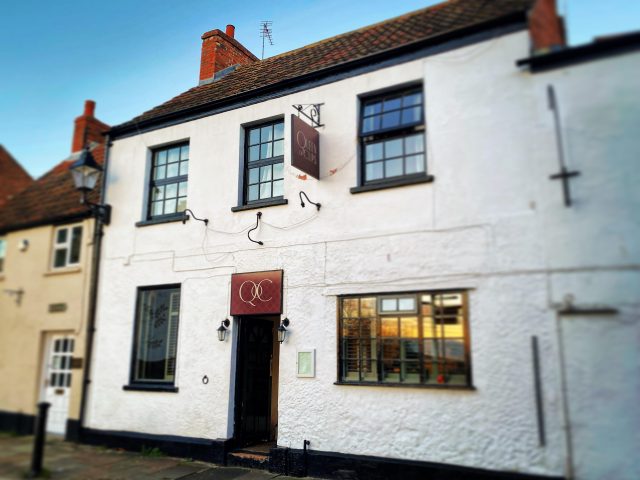
As a child, Ayesha Kalaji struggled to stuff vine leaves in her grandma’s kitchen in Jordan. Today, she heads a Glastonbury gastropub named after a Tarot card, which continues, like a “hummus-covered phoenix”, to snap up serious awards. How did she get here? Amelie Maurice-Jones finds out.
This Friday (20 March), hundreds of pagans, druids, local families and curious travellers will gather at Stonehenge to watch sun rise over ancient rock, in celebration of the Spring Equinox. For the Neolithic farmers who built the iconic landmark, spring’s dawn marked the end of winter scarcity, and the start of a season of renewal, rebirth and abundance.
Around 40 miles away, in The Queen of Cups, a quaint gastropub in Glastonbury, Ayesha Kalaji’s also eagerly awaiting spring. Like her prehistoric ancestors millennia prior, she’s excited by the new ingredients the long, sunny days will bring to her award-winning kitchen. “Wild garlic is the advent of spring,” she gleefully chimes. This time of the year, her team set out on missions to pick the stuff, process it, clean it and preserve it. Beyond butter and oil, Kalaji uses garlic in a myriad of ways. The leaves are fermented for krauts and kimchi, the seed pods pickled like capers, and flowers styled as artful garnish.
Growing up in Wales, Kalaji was raised with deep respect for the world around her. “The sheep in the field next door were inevitably going to end up on a plate; the mussels from the Menai Straits are the best available; and the mackerel we went fishing for near Puffin Island is the sweetest,” she recalls, evoking windswept memories of her childhood on Wales’ north-west Anglesey island.
A menu shaped by childhood memories
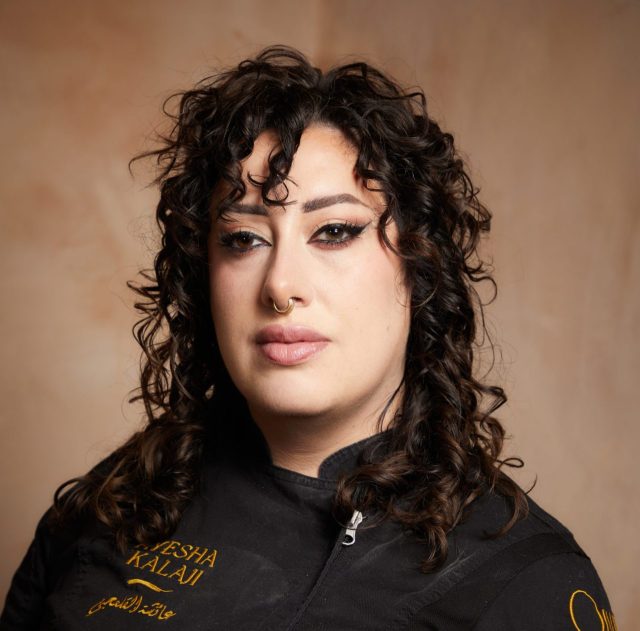
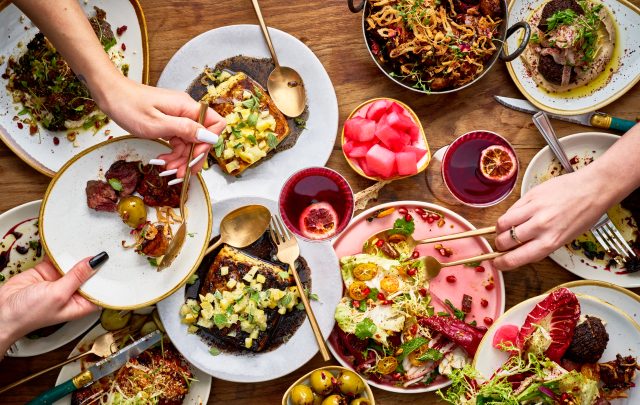
Married with her Welsh upbringing is her Jordanian roots, and Middle Eastern influence meets Mediterranean fare on her menu. The laverbread falafel, for instance, is a staple. “Falafel is something so instantly recognisable as Arab, but with the inclusion of Welsh seaweed, a small crispy ball of chickpeas suddenly becomes a representation of who I am and where I came from,” Kalaji explains. Previously speaking to the drinks business, she also made the point that cooking from multiple cultural lineages, “openly and unapologetically”, is a statement in itself in an increasingly polarised society.
As a child, the chef, who is half British and half Jordanian, spent summers wonderstruck in her grandmother’s kitchen in Jordan. Looking back stirs feels of nostalgia and longing – memories of “quiet breakfasts and bustling family lunches; the smell of trays lined with newspaper with fresh za’atar drying on them; great bowls of cheese soaking; huge bouquets of herbs being chopped; jars of neon pink pickles; and her small hands, wizened by years of cooking but softened with olive oil, deftly shaping kibbeh”.
One day in particular glimmers in Kalaji’s memory. She remembers sitting at her grandmother’s table with its plastic checkered tablecloth, Neither of them could speak the same language. “Despite not being able to converse, she taught me to roll warak dawali,” she smiles, “how to select the best vine leaves, how much filling to use, how to roll them tightly but not so tightly that they burst when the grains of rice swell.” Her grandmother laughed at her first few terrible attempts, but with patience, she nailed it.
How to show love through food
Partner Content
“I will always remember her smile when I presented her with my first good one and she added it to the pan to be cooked — a moment of pride for both of us,” Kalaji warmly recalls. “That was something she taught me that I’ll never forget. She didn’t just teach me this recipe, though; she taught me generosity and how to show love through food. And I do roll a pretty excellent stuffed vine leaf.”
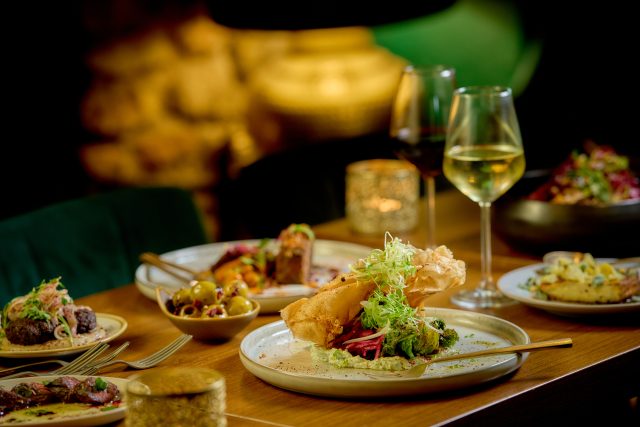
And that’s an understatement. The Michelin Guide describes small plates that “burst with colour and flavour.” Trenchmans acknowledges that a 17th century Somerset inn isn’t where you’d expect to find some of the best Middle Eastern food in the country, but nevertheless, here are “dishes that dazzle”.
Kalaji takes us through one of these dishes. Her pick is Zarb – a take on a Bedouin classic – of meat cooked underground in desert sands. “I have reimagined it with slow-braised and smoked short ribs; a rich tomato, pepper and charred onion sauce enriched with bone marrow; bright coriander oil; hazelnut and fennel dukkah; a beef ragout with merlot agridolce; and pickled wild garlic buds,” she says. “It’s unctuous, smoky, deep and utterly satisfying to every sense.”
Award-winning cuisine
When asked what wine she’d pair it with, she naturally plumps for a Jordanian bottle – Haddad Estate Jordan River Reserve Shiraz. “It would be a toss-up between that and a Priorat — something with dark fruits and spice, but dry and acidic enough to cut through the rich beef.”
Kalaji’s come a long way from struggling to roll warak dawali in her grandmother’s kitchen. Since its launch five years ago, her gastropub has scored armfuls of accolades, including a Michelin Bib Gourmand, Best Chef at the Trenchermans Awards 2025 and a BIH Spotlight Award 2022. She’s also appeared on both Great British Menu and MasterChef, shining in the TV limelight.
“Every time we win an award, a photographer captures a photo of me looking utterly flabbergasted. I never expect to win them and I’m genuinely just grateful to be in the room alongside the peers I admire so much,” she humbly acknowledges.
Rising like a ‘hummus-covered phoenix’
Winning awards, though, is a wonderful feeling – it feels like validation for all her hard work, sacrifice and dedication. “It is motivating for the team who make everything I do possible,” she continues. “We are a quirky bunch. Someone once described us as a bit of a ragtag pirate ship — who somehow make this incredible food and serve beautiful drinks.
“These awards mean we are doing something right. It’s reinforcement to keep doing what we do and continue to rise like a hummus-covered phoenix.”
Related news
Britain split on kids and dogs in restaurants


