



The great Lambrusco reawakening
Sparkling red Lambrusco wines are undergoing an exciting renaissance, with a slew of maverick producers rewriting the story of the much maligned fizz, reports Anthony Rose.

THANKS TO the phenomenal success of Prosecco, Italian sparkling wine has become famous, or infamous, depending on your point of view. Either way, the growth in the reputation of traditional method sparkling wine regions, mainly Franciacorta, Trentino and Alta Langa, has demonstrated that Italy can produce quality sparkling wine at the highest level.
Did somebody say Lambrusco? Well, no actually, because somewhere between the devil of Prosecco and the deep blue sea of traditional method Italian fizz, Lambrusco has languished in a backwater of its own. Until recently.
Lambrusco has been tarred with a cheap and not very cheerful brush since before the late Nicolas Belfrage MW wrote his 1984 guide to understanding Italian fine wine, pointedly called Life Beyond Lambrusco. In a blistering foreword, Jancis Robinson wrote: “Lambrusco is the sweet frothy red that constitutes some frightening proportion of Italy’s wine exports and has weaned thousands of Americans off cola towards wine. It also epitomises the manifold obstacles facing Italian producers of fine wine today.” “
Some of the blame for this state of affairs can be laid squarely at the door of Enotria Wines founder Remo Nardone, who, while working for the Lambrusco producer Cavicchioli, thought it would be a good idea to create a cheap charmat method white fizzy wine for export. To produce his San Prospero brand, Nardone went to Chiarli (the first wine-producing company in the Emilia-Romagna region), which produced the wine more cheaply, with added sugar, using a screwcap instead of a cork in order to avoid the heftier duty payable on traditional method sparkling wine.
Glugging fizz
The inglorious introduction of this ‘bleached’ Lambrusco into the UK market all but extinguished for a generation any idea that Lambrusco might actually be an honest glugging fizz. The phenomenon reached its nadir in the US, where exports of 81.6 million bottles in 1979 were led by Riunite and sold by the House of Banfi as a sweet fizzy red, dubbed Lambruscodotto transatlantico by the Italian magazine Civiltà del Bere.
To be fair, Belfrage made it clear that the image of Lambrusco was being distorted through the lens of producers keen to make a quick buck at a time when traditional mixed agriculture was changing in favour of a high-yielding monoculture of the vine.
“Lambrusco’s serious side should not be dragged down by the pop image,” Belfrage said. “In among the super-vast industrial concerns,” he wrote, “there are one or two by no means modest wineries for whom the emphasis remains on quality and not on price. Foremost among these is probably Cavicchioli. While it produced mostly bulk wine, Cavvicchioli had a range of quality sparkling wines produced by both Charmat and traditional method.
According to Sandro Cavicchioli, who runs the company today (part of Riunite since 2010), “until the 1990s, co-operatives were car parks for failed politicians, but today, they are professional and competitive” winemaking operations.
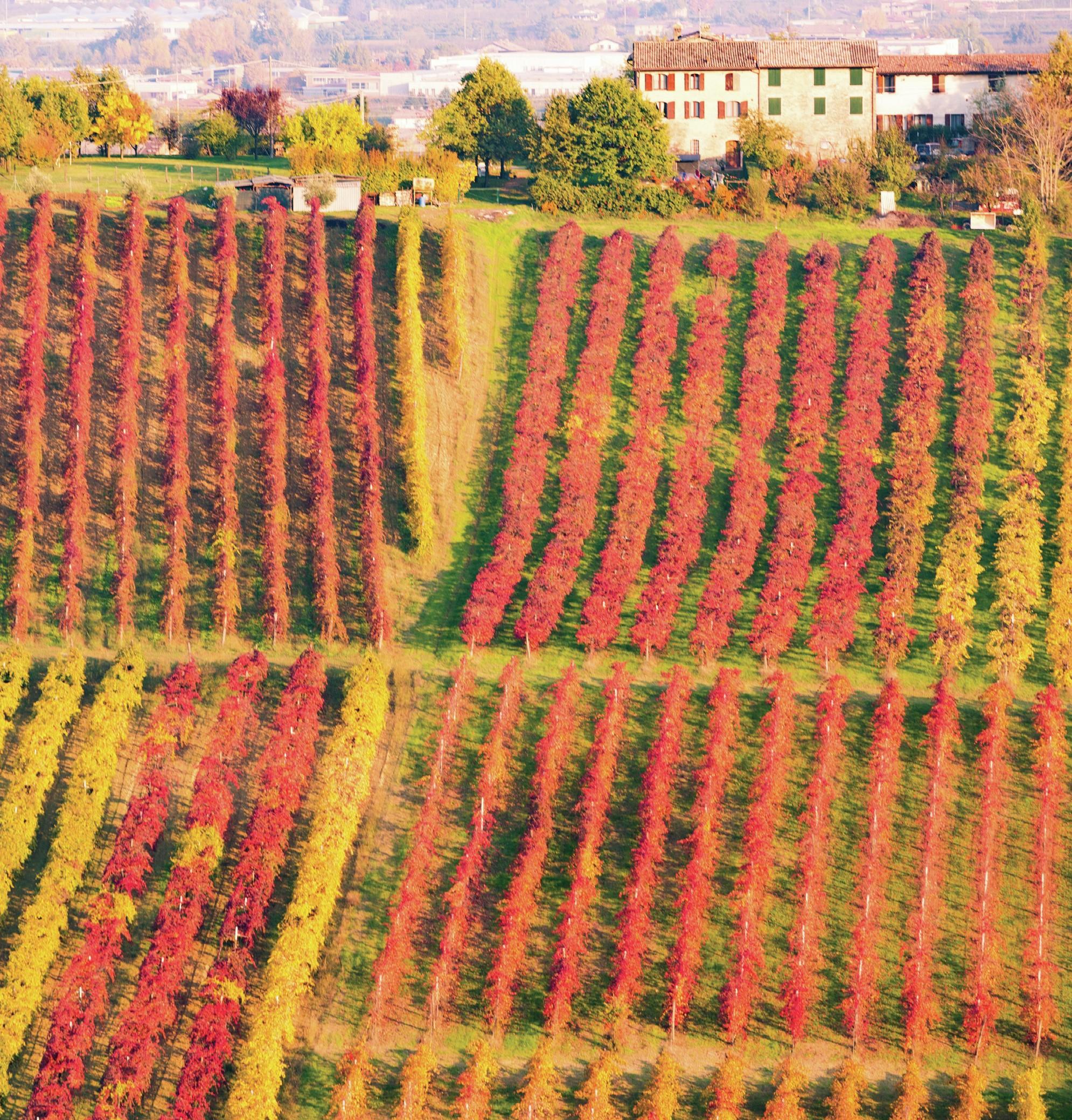
Autumn colours: The Lambrusco vineyard totals 10,000 hectares
Discriminating palates
Even before Belfrage’s book came out, the American wine writer Burton Anderson had written in Vino (1980): “Perhaps the most convincing argument for Lambrusco’s inevitable worth is that it is made and drunk by Emiliani, people whose palates are as discriminating as their appetites are insatiable. Few natives are naïve enough to call Lambrusco great, but most will admit that they consume more of it than any other, and not only because they like the bubbles and the modest price.”
Anderson mentioned a number of companies producing such Lambrusco, among them Cavicchioli, Chiarli, Contessa Matilde and Agostinelli.
The appearance on the UK market in 1994 of Lambrini, a sweet, fizzy perry created by Halewood International, did Lambrusco no favours whatsoever. Deeply unflattered by the imitation, Lambrusco producers launched a legal action against Halewood in 2000, claiming that the cheap British drink was fooling customers into believing that it was Lambrusco Bianco.
In hindsight, there is some irony in one producer suing another for piggybacking on its own (at the time) cheap and horrible product and, as it turned out, the High Court dismissed the writ.
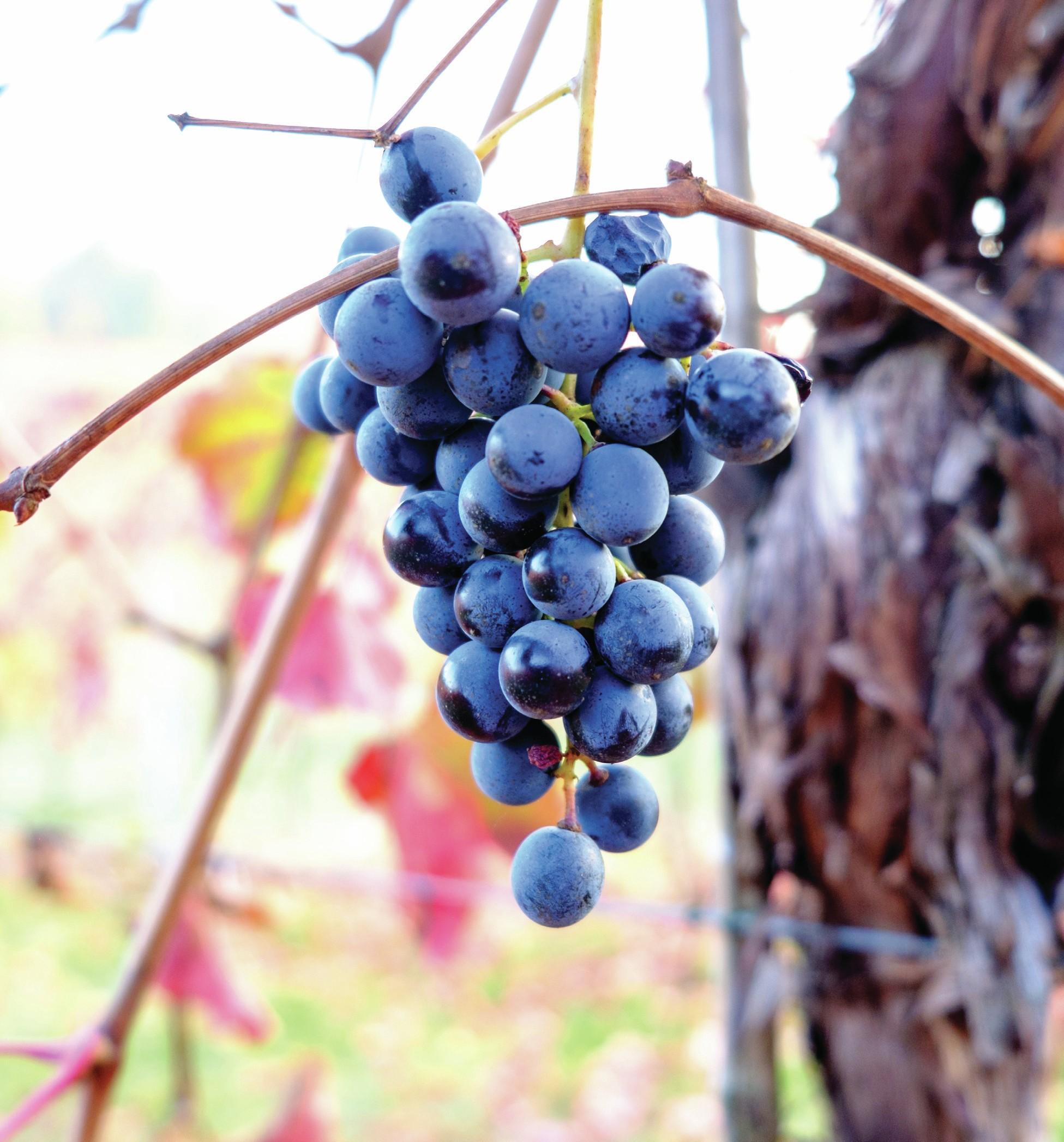
Late developer: Grasparossa is the last Lambrusco grape to ripen
Given these many setbacks, it’s not surprising that the renaissance of Lambrusco that is emerging today has been a long time coming.
Modern revival
The revival on export markets started in the US, where sommeliers and wine merchants gradually cottoned onto the reawakening taking place in Emilia-Romagna. They in turn have started to convince their customers that the bad old days of Lambrusco being cheap, sweet fizz are well and truly over. What shape has that revival taken? I went to Modena in Emilia-Romagna and I was surprised at what I found.
What struck me above all was the number of enthusiastic young winemakers and owners, male and female, confident in their assessment of Lambrusco as a wine whose turn it is to shine.
Light, relatively low in alcohol at mostly 10.5%–11.5% ABV, refreshingly dry and for the most part good value, Lambrusco is an everyday wine, not to be taken too seriously, but made for a wide variety of dishes, and not only pasta, prosciutto and pizza, to be enjoyed in informal settings. It’s a compelling message and one that I believe is on the cusp of being embraced by a growing number of consumers worldwide.
A further surprise was that there is not one Lambrusco grape or style of wine, but in fact a family of 12 native grape varieties producing diverse expressions of rosé and red, all sparkling and increasingly dry. Under the Lambrusco varietal umbrella, there are three main grape varieties, Salamino, Sorbara and Grasparossa, which between them account for 8,200 hectares of the total area of production of 10,000ha.
Of the remaining nine varieties, Maestri, Marani and Oliva account for another 1,300ha, with seven varieties each vying for the accolade of tiniest area of production. Del Pellegrino wins with just 0.67ha.
Distinct characteristics
Each grape variety has its own distinct characteristics, the most striking of which are the differences between ‘the big three’.
Lambrusco di Sorbara, which grows on potassium-rich, sandy soils with limestone, mainly between the Secchia and Panaro rivers in central Modena, is the highest in acidity, making light, refreshingly strawberry-ish sparkling wines which vary from pale to a deep bronze pink in colour.
Sorbara needs a pollinator, so step forward Salamino, which is usually planted together with Sorbara. At family-run winery Cantina Paltrinieri, for instance, two rows of Sorbara are planted to every one row of Salamino. The most widely planted variety originating in Santa Croce in the north of Modena, Salamino now spreads out across the flat alluvial plains of Modena and Reggio Emilia near the Po river. Its salami-like bunches (hence the name) produce a lightish, raspberry-ish and cherry-ish sparkling red with moderate tannins, and it’s “the most balanced variety”, according to Alessandro Medici of Medici Ermete.
Grasparossa, in contrast, originates in Castelvetro di Modena in the undulating foothills of the southern part of the province, where the terra rossa soils contain a clay that’s rich in iron, and also sandy with silt and marl. Grasparossa is the latest grape to ripen, producing a vivid, black cherry-ish sparkling red; its higher tannins bring structure to the wine, which usually needs to be tamed by an extra dose of sugar to balance and round it out.
Consorzio clout
There are 70 members of the Lambrusco Consorzio, which seems like a small number until you remember that many are large co-operatives, the biggest of which, Riunite, has 1,440 members and covers 4,450ha.
The two provinces of Reggio Emilia and Modena produced 140m bottles in 2022, 100m of which are IGT, the remaining 40m coming from six DOCs. The two DOCs in Reggio Emilia are Reggiano and Colli di Scandiano e di Canossa. Of the four in Modena, one is Modena DOC itself, while the other three contain the names of ‘the big three’ grape varieties, so there’s Lambrusco di Sorbara, Lambrusco Salamino di Santa Croce and Lambrusco Grasparossa di Castelvetro.
At first sight, it seems confusing to have grape variety and place name combined in a single DOC. Logically, you might think that the DOCs correspond to the differences in the soil profiles and, while the soils are varied in composition, they are by and large water-retentive, alluvial clays, and so the names, at least in the case of Salamino and Grasparossa, in fact correspond to their place of origin.
A mere 40 years after Jancis Robinson penned that damning foreword to Life Beyond Lambrusco, she says in the latest edition of The Oxford Companion to Wine that “its industrial image is now challenged by a new generation of artisanal, dry versions”. And, while she rightly points out that most Lambrusco is a fairly “anonymous, standardised product”, at the same time she recognises the efforts being made to increase the quality of the wines.
Frost protection
In the vineyard, the traditional, high Geneva double curtain trellising system brings protection from frost and ventilation in the continental climate of the two provinces, which can be extremely humid. Yields can rise to 18 tonnes to the hectare (t/ha), but the more quality-conscious producers are reducing yields and hand-harvesting (in contrast, 80% of production is harvested by machine) to optimise grape quality.
Chiarli, for instance, the estate arm of which controls 400ha, brings its Sorbara in at 12t/ha–15t/ha. A gradual move towards a reduction in agro-chemicals and the adoption of the more sustainable lotta integrata (integrated pest management) system has also seen yields brought down by smaller producers, such as Ventiventi, to below 10t/ha. There is also a trend in new vineyards to espaldera, or guyot.
By far the majority of Lambrusco is made by the Charmat method or, as the Italians would prefer us to say, the Martinotti method, and is brut (less than 12 grams per litre of residual sugar).
It was Piemontese winemaker Federico Martinotti who developed a prototype of the tank method, allowing the refermentation of the base wines in autoclavi (large pressurised tanks), and the metodo Martinotti was patented in 1895 before Frenchman Eugène Charmat patented the Charmat method in 1907.
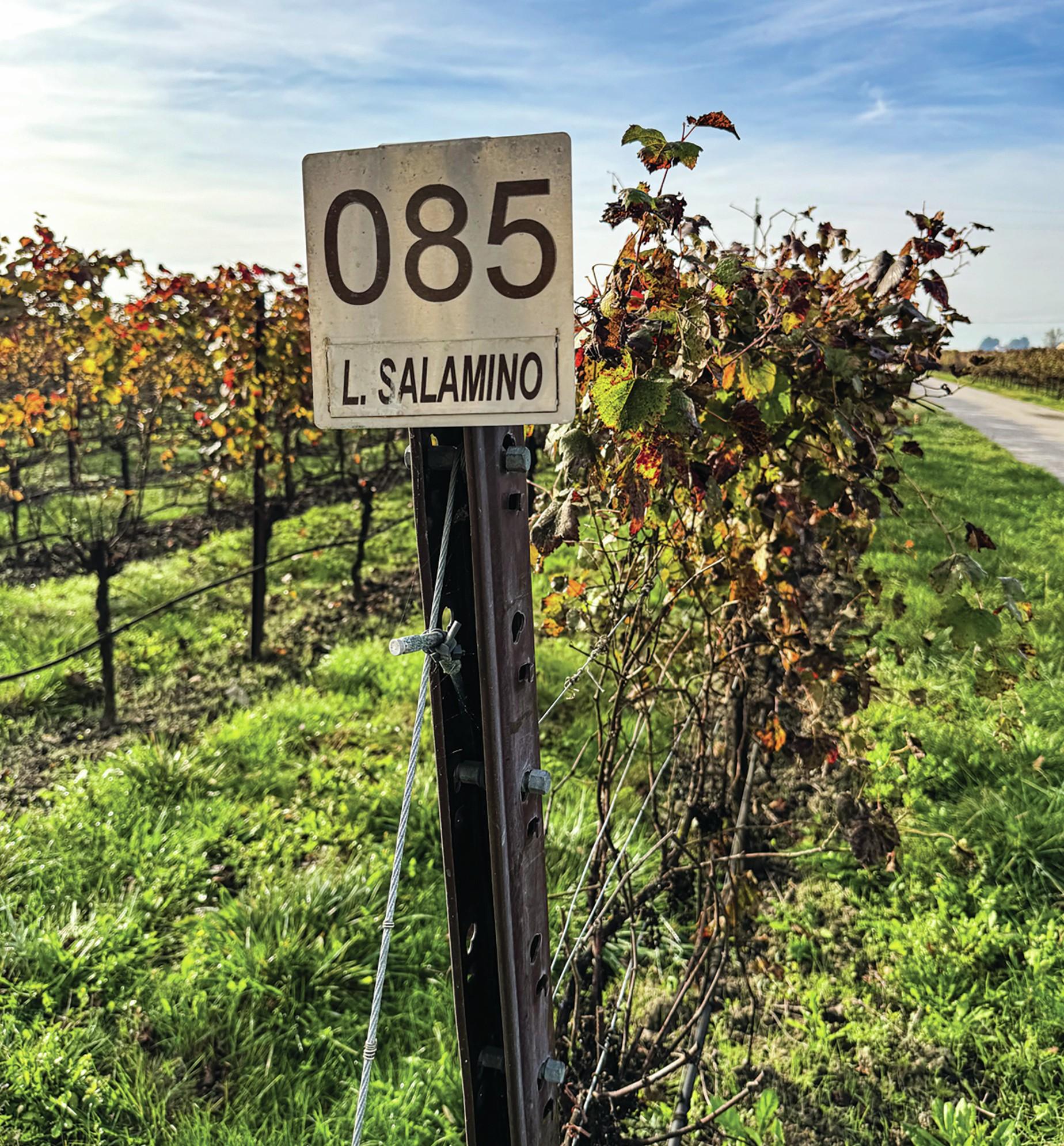
Melting pot: Lambrusco is home to 12 grape varieties, including Salamino
The secondary fermentation in large tanks not only brings economies of scale but, by refrigerating the must, it allows producers such as Chiarli to produce their Lambrusco in small batches throughout the year, thereby keeping each batch as fresh as possible. At the same time, most Lambrusco produced by this method is frizzante – that is sparkling, with a pressure of between 1 bar and 2.5 bar. Paltrinieri’s Leclisse, a dry, fresh, pink frizzante made from Sorbara grapes, has proved hugely popular with young consumers.
Medici Ermete’s delightfully fragrant, complex Concerto Reggiano, a 100% Salamino red, is also made by this method.
Single-vineyard Lambrusco
“When my father first started thinking about wine in 1988, the image of Lambrusco was terrible,” says Alessandro Medici of Medici Ermete. “The idea of a varietal Lambrusco from a single vineyard was considered crazy, but it has become increasingly common. Equally, terroir has become a valid way of communicating the authenticity of Lambrusco.”
Concerto is considered one of the pioneering wines of the Lambrusco renaissance.
Spumante, on the other hand, starts at 3.5 atmospheres of pressure and is more suited to sparkling Lambrusco made by one of two different methods. On the one hand, there is the traditional method with a second fermentation in bottle, followed by disgorgement after ageing on the lees in the cellar; on the other is the ancestral method.
Most quality producers have at least one metodo classico in the range, with a trend towards more production by this method. Cavicchioli’s Vigna del Cristo, for instance, is probably the best-known example, having been awarded Tre Bicchiere by the Gambero Rosso.
Ventiventi, a venture started by the Razzaboni family in 2014, focuses on the classic method with a view to making wines of greater authenticity and longevity. “We’re looking for drinkability, and everything we do is aimed at maximum respect for the raw materials,” says Andrea Razzaboni, one of two brothers who run the company.
“In recent years, the number of wineries making classic method Lambrusco has grown. We believe that it shows that Lambrusco doesn’t have to be just a basic product, but can be a refined one too.”
Ancestral sparkler
Ventiventi also makes a Lambrusco Frizzante Secco Rosato dell’Emilia IGT, an ancestral method sparkler, which starts its fermentation in tank and, bottled with 12 grams of residual sugar, finishes its fermentation in the bottle without any disgorgement under a crown cap. Historically, the refermentation in the bottle was done without adding yeast, but today there are a growing number of pet nats with yeast, and sometimes grape must, added to the next stage of fermentation in bottle. Medici Ermete, for instance, makes a pet nat from Lambrusco Sorbara called Phermento, a mouth-wateringly sour cherry and strawberry vino frizzante secco which ferments as a dry wine and then has must added for the second fermentation in the bottle.
Demonstrating outside-the-box thinking in the region, the new generation of Lambrusco is illustrated in its multifaceted form by Gianluca Bergianti, the enfant terrible of Lambrusco, whose atypical, biodynamic Terrevive wines (he names one of his bottlings, ironically, “No Autoclave”) use spontaneous fermentation, followed by the addition of unfermented grape juice from the same harvest, and are bottled without sulphur.
The results are bone-dry sparkling wines of notable energy and ageability, described by the New York wine merchant Rosenthal as “bracingly pure, low-tech renderings… high-acid wines streaked with the refreshing effervescence of active fermentation”.
Related news
Ashley Graham launches Lucci Lambrusco
World Lambrusco Day highlights 'world class bubbly' from Emilia-Romagna
Lambrusco’s new wave of vibrant, crunchy and saline fine wine


