



Wine List of the Week: Bonheur by Matt Abé
Occupying the former home of Le Gavroche, Bonheur marks Matt Abé’s first solo step into a room heavy with history. Does it move forward without leaning on nostalgia? “Largely,” writes Douglas Blyde.
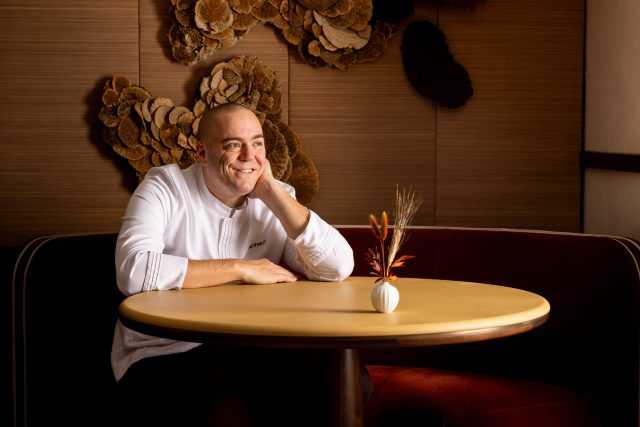
This was Le Gavroche, a dining room which shaped London’s understanding of French fine dining for decades. It is now ruled by Matt Abé, who spent eight years as chef-patron at Restaurant Gordon Ramsay, maintaining three Michelin stars, before opening Bonheur in November 2025. Ramsay is involved, retaining the long lease of Abé’s first solo venture.
Critical response matched the ambition of the address. Writing in The Standard, David Ellis noted, “Christ can Abé cook. He is not only the name above the door, but the man sweating it out at the stoves.” Hot Dinners found the redesign effective, if divisive, while Andy Hayler focused squarely on cost, arguing that “the size of the bill is the main issue”. Michelin’s view followed swiftly, awarding two stars within three months of opening.
Interiors by Russell Sage, working closely with Abé, deliberately avoid revival. Guests pass an aperitivo lounge – several bottles still factory-sealed – before descending to a dining room of creams, rusts and ochres, a nod to Abé’s Australian roots. Horsehair wallpaper, illuminated glass alcoves, leather tabletops albeit evocative of padding pre-linen, and sculptural waiter stations signal a clean break from the past. 48 covers compared to Gavroche’s 90 rise to 56 when Petit Bonheur, the six-seat chef’s table within the room, is in use. Artworks of debatable taste adjacent function as ingredient studies, one incorporating real pistachio husks, while a sometimes-jarring soundtrack of Madness and Elton John with Kiki Dee underlines that nostalgia is not the point.
Drinks
Born in Alsace and raised in his parents’ restaurant, Eric Zwiebel MS trained in Paris before moving to England in 1997. Since achieving his Master Sommelier diploma in 2001, he built major programmes at Hotel du Vin, Cliveden House, Summer Lodge and The Samling. At Bonheur, a wine list exceeding 550 references has been assembled from scratch, with Zwiebel acting directly with Abé, who sees drinks as inseparable from cooking and the pairing process as collaborative.
Zwiebel leads a team of five, including Daniel Pereyra (formerly of The Samling), and Ciaran Bagchus (Pied à Terre, and High by Gordon Ramsay), with sommeliers embedded fully into general service rather than operating as a silo.
Champagne sets the tone. Alongside benchmark houses sit grower producers and a defining relationship with Henri Giraud, whose Argonne cuvée appears in a deep vertical from 2002 to 2017, including magnums. Dom Pérignon spans P2 and P3, while Cristal, Krug Clos du Mesnil, Bollinger Vieilles Vignes Françaises and Salon reinforce the cellar’s emphasis on recognised prestige.
Not surprisingly given Zwiebel’s heritage, Alsace is one of the most coherent sections, spanning Boxler, Barmès-Buecher, Pfister, Tempé and Marcel Deiss, with Trimbach represented up to Clos Ste Hune. White Burgundy is trophy-led – Coche-Dury, Lafon, Leflaive, Roulot, Roumier – while Bordeaux is exhaustive rather than selective. New World selections reveal more of Abé’s own palate, particularly his native Australia, Oregon Pinot Noir and Ridge’s restrained Californian wines. English sparkling appears through Wiston, Coates & Seely, Gusbourne and Hattingley, though Abé is yet to be convinced on the consistency of homegrown still wines.
Sweet and fortified wines function as tools: Ratafia Champenois, Commandaria, Tokaji, Vin de Constance and d’Yquem appear by glass and bottle. Pricing is assertive, with a median bottle price around £275 and little under £100. Corkage is not offered, which has put off at least one champagne ambassador from visiting. The bar programme is deliberately contained, cocktails batched and kitchen-led, reinforcing that, unlike Whisky & Seaweed at Clare Smyth’s Core which made the bar fun, Bonheur is a dining room first. Coffee is supplied by Workhouse in Reading, an Australian-founded roaster, and is served tableside in decanters.
Dishes
Lunch opens with sharply executed canapés: a 125-day aged beef tartare seasoned with seaweed, and a potato and chive dauphine topped with Oscietra caviar, so immaculate it looks digitally rendered. That beef reappears as a rendered consommé, comforting and restorative. “It would rouse someone with flu,” said our guest.
Partner Content


Vinous pairings for the Journey menu are conceived as a geographical progression, though on this visit we ordered à la carte to draw from both the Journey and Dream menus. Abé is explicit that wine is functional. In discussion, he describes three modes: contrast, accompaniment, or seasoning. At Bonheur, Zwiebel’s pairing philosophy is consciously deferential to the kitchen.
That restraint works best where the cooking leans into classical roots. The Quiche Lorraine, already a house signature, knowingly departs from orthodoxy, however. Alongside aged Gruyère, black garlic and smoked pork belly, it incorporates creamed leeks, finished with Vin Jaune sauce poured tableside. The pairing, 2023 Sylvaner (Albert Boxler) does not seek to lift the dish but steady it, cushioning fat and smoke. Zwiebel explains: “you don’t need cleverness. You need the wine to support the dish.”
The most vivid pairing arrives with Isle of Skye scallop from the Dream menu. Seared and finished over fire, it is served with carrot, pomelo, clementine, finger-lime “caviar” and yuzu kosho. Matched with 2023 Santorini Assyrtiko from Mikra Thira, the effect is electric: saline grip and bitterness sharpen the citrus and amplify the scallop’s sweetness. Here, wine acts unmistakably as seasoning.
Elsewhere, the pairings favour tact over tension. Vendée quail blanquette (another choice from the Dream menu) poached to retain a blush of pink and served with crisped Jerusalem artichoke skin, black garlic, Morteau sausage and a deeply savoury jus which could do with a sauce spoon, is paired with 2023 Bergström Cumberland Reserve Pinot Noir from Willamette Valley. Red is an unusual instinct here, where white might feel more natural. The Pinot behaves politely, offering freshness without intrusion, supporting rather than challenging the plate.
The balance tilts further with Aynhoe venison from Brett Graham’s farm, ordered from the Journey menu and paired with 2021 Torbreck The Steading. Here, the blend of Grenache, Shiraz and Mataro begins to lead, bringing warmth and generosity which push the pairing decisively towards comfort. Indeed, were the venison removed, the accompaniments of pine and blackberry could plausibly read as pudding. Then Cornish turbot (also Journey) arrives with lobster reduction, celeriac and hollandaise, paired with 2023 Rafael Palacios “As Sortes” Godello, its saline edge aligning neatly, though a touch more oak might have introduced greater tension.
Not every course is paired. Sheep’s yoghurt with lavender, vanilla and blossom honey offers a pause, allowing the meal to breathe. Unpaired, it proves the most enjoyable dish on the table.
Desserts are where collaboration sharpens again. Toasted grains with whisky, smoked chestnut and caramel, more exciting than it sounds, and realised by Pastry Sous Chef, Hesky Meyer, are paired with 2021 Tsiakkas Agios Mamas Commandaria, which Zwiebel notes is the world’s oldest named wine still in production. “People expect Sauternes,” he says. “The idea is that you leave the table feeling you could keep drinking.” And 2015 Gewürztraminer VT from Rolly Gassmann, with whom Zwiebel went to school, dovetails with a knowingly camp, though ultimately unexciting, îles flottante of steamed meringue, forced Yorkshire rhubarb, confit orange zest and crème Anglaise.
Last Sip
The cooking is assured, classical and confidently delivered, though service can slip – on this visit, a waiter acknowledged empty plates and moved on. The wine list, vast and ambitious, was described privately to us by another Mayfair restaurateur as “a hotel wine list” – not as a slight, but as shorthand for breadth and reassurance, where a more singular voice could yet emerge. That philosophy plays out across the menus: Dream occasionally allows wine to intervene, to sharpen and season, while Journey keeps it largely in service, easing at times into comfort. At 53, a fact he often notes, Zwiebel stays firmly on the floor, favouring collaboration over command; a firmer hand, perhaps extending to the occasional sake, would add tension rather than disturb the balance. Stewardship, however, counts. When Michel Roux Jr returned recently, he was at first stilled by the transformation, then satisfied that this storied address is being carried forward with standards intact, rather than trading on nostalgia alone.
Best for:
- Champagne and Burgundy
- Petit Bonheur chef’s table, attended by kitchen team
- Cheese trolley (smelled, but not sampled on our visit)
- Value: 92, Size: 97, Range: 95, Originality: 95, Experience: 96; Total: 95
Bonheur by Matt Abé – 43 Upper Brook St, London, W1K 7QR; 020 7139 8624; [email protected]; bonheurbymattabe.com
Related news
Wine List of the Week: Orrery by Pierre Minotti


