



English wine’s golden age faces a tiny villain
Spotted wing drosophila has gone from curiosity to complication across English and Welsh vineyards. Once the question was whether SWD had arrived; now it is about when it will bite and how quickly it might turn ripe fruit into a rot problem. James Bayley reports.
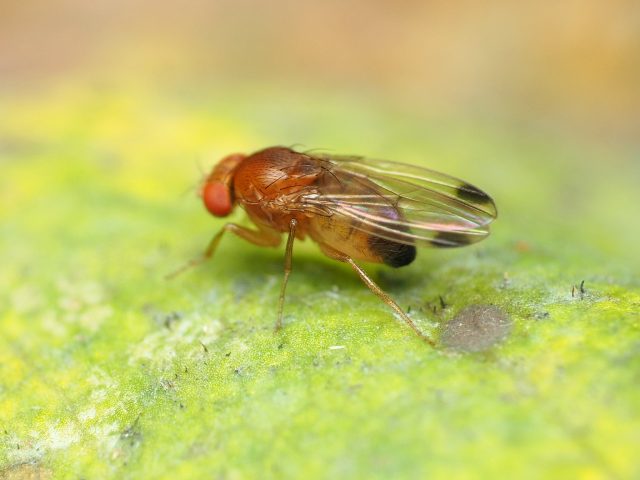
Just as English and Welsh vineyards celebrate their ripest harvest on record, a tiny fly with an outsized appetite threatens to spoil the party. The spotted wing drosophila may be reshaping how Britain makes wine.
The 2025 vintage should have been an unqualified triumph. After the driest summer on record, English and Welsh vineyards delivered what WineGB called the ripest fruit ever recorded, with yields in line with the 10-year national average and total production estimated at between 15 and 16 million bottles. Growers finished picking in early October, roughly three weeks ahead of 2024, and for once had the luxury of timing rather than weather panic driving their decisions.
But beneath the jubilation runs a thread of concern about an insect barely three millimetres long. Spotted wing drosophila, or SWD, has quietly established itself across England and Wales, and the industry is beginning to reckon with what that means for vineyards that were, until recently, relatively unbothered by such pests.
Matt Strugnell, chair of WineGB’s viticulture group and founder of Visit Strugnell Viticulture, says the industry needs to keep perspective on sour rot while recognising what makes SWD different.
“It is important to note that SWD isn’t the only cause of Sour Rot,” he tells db. “Drosophila melanogasta (common vinegar fly) also causes sour rot. The difference is the ability of SWD to create its own entry point into the berry.”
That detail is doing a lot of work. SWD does not just take advantage of damaged fruit; it can start the damage. Strugnell says 2017 was the worst outbreak he is aware of, mostly contained to Kent and Sussex, with verbal reports of it being seen further west since 2018.
“Growers who say ‘we don’t have SWD’ are often actually saying we don’t monitor systematically” – Rob Poyser
Vinescapes, a vineyard and winery consultancy and WineGB patron, says SWD is now part of the landscape.
“SWD is now well established throughout England and Wales,” Rob Poyser, viticulturist at Vinescapes, tells db. “The industry view has quietly shifted from ‘is SWD present’ to ‘when and where will pressure peak this year?’”
Poyser says SWD is assumed to be commonplace across most English wine regions, even where growers do not record visible damage each year. With host plants ranging from wild fruits to orchards and soft fruit plantations, he believes the pest is here to stay. Pressure varies seasonally, with significant outbreaks mostly prevalent in warmer, more humid seasons.
“What’s uneven is impact, not presence,” he says.
The pattern differs by site and style. Poyser says early harvest sparkling sites often see SWD activity but limited economic damage because fruit is picked before, or just as, populations peak. Later-ripening still wine sites, especially those for Pinot Noir, face a more consistent risk.
SWD as a rot trigger
SWD is increasingly viewed as a quality problem as much as a yield problem.
“Importantly, SWD is increasingly seen as a secondary enabler of rot rather than a standalone yield pest,” says Poyser. “Even low infestations can accelerate sour rot and botrytis, as well as impact wine quality, close to harvest.”
That framing matters because it changes the response. This is not always about heavy infestation. It can be about a small amount of fruit damage at exactly the wrong time.
Poyser also challenges the idea that some vineyards simply do not have SWD.
“Growers who say, ‘we don’t have SWD’, are often actually saying ‘We don’t monitor systematically’, or ‘we haven’t linked late season disease issues back to SWD yet’,” he says. He believes the UK consensus is less that SWD is a spreading risk and more that “we’re still under detecting it’s value”.
Climate patterns are lining up with SWD
Poyser says SWD risk is linked to climate conditions but not in the simplistic sense of heat alone.
“UK summers aren’t warm enough to suppress SWD but are increasingly stable enough to allow multi-generation build up,” he says. “The real driver is extended autumn and winter viability.”
He points to longer, milder Septembers, where SWD populations can peak when grapes are most vulnerable. Milder winters can also bring earlier spring activity, meaning populations build in surrounding habitats such as hedgerows and woodland edges before vineyards become attractive.
Dense canopies and humid seasons can also delay detection. Poyser says growers should watch for cool, humid refuges that help adults survive and prioritise airflow and sunlight through early canopy management. He adds that SWD risk may be a “phenology mismatch problem”, with grape ripening drifting into conditions that suit SWD better.
Producers on the lookout
At Black Chalk in Hampshire, vineyard manager Gwil Cooper describes close monitoring as routine as harvest approaches.
“In 2025, we monitored the SWD traps daily in the run-up to harvest,” he tells db, adding that he watched the hedgerows of Rivers block particularly closely due to the opportunities for SWD to lay eggs in a variety of hosts.
Partner Content


“This year there wasn’t a significant population to take action,” he says. “2023 was notably worse than other years.”
Cooper says he has noticed SWD more in the last five years in Sussex, Kent and Hampshire and sees “for sure an upward trend, especially as temperatures are rising.”
Black Chalk monitors traps across all blocks and keeps the canopy as open as possible. Cooper says insecticide is available if necessary but calls it “a last resort as we love all the other insects in our vineyards”.
Langham: a “perfect storm” in 2023 and a spike in 2025
Langham Wine Estate vineyard manager Becky Bowyer says SWD first appeared on site in 2023.
“It was, in hindsight, the perfect storm: high crop load, high humidity and a late harvest date,” she tells db. Bowyer says the team noticed SWD too late in Pinot Noir and Pinot Meunier and suspected increased botrytis pressure was a primary cause.
In 2024, Langham began trapping and monitoring weekly. Numbers were not notable. In 2025, Bowyer says there was “a sharp increase at the beginning of August” that could have threatened the crop if it had continued.
“I can only suggest that the sudden high winds and rapidly cooling temperature was why we did not see numbers increase further,” she says.
Bowyer calls the annual threat “very concerning” and says sour rot is the biggest quality risk. She lists best practice as open canopy design, low weeds to encourage airflow, removal of damaged or diseased bunches and insecticide as a last resort.
Picking early is not always an option.
“Being so far West, in anything but an exceptionally warm year, we require the full season to ripen our grapes,” she says.
She also expects tougher choices ahead. Infected fruit, she says, will ultimately have to be dropped, removed from site and destroyed to prevent sour rot and further infection. She adds that the lack of specialised predators in the UK is frustrating and dead-end hosts offer hope but are “in no way a sure-fire fix”.
At Wiston Estate, brand director Kirsty Goring says SWD has only been an issue in the last three years, with numbers increasing year on year. The team monitors closely using sticky traps and manages the canopy.
SWD has influenced picking decisions in a very specific way. Goring says it has affected the timing of picking Dijon clones of Pinot Noir, where the flies first seem to land.
This year, the team spotted SWD on Dijon Pinot Noir in the first 26 rows of the vineyard. Those rows were picked earlier than they might have been to stop it spreading to the rest of the vineyard. That earlier pick closed off a potential still wine option.
“If we had been able to leave those grapes on for longer, we might have been able to make a still Pinot, which we have done in exceptionally warm years,” she tells db. “We weren’t able to do that this year as a result of this timing decision.”
Netting, biology and what comes next
Physical exclusion is being explored in limited form. Poyser says NIAB has recently conducted a netting survey and the results show netting as a potential mitigation strategy. He calls netting viable for high-value parcels but impractical for entire vineyards, with some growers trialling partial exclusion, such as netting vineyard edges to a pre-determined height or focusing on late harvest blocks.
“Probably realistic to say biological controls won’t be a silver bullet in vineyards,” he says, though reducing populations may be achievable through habitat manipulation and encouraging predators. He also flags behavioural disruption approaches such as repellents, attractants, sterile insect techniques and dead-end hosts, but says more research is needed.
A growing sector, with a growing list of risks
SWD is arriving as English and Welsh wine continues to expand. WineGB says the 2025 vintage combined ripe fruit, strong volumes and a sense of long-earned confidence across the sector, with total production estimated at between 15 and 16 million bottles.
WineGB also reports export volumes are up 35% and overall sector growth has risen from 4% to 9% over the past five years. Government records cited by Wines of Great Britain show more than 1,000 UK vineyards for the first time, total vineyard area up 123% over the past decade and sales of English and Welsh wine rising to 8.8 million bottles last year.
Yet that success makes the industry more vulnerable to disruption. As climate conditions shift in ways that favour SWD, and as more vineyards plant later-ripening varieties for still wine production, the mismatch between harvest timing and pest pressure may become more acute.
The response so far has been measured and evidence-based, which seems appropriate for an industry that has learned patience from decades of marginal vintages and gradual improvement. SWD is not an existential threat, but it is a persistent one, and how growers adapt over the next few years will likely shape vineyard practice for a generation.
Related news
English wineries battle ‘severe’ frost
Silverhand champions 'more accessible, more local, more sustainable' English wines


