



Tiny Wine prepares crowdfund as fine wine format divides opinion
The London startup converting premium bottles into tube-sized portions plans a public raise following Christmas trading success and corporate orders. Tiny Wine co-founder Harry Crowther sat down with James Bayley to discuss the future of the business and fine wine.

Harry Crowther spent years watching wine samples pile up at his door. As head wine buyer for an online subscription business, he received two dozen bottles weekly, most destined for the bin. The waste troubled him, and so too the prices, rendering fine wine a spectator sport for most.
Three years ago, technology finally caught up with his ambition. At the London Wine Fair, drinks PR stalwart Ali Mann introduced Crowther to Coravin’s latest machine, designed to transfer wine from bottles into tubes under preservation conditions. The encounter reignited a pre-Covid project he had shelved with business partner Rob when minimum order quantities and economies of scale proved prohibitive.
“I got into the wine trade principally because, like a lot of us, I can’t afford to drink the good stuff,” Crowther told the drinks business. “So if you work with it, you can sort of get access to it. And I just really wanted to share that, to give consumers access, and to make them privy to what I’ve been lucky enough to work around for the last decade and a half.”
Coravin partnership
Crowther said he would not have launched without the backing of a reputable technology partner, given the venture’s aim to alter consumer habits. Coravin’s patent protection provided credibility in a market where producers questioned whether wine transferred to different formats would taste correct. Professional concerns are one thing, although Crowther hinted at a more elitist kind of opposition, the kind that would prefer the mystique of fine wine to remain exclusive and available to only a select few.
“If everyone was saying it was amazing, it wouldn’t be as much of a talking point,” Crowther said of the scepticism he encounters. “Those are the sort of people I’ve worked around and been around, and they’re not the future of the wine trade, in my opinion.”
The Tiny Wine format allows customers to purchase 100ml tubes instead of a pricey bottle, with each tube representing roughly a glass. A customer who spent £96 on six tubes this week would have paid approximately £1,000 for the equivalent tasting experience buying full bottles, according to Crowther’s calculations.
Business splits revenue between trade and consumer channels
Tiny Wine generates about half its revenue from direct-to-consumer sales and half from business-to-business channels. The company works with traditional wholesalers and distributors to reduce their sample footprint, supporting marketing calendars such as 31 Days of German Wine. Wine marketing bodies in Austria and Georgia use the format to tell their producers’ stories in the UK market.
Crowther sees the tubes primarily as risk reduction rather than retail revolution. He has no interest in supermarket distribution and envisions conversations with luxury retailers and department stores focused on try-before-you-buy propositions.
“Buying a bottle of wine is a huge risk, buying an expensive one especially, and unless there’s a fault with it, it’s very hard to return it,” he said. The company plans to expand its whole-bottle offering this year, creating a natural pathway to reconnect with customers who sampled wines in tube format.
Corporate gifting
Orders during the Christmas period demonstrated that 75% of corporate gift purchases serve to close deals rather than mark seasonal occasions, Crowther learned through conversations with a corporate gifting platform the company plans to join.
The business closed a small private raise towards the end of last year, funding Christmas operations and an advertising campaign that delivered encouraging customer acquisition numbers and average spend figures. In the coming weeks, Tiny Wine will launch a public crowdfunding to raise capital for stock investment, marketing and subscription model development.
Partner Content




“Strategy-wise, beyond this year, it’s really just about looking past next month and trying to get more cash in the bank,” Crowther said.
Changing consumer behaviour
Resistance to the concept often manifests in social media comments claiming the format represents poor value. Critics point out that seven tubes (the equivalent of one bottle) cost more than a single bottle. Crowther counters that the comparison misses the point, likening objections to restaurant customers complaining that five glasses equal a bottle’s worth.
“We’re offering you access to that wine for five times less upfront,” he said. “It’s exactly the same as going to a restaurant. You don’t get people saying, ‘If I buy five glasses, that’s a whole bottle!’ It’s the exact same concept.”
The analogy extends to luxury goods more broadly, just as supercar enthusiasts might rent a Ferrari for a day rather than purchase it outright, wine lovers can access premium bottles otherwise beyond reach. The model addresses a market shift Michael Saunders, CEO of Coterie Holdings, identified in a recent interview with the drinks business. He playfully compared current pricing to that of the 1981 vintage campaign, when first growths sold for £120 per case and Le Pin cost £90. In today’s money, that case of 1980s Le Pin would sit comfortably within bottomless brunch territory in east London.
“To get access to drink this really top-end stuff is really, really, really tough,” Saunders said of the contemporary fine wine market.
Tackling duty and en primeur
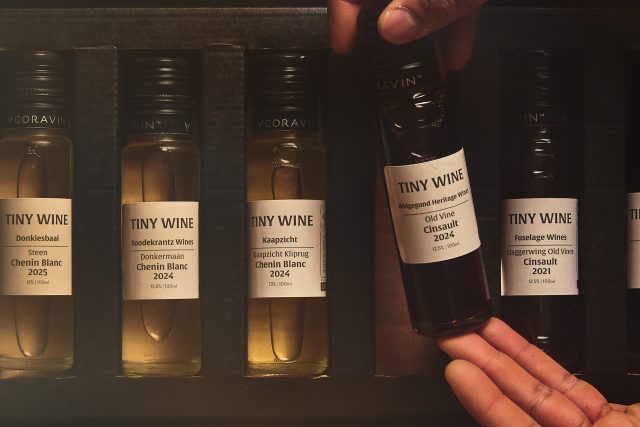
The business deliberately operates at quality levels where duty and tax represent manageable percentages of overall value. Crowther made that floor his baseline quality commitment, insulating the company from the duty increases hampering much of the trade.
Testing for en primeur applications is scheduled with Albert Bichot for early next year. While the subscription model focuses on wines drinking well now, producers interested in reducing sample footprints during futures campaigns could find the format useful on a business-to-business basis.
Crowther remains philosophical about polarisation; he believes good ideas should divide opinion and views criticism as evidence of creating something worthy of debate. The upside comes in the form of genuine advocates who understand the proposition.
“That’s when I know I’ve done a good job and created a brand,” he said, “when people are genuinely supportive and believe in what we’re doing.”
Perhaps most importantly, Crowther is making fine wine more accessible for the masses, which can only be a good thing for the long-term health of the trade. And if he upsets a few snobs in the process, well, that can’t be a bad thing either.
Related news
Fine wine market stabilised during H1 as US buyers 're-engaged'
H1 sees disciplined buyers, selective demand and broadly stable prices for fine wine
The importance of fine wine data: 'each bad decision has a cost'


