



Beer Hour: Sam Calagione
Dogfish Head Brewery has slaked the thirst of hop chasers in Delaware for the past 30 years. Jessica Mason speaks to its founder Sam Calagione to find out how beer began to “colour outside the lines”.
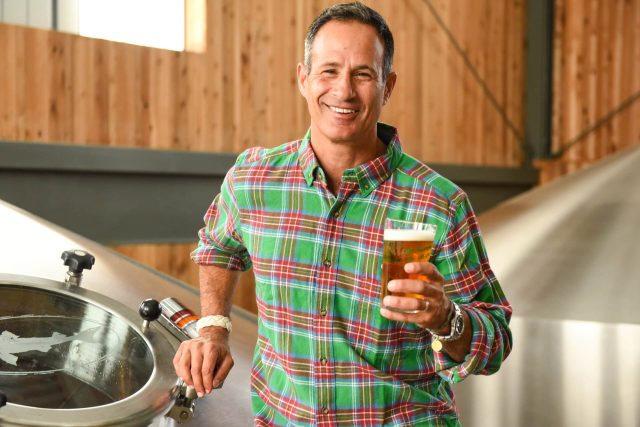
Dogfish Head, which merged with Boston Beer in 2019, was founded in Rehoboth Beach, Delaware in 1995. It was the year that Fugazi played in Newark, Sony launched the Playstation and Bill Watterson completed his final Calvin & Hobbes comic strip. Grunge was big and something called craft beer was burgeoning. Perhaps nobody knew it at the time, but it was an era when everyone was searching for something. Sitcoms like Friends and films like Toy Story grew in popularity and yet reassurance came not from celebrating similarities, but idiosyncrasies. It was the age of misfits.
This is where Dogfish Head entered – satisfying a need for the offbeat. Its flagship 60 minute IPA gave us a slap of resinously skunky pine, grapefruit and citrus. Named so for being continuously-hopped for an hour during the brewing process. It woke us all up from a light nap and shouted: “Let’s go!” Beer became exciting again and it commanded our attention.
The foodie scene in the US had already gone from strength-to-strength and had cultivated in people a renewed sense of discovery. Throughout the eighties and early nineties convenience had reigned, but by the late nineties a longing for flavour emerged – sometimes with a wry sideways look at the possibilities and often with a genuine back story with provenance and a dose of transparency from businesses keen to say “this is who we are”.. This, along with the tropical notes of hops grown in the sunshine,saw Dogfish Head take our tastebuds on a tour.
Exploring flavour
“I started it because I wanted to build a brewery that treated beer like food – using culinary ingredients and creativity to make beers that were truly distinctive,” says Calagione, remembering it all fondly. Reminiscing, he points out that “from day one” Dogfish Head has really “been about exploring flavour and doing things a little differently”.
Here, Calagione gives a nod to the brewing prowess of those who were with Dogfish Head from those early days for long enough to play a central role in its development, its style and its reputation. Namely, Bryan Selders led the scope of the brewing and while he fine-tuned those beer recipes, people just kept coming back for more.
“For us, it’s always been about flavour-forward beers with a culinary point of view,” says Calagione, wistfully. “Hoppy beers are a big part of our DNA, and we’ve long loved styles that invite experimentation – like pale ales, IPAs, and beers where fruit, spices, or unexpected, all-natural culinary ingredients help tell a story,” he explains: “If it’s off-centred, but delicious, it fits.”
Never chase sameness
By his own confession, Calagione admits that Dogfish Head has “always believed in off-centred ales for off-centred people”. But why lean in towards taking a non-populist stance, you might ask. He says: “It’s a reminder to colour outside the lines, stay curious, and not chase sameness.”
There is also a little method to the madness, because the beer industry keeps adapting, beer fans become fickle or fall away, the sector is facing new challenges each week and there is never time to stand still.
Calagione believes that “the category is more competitive than ever” but still points out that “consumer habits continue to evolve”.
How does one brewery satisfy everyone? It can’t. But it can try. Giving people some agency and a way to see a broad line-up and let them make their own decisions based on their current preferences actually helps the brewery stay informed.
Give people choices
“People want quality, variety, and experiences, often with more moderation and more choice,” Calagione observes and says he reckons that Dogfish Head has tried to do that without losing sight of what made it a success in the first place – over-delivering.
He notes that this isn’t just for a local audience though. Indeed, making a name as a destination is one thing, but also being able to be placed on a global map for recognition is also the halo-effect of good word-of-mouth.
Partner Content


“We’re navigating that by staying focused on what we do best: innovation, hospitality, and making beers and beyond that feel worth seeking out, whether that’s at our locations or out in the world,” says Calagione.
How does the brewery keep its reputation for innovation fresh and alive? Even if tastebuds grow tired of the latest showstopper, how might a brewery such as Calagione’s retain a pulse?
Calagione’s view is simple: “We stay relevant by continuing to experiment, but we stay authentic by keeping our ‘why’ the same, exploring goodness through creativity, craftsmanship, and community. Not every idea is meant to be a national volume play, but every idea keeps our team sharp and our culture alive.”
What remains important to Calagione, personally, is the calibre of each beer, certainly. But also truly valuing the ecosystem of support that has been there all along. That, and remembering to stay alert and ready to adapt.
Knowing what matters
“Quality matters, consistency matters, and differentiation matters,” he says.“But the biggest lesson is: take care of your people and your community, and build something you can sustain. Be flexible, keep learning, and don’t be afraid to adjust when the world changes”
Pressures have been felt across all sides of the US beer scene from the biggest players right through to the smallest of microbrewery businesses. The geopolitical climate has affected trade, pricing, ingredients, costs and sales.
But not just those wider elements having direct impact, the fact is that morale has also taken a beating and this is why, as Calagione suggests, people really benefit from gathering together, socialising and sharing parts of their day with others. Beer unites people.
“There’s a lot of noise and uncertainty out there,” says Calagione and admits that this means that “people are feeling stretched, divided, and in many cases, disconnected. What I’m hopeful about is that the best parts of local communities are still very real, and you can feel that when people gather in person at a brewery, a concert, a community event, or around a table”.
Beer brings people together
Calagione goes further to remind that “beer has brought people together for centuries” and insists “that’s more important now than ever”.
He explains: “In a time when loneliness is a real concern, places like brewpubs and taprooms can be modern third places, a welcoming spot where strangers become neighbours. At its best, beer isn’t just a drink. It’s a reason to connect, share stories, and feel a little more human together.”
There is, after all, only one goal that is underpinned by three objectives for Dogfish Head and it has something to do with integrity and never losing sight of the things that matter.
Calagione believes the three points are quite simple: “Make things with intention, make them well, and make them in a way that feels true to who you are.”
Related news


