



When ‘green’ means drinking differently: Laura Catena on Domaine EdeM
As the wine industry wrestles with what sustainability really means, Dr Laura Catena is reframing the debate — not around carbon alone, but around moderation. Her science-led Domaine EdeM project positions low- and no-alcohol wines as a vital part of a more sustainable drinking culture.
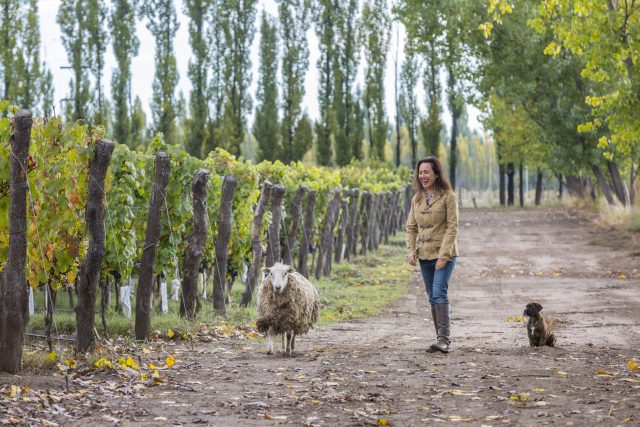
When the wine trade talks about sustainability, the conversation usually turns to lighter bottles, water use, carbon footprints and cover crops. For Dr Laura Catena, however, sustainability starts somewhere else entirely: with how (and how much) we drink.
Catena wears more hats than most in the global wine industry. She is managing director of Bodega Catena Zapata in Argentina, and founder and board director of the Catena Institute of Wine. Alongside her wine career, she practised emergency medicine in San Francisco for 28 years, is the author of three books and numerous scientific and industry articles, and represents the fourth generation of her family to make wine in Mendoza, having joined her father Nicolás Catena Zapata at the winery in 1995.
Going into 2026, Catena is launching Domaine EdeM, a science-led, low- and no-alcohol project developed by the Catena Institute of Wine. Rather than positioning the initiative primarily as an environmental play, Catena frames it as what she calls “a sustainability initiative for people”.
“Its all about creating a sustainable lifestyle,” she explains. “We need people to moderate alcohol consumption without just stopping drinking.”
That distinction matters. Catena, a medical doctor as well as a fourth-generation Argentine vintner, is careful to separate moderation from abstinence. While she is clear that there are health reasons that mean some people should not drink at all, she believes the wine sector has a responsibility to offer solutions for those who want to drink less, not simply to tell them to stop.
“The biggest threat to alcohol, [as opposed to health warnings] is that people are staying at home on their phones instead of going out,” she says. “Wine is about culture, bringing people together, the rituals. We have to protect that.”
A project born in the pandemic
The Domaine EdeM project began during the pandemic, a period Catena describes as a turning point for global drinking habits. Lockdowns, stress and isolation drove many people to drink more at home, followed by a sharp correction as health messaging around alcohol intensified.
“What we’re seeing is not just people drinking less,” she says. “It’s that moderate drinkers are often the ones quitting altogether, while people who drink too much are still drinking too much. As an industry, we need to provide solutions.”
Those solutions, she argues, lie in giving consumers more choice across an occasion — an approach her son, Dante McDermott Catena, describes as “zebra striping”: alternating no-, low- and full-strength wines during a meal or evening.
“It’s about offering people solutions,” Catena says. “Instead of one glass of 14% wine, maybe you have two or three glasses at a lower ABV. People don’t want to stop after one glass — they want the experience.”
Science-led, not trend-led
Domaine EdeM is explicitly positioned as a research-driven project rather than a reactive trend play. The Catena Institute asked a simple but demanding question: could it create no- and low-alcohol wines that were genuinely as delicious as wine?
“People like flavour,” Catena says bluntly. “They’re not going to replace something delicious with something that isn’t.”
The result is a range built around high-quality raw materials and minimal intervention. All products use vinifera grape must, verjus and botanicals, with no added sugar and no artificial flavourings. Sulphites are used for stability, but otherwise the ingredients are entirely natural.
Partner Content



“The big difference is that we start with the highest quality ingredients,” Catena explains. “Early on, some people thought it didn’t matter if the base wine was good, because you were going to de-alcoholise it anyway. That turned out not to be true at all.”
Spain, sustainability and carbon neutrality
One of the more contentious aspects of no-alcohol wine is dealcoholisation, which can be energy-intensive. Catena is upfront about the trade-offs, but says Domaine EdeM’s production choices were made deliberately.
The flagship N.0 Rosæ (0%) is produced in the Toledo region in Spain, where the winery operates on solar power and is carbon neutral. Spain was also chosen because Argentina does not yet have access to the most advanced dealcoholisation technology.
“We know people will question the sustainability of dealcoholisation,” she says. “That’s fair. But we mitigate that by working with a carbon-neutral facility, and by the impact this can have on helping people drink in moderation.”
The wines themselves are quietly ambitious. N.0 Rosæ, made from Airén grapes and finished with a natural rose-petal infusion, contains just 25 calories per 148ml serving — a figure Catena admits she initially questioned herself. Blonde (0%) and Brunette (0.4%) are sparkling apéritifs built around Chardonnay must, verjus and botanicals, while Uco Stones (7%) blends high-quality mountain Chardonnay with must and verjus to create a genuinely lower-alcohol wine, rather than a diluted one.
Green credentials still matter
While Domaine EdeM reframes sustainability around consumption, Catena is keen to stress that environmental considerations remain central to everything the Catena group does.
“When sustainability started, it felt like a pressure,” she admits. “People still liked heavy bottles, and it was hard to convince them that lighter weight didn’t mean poorer quality.”
Today, she says, that mindset has shifted. Bottle weights across the portfolio have already been reduced by more than 40%, with ongoing work alongside glass manufacturers to go further. Water use is another major focus, with current research indicating potential savings of up to 30% through new vineyard trials.
“We don’t do any projects without thinking about sustainability,” Catena says. “It’s in our DNA.”
Redefining what ‘green’ looks like
For Catena, the idea that sustainability should only be measured in carbon metrics is too narrow. Protecting consumers’ long-term relationship with wine, she argues, is just as critical to the future of the category.
“To me, it’s just as important to provide a healthy product as it is to save water or lower bottle weights,” she says. “We need to take care of our customers. If we do that, we’re being sustainable.”
In a wine industry often characterised by “doom and gloom”, Domaine EdeM is Catena’s attempt to change the narrative — not by retreating, but by adapting.
“This isn’t about fear,” she says. “It’s about solutions.”
Related news
AB InBev opens wastewater treatment facility
'Sustainability must be grounded in real action': Banfi CEO on portfolio strategy


