



On the fifth day of Christmas…
On the fifth day of Christmas – when my true love thought her relentless search for rare and special bottles was over, we have another mixed case – and possibly the most difficult thus far to assemble – of monovarietal rarities.
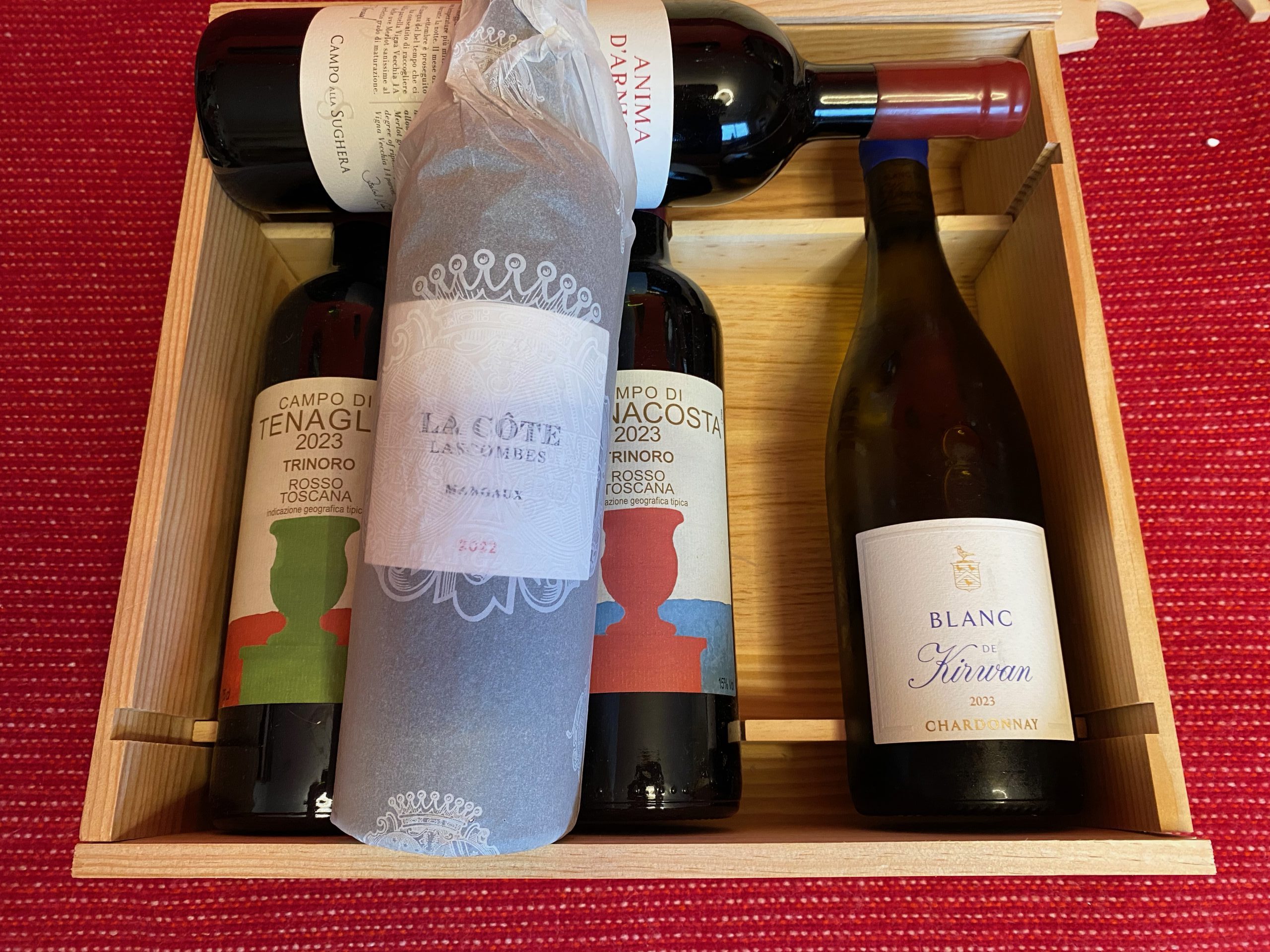
The concept: Here the idea is simple: to assemble, in a single case, a bunch of truly exceptional and unique wines. They come in two categories. First we have a group of single varietal and single vineyard expressions of a grape variety not at all associated with the region from which the wine comes. We have Chardonnay from Saint-Émilion and Margaux, Cabernet Franc from Tuscany, Pinot Noir and Petit Corbu from Madiran and Syrah and Petit Manseng from Tuscany. In the second group we have rare monovarietal and, again single-vineyard, expressions of varietals associated with the region but invariably as minority elements in a blend – monocépage Merlot from Moulis and Margaux and Cabernet Franc from St Emilion.
A Christmas quiz: Can you match the property or property to the varietal or varietals (answers in the tasting notes below)?
| Varietal | Property |
| Syrah | Château Montus |
| Cabernet Franc | Château Kirwan |
| Merlot | Château La Gaffelière |
| Petit Manseng | Fattoria Le Pupille |
| Pinot Noir | Tenuta di Trinoro |
| Chardonnay | Château Lascombes |
| Château Branas-Grand-Poujeaux | |
| Campo alla Sughera | |
Yours for: Not for the first time, we’re at risk of testing the patience and the dedication (to say nothing of the elasticity of the purse strings) of your true love. The search for these wines is likely to prove time-consuming and some of them don’t come cheap. But I’m sure that you’d settle for a mixed case under the tree that contained any of these items. I know I would! This is a diverse array of wines at quite an array of price points. Assuming your true love has not recently won the lottery, she or he might well need to be selective, bearing in mind that a case each of Montus’ Pinot Noir and blanc sec come in at less than the price of a single bottle of Marpaout. On my estimation, the entire case (of 12 bottles) would set your true love back a rather jaw-dropping £2750.
Tasting notes:
G Chardonnay de La Gaffelière Episode III MV (Vin de France; 100% Chardonnay; from a single parcel, ‘La Palat’, of 0.5 hectares below Ausone on a cool argilo-calcaire terroir despite its southern exposition, producing around 500 bottles; 60% from the 2023 vintage, 30% from the 2022 vintage and the remaining 10% from the 2021 vintage; the 2022 and 2021 we stored after vinification in a wine globe; tasted in Paris from magnum). A magical wine. This is the third multi-vintage expression of this that I have tasted (indeed, there are only three!) and it is better than the other two, wonderful though they are too. We could easily be in a hallowed, cool, terroir in Burgundy – I think immediately of the Grand Cru Les Clos from Vincent Dauvissat – with the tension between the richness and the penetrating acidity from the limestone that suggests. Initially quite full and ample on the attack, but then the freshness that structures the wine become evident, as the citrus engages. Lime juice, lime zest, lime cordial, citron vert pressé, with a little white melon, perhaps a hint of white pear and a suggestion of candlewax. The limestone brings poise, elegance and, above all, structure to this. Very special. 96. Available directly from the property for €250 per bottle, duty and tax paid.
Chardonnay de Château Kirwan 2023 (Vin de France; 100% Chardonnay; 13.5% alcohol). The first vintage of this to be offered publicly (though I’ve tasted the 2022 and it’s also excellent). Vinified in oak and then aged in amphorae. Fabulous. Rather different from all of the other left and right-bank Chardonnays I’ve tasted. Green highlights catch the morning sunshine. There’s almost a Sauvignon Blanc-esque freshness and leafiness But there’s a Chardonnay exoticism too and the tension that comes from their co-presence. Greengage and gooseberry. A hint of passion fruit and passion flower. Green tea. A little fresh ginger. Tight and crisp and fresh and dry on the palate with a well-defined citrus core. Sapid and very refined on the lifted and long finish. Juicy. 93. Available directly from the property at €48, all taxes paid.
G Cabernet Franc de Château la Gaffelière 2022 (St Emilion; 100% Cabernet Franc; from 2 single-parcels, amounting to 1.5 hectares in total, next to Ausone and La Clotte respectively, and on terroirs, respectively, of molasse de fronsadais (essentially, blue clay) and calcaire à l’astéries; this is the first vintage; tasted in Paris from magnum; 2500 bottles and 300 magnums). A tad closed at first, reinforced by this coming from magnum, but that’s never a bad thing with Cabernet Franc, as we get to experience its opening in all its aromatic detail and glory. Slight hints of iodine and oyster shell, a florality that is at first rather bulby (though that will change) and bright, crisp, blue and purple berry fruits, maybe a hint of damson. With a little more time to open, the herbal element arrives – bay leaf and sage, wild thyme, maybe a little oregano and an increasingly cedar and graphite-inflected Cabernet Franc leafiness that becomes more and more floral. Lilacs and lilies are the last to show, with more and more graphite. In the mouth, this is lithe and svelte, fresh and pure, but substantial and with a depth and concentration rare for Cabernet Franc that comes from the sheer quality of the vintage, the parcels and also the relatively narrow frame in the mouth. When those lovely grainy tannins, so fine yet so crucial to the structure here, engage they pinch the flow of the wine across the palate releasing a second, colossal wave of fresh sapidity and the wine then builds and builds forming a wondrous fantail finish. Excellent, exquisite and glorious. All Cabernet Franc lovers (if you haven’t yet guessed, that includes me) will want to taste this. A wine I covet! 97. Available directly from the property for €250 per bottle, duty and tax paid.
Trinoro Campo di Magnacosta 2023 (IGT Toscana; 100% Cabernet Franc). A little less concentrated than the other Trinoro Cabernet Franc cuvées. At lower altitude. Delicate. Aromatic. Aerial. Blueberry and cassis. Wild garrique herbs and a little thyme. Graphite and a delicate lilac and rose petal florality. Very pure and focussed, precise. Not ample but intense and targeted towards the finish – like a spear or an arrowhead. Very long and with lots of dynamism. Staggeringly focussed. There’s just little red liquorice and salinity on the finish. 95. The no less impressive 2022 vintage is available from Petersham Cellars for £372 for a case of 6 bottles, in bond.
Partner Content
Trinoro Campo di Tenaglia 2023 (IGT Toscana; 100% Cabernet Franc). Usually the most concentrated of the Cabernet Franc cuvées. At 500m, with more direct sun-exposure and with shading in the vineyard to reduce this effect. Earthy and more serious than Magnacosta. Stonier too, with a whetstone, almost slightly flinty note. There’s more power here too. Plums and dark stone fruit accompany the plump blueberries. This has a more bulby florality. This is both more ample and actually more sinuous too, with a lovely quite generous but still taut and tense mid-palate. Cedar on the finish. Lush. Gentle tannins, very much at the front of the mouth and softer and more gracious on the finish. 97. The equally impressive 2021 vintage is available from Petersham Cellars for £354 for a case of 3 magnums, duty and VAT paid.
Anima di Arnione (Campo alla Sughera) 2020 (Bolgheri Superiore DOC; 100% Cabernet Franc; just 1000 bottles produced, individually numbered and in a presentation carton). Just the second vintage of this special edition single varietal micro-cuvée of Campo alla Sughera, here paying tribute to the quality of the estate’s Cabernet Franc. I love this, as I so often do the best Cabernet Franc from Tuscany. Aged for just 6 months in barrel before 12 months in amphora. As that suggests, this is a wine of purity and precision – all about the freshness of the dark berry fruits, with that lovely characteristically floral and leafy Cabernet Franc signature. Saline in its minerality with a little of that redolently Tuscan balsamic note and a scratch of freshly grated liquorice root. There’s density and concentration too, but this is, above all, stylish, svelte and beguilingly beautiful. 95. Available directly from the property.
La Côte Lascombes 2022 (Margaux; 100% Merlot sourced from the 4.5 hectares and 4 contiguous parcels that together comprise the vineyard of La Côte; a final yield of 36 hl/ha; 14.5% alcohol; tasted from magnum in Paris with Axel Heinz; around 20,000 bottles were produced). The infusion vinification is very important here. A staggeringly elegant and refined wine with extraordinary levity and freshness, even in such a hot and dry vintage. This is plush, svelte, gracious and silkily-textured – and rather more ample in the mouth than Lascombes itself. The fruit is dark – sloes and damsons, brambles and mulberries – and there’s a scratch of black pepper and twist of graphite from the sharpener’s blade. The quality and character of the tannins is remarkable and a real statement of both the direction of travel at Lascombes and, of course, the sheer quality and singularity of the terroir from which this is sourced. You would not necessarily pick this as Margaux not least because of the evident ‘calcaire’ touch of the tannins. That said, there is certainly a trace of that subtle bulby florality of the grand vin if much less of its rose petal quality. Texturally this feels more like a St Emilion plateau Merlot in a way, an impression only accentuated by tasting this from magnum – a format in which the tannins seem to form more of an integrated mesh – here of the finest woven silk. Subtly understated, sapid and chalky on the finish, it will be fascinating to see this evolve. 96. Largely sold out in the UK, this is available from Mövenpick Wein in Switzerland for around £150 per bottle, tax and duty paid.
Marpaout 2022 (Moulis-en-Médoc; 100% Merlot; from a final yield of 41 hl/ha; pH 3.66; 14.5% alcohol; a total production of around 900 bottles and 50 magnums). Tasted twice, first from the amphora prior to bottling and then from bottle at Vinexpo with Aryen Pen. Sourced from the highest Merlot parcel in the appellation and the highest point on Terrace 3, this comes from arguably the best Merlot terroir in the Médoc. Ethereal. Plump. Plush. Curvaceous. And ultra-refined. There is no suggestion of oak, but you’d notice if it weren’t there. It has that gorgeously sumptuous lushness that comes only from top Merlot. Graphite, with the slightest hint of cedar in the aromatics. Damson. Mulberry. Blue fruits. Fruits of the forest. A touch of wild sage. Thyme too and maybe a sprig of moorland heather. There’s a certain Médocain austerity that I really like about this – it’s much more Le Pin than Petrus in that respect. Sapid and succulent with signature freshness and lift. Gently spicy, with a little nutmeg and cinnamon, but all in moderation and balance. When decanted for three hours, there is even more freshness and more florality too – blood orange, orange blossom and early spring blooms. I find this very composed and gentle on the entry, but then increasingly sinuous, fluid and dynamic in the mid-palate. Ultra-fine grained tannins bring great precision and great clarity. Delicate yet powerful as the finest Merlot should be. So long too on the aerial, floaty, seemingly eternal and gently tapering finish. Beguilingly fresh and exquisitely balanced. 98. Available in the UK from Hedonism Wines for £1560 per bottle, tax and duty paid.
Château Montus Pinot Noir 2021 (Vin de France; 100% Pinot Noir; planted on quite steep sloping parcels with a cooler Eastern exposure on a terroir of galets and clay; 70% new oak for a year and than further aging in 2nd or 3rd year oak barrels for a further year; around 2000 bottles produced). Richer and fuller than the Bouscassé Pinot. Rather more ample and with greater viscosity and natural density too. But, once again, this never lacks in freshness or vivacity. Rich and layered with the concentration offering more resistance to the desire of the acidity to fold the wine in on itself and impart a certain fluidity. This is tense as a consequence. Layered, with the tannins entering between the layers. Succulent. Long and refined with a finely focussed finish. If this were Burgundian, we’d be in Pommard! 93. The 2019 vintage is currently available from the Wine Society for £47, tax and duty paid.
Le Pupille 2020 (IGT Toscana; 100% Syrah; aged in French oak and terracotta; 1344 bottles; 15.5% alcohol). Lovely quality, immediately evident. Slow to open. All in grace. Spherical at the core. Delicate yet expressive from the get go, but as it opens it imparts greater and greater grace. Less intense in its pepperiness than some of Fattoria Le Pupille’s other wines, but with a subtle Szechuan kick. The oak has been delicately managed. Exquisite tannins. Spherical indeed (just as you imagine it from the aromatics). Dense and compact at the core, but still crystalline. More Côte Rotie than southern Rhone in the style of its Syrah. 96+. Available from the property and from a variety of Italian cavistes for around £85 per bottle, tax and duty paid.
Château Montus blanc sec 2020 (Pacherenc du Vic-Bilh; 100% Petit Corbu planted on a terraced vineyards at 250 metres with a south-eastern exposition on a terroir of rolled pebbles over fine clay; fermented in 228 litre and 600 litre French oak barrels on the fine lees for 30 days before 2 years of aging in oak, the first year in barrel, the second in larger format foudres with much less protection of the wine early on to give it the capacity to deal with oxidation later on). Tasted after Bouscassé’s Jardins Philosophiques, this is more classical and more serious, with a certain aromatic richness, swagger and opulence before the freshness arrives on the palate. Toasted almonds. A delicate florality and the sense of lift that implies. Candlewax. Peach. White pear. A little apricot. Confit fruits. Mirabelle. Wonderfully fresh and vivid in the mouth, with a dynamism that comes from the naturally low pH that really takes the rich, full and viscous fruit in charge immediately. But this is also gracious, glassy and crystalline in the mid-palate, an impression almost increased by the swirls and eddies of freshness – it’s like one can see the clarity of the stream better for the ripples and bubbles and currents in the water. Vibrant and vivid. Racy and energetic. Very youthful and with considerable aging potential. The élévage on the lees is very important here, imparting richness and depth and giving this a certain viscosity but at no expense in terms of clarity and precision – which speaks again both the quality of the vinification and the vintage. Probably the greatest vintage of this – though watch out too for the similar 2025 (tasted just after vinification from barrel). 94. Available from Vinatis UK for £36.50 per bottle, tax and duty paid.
PIEMME 2022 (Costa Toscana IGT; 100% Petit Manseng; 15% alcohol; no fired oak, steam formed. No toast). Made since 2014, buommercialised only more recently. Rich, concentrated. That touch of rose petal and pot pourri that is very Petit Manseng (or ‘PIEMME’ as it is pronounced, letter by letter, in Italian). Gooseberry. Mirabelle. This is super crisp on the palate and ever more focussed and linear as it gets towards the finish. Sapid and salivatingly scrunchy on the finish. Viscerally refreshing yet at the same time powerful, deep, rich and concentrated. 93. The 2021 and 2020 vintages are available from Hedonism Wines for £95 per bottle, tax and duty paid.
Related news
Why electrolytes have become wine's newest additive
Bordeaux marks milestones with commemorative bottles
#WeekInPictures: the Queen visits Plumpton as craft beer and rum move into new territory


