



Are we about to hear more about Surrey wine?
A group of producers in the Surrey hills are on mission to boost wine tourism to the area and leverage its ease of access to the capital, reports Tom Bruce-Gardyne.
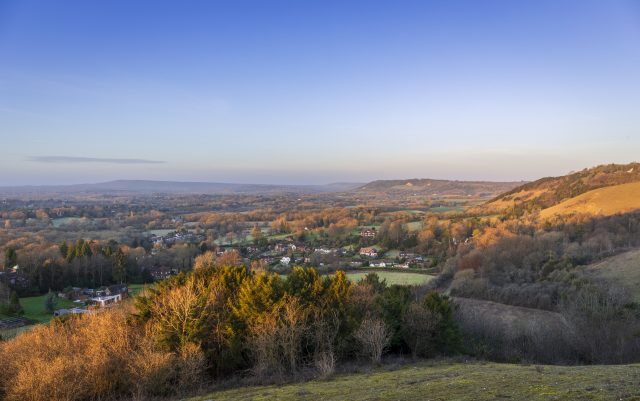
“I think any other category of wine where sales went up 3% last year would be doing back-flips in celebration,” says Mike Wagstaff about the performance of English wine. “I think we’re doing well in a tough environment.”
In 2010 he and his wife took over the Greyfriars Vineyards in the Surrey hills, west of Guildford, and built a winery there.
“In the last three years, we’ve had the biggest harvest and the smallest, the hottest and the coldest, and the earliest and the latest,” he says about our increasingly volatile climate. “But, in terms of fruit quality, 2025 is no doubt the best year we’ve ever had.”
Wood pigeon woes
Albury, an organic vineyard the other side of Guildford, had “some of the ripest fruit we’ve ever seen, and for our Seyval, we couldn’t have asked for more,” says general manager, Lucy Letley. The vineyard has been fitted with a Lazer system to deter birds. Last year, thanks to wood pigeons “we lost three tonnes in 48 hours, two days before the harvest,” she says.
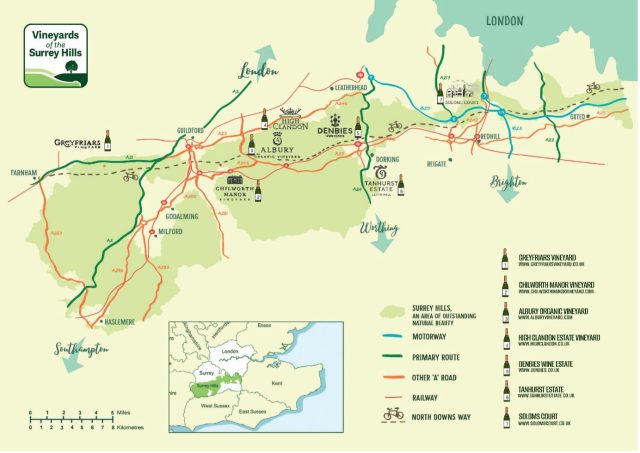
After Covid, the two joined forces with five other wineries in the area, to set up a new association – the Vineyards of the Surrey Hills. “Really, what we’re trying to do is put Surrey on the map as a wine region,” says Letley. “To date, most of the focus has been on Sussex, the ‘wine garden of Kent’ and the vineyards of Hampshire.”
Partner Content


“It’s to highlight what we’ve got here in the Surrey hills – beautiful vineyards that are so easy to get to from London,” adds Wagstaff, the association’s current chair. It is a diverse group of growers and grower-producers ranging from Denbies, which now has 265 acres under vine, to High Clandon with just one acre.
“Diversity is always a strength in my view, and I think we’re all quite unique in what we do,” says Nik Badain of Chilworth Manor, another member of the group. Like the others she is keen to encourage wine tourism to the region and, says: “We want to do more direct sales, and get the London market to come to us.”
Cellar door sales
So does Denbies which celebrates its 40th anniversary next year. “Direct sales are supremely important to us,” says Jeannette Simpson, the COO. “We have more than 400,000 visitors a year to the estate.” Many make use of the restaurant and cafés, and some stay in Denbies’ hotel.
At Greyfriars, cellar-door sales “are probably 35-40% of our turnover, so it’s a really important part of our business,” says Wagstaff. “But for me, the most important thing is building that direct relationship with our customers. I think most people would prefer to drink a story that just a bottle that pops up on the shelf.”
As for a regional identity, he says: “I’m not interested in a Surrey P.D.O. I think what makes England an amazing place to grow grapes and make wine is because we have the freedom to do whatever we want, in essence.” While, specifically on sparkling wines, he says: “Initially, it was about copying Champagne in method, style and packaging. Now, I think most people recognise we should focus on what makes us unique.”
Related news
All (Good) Things wine brand ‘exceeds all expectations’
Final call: The Global Syrah Masters 2026
UK drinks company to be liquidated after selling wine 'off the books'


