



The Big Interview: Raquel Pérez Cuevas
The first female president of DOCa Rioja, Raquel Pérez Cuevas needs plenty of grit and determination at a difficult time for the region. Amelie Maurice-Jones reports.

In July, thousands of Londoners thronged Hackney Bridge to drink wine to Spanish folk music, bagpipes and DJ sets across a two-day celebration. One month prior, at the Marqués de Riscal winery in Elciego, His Majesty King Felipe VI sampled a bottle of 1925 wine alongside more than 100 winemakers. Separated by sea, nationality and status, Spanish royalty and Brits were united by one thing: marking Rioja’s 100th anniversary as a Designation of Origin.
And for Raquel Pérez Cuevas, originally from the village of Quel in southeastern Rioja, the cause for celebration was twofold. Not only was she toasting the anniversary of one of Spain’s oldest designations, where she has worked as CEO of her family winery Bodegas Ontañón since 2010, but she’d just been elected as the DOCa Rioja Regulatory Council’s first female president, scoring a landslide 99% of votes. “The result deeply humbled me,” she confesses. “I didn’t interpret it as a personal victory, but rather as a clear demonstration of the sector’s collective willingness to reach a consensus at a crucial moment.”
While revellers savoured fruit-forward wines, Pérez Cuevas reflected on times in its history that the region had overcome obstacles – from wars to phylloxera to economic crashes.
“Even today, in an extremely complex and turbulent global context, marked by economic and geopolitical uncertainties, the unwavering trust that consumers continue to place in the Rioja brand is a testament to the quality of our work,” she explains, hauling the conversation back to the 21st century. “This consumer loyalty is our greatest asset and gives us the energy to look to the future with determination.”
Vital Steel

Determination is vital steel for any leader of Rioja in 2025. Let’s add to our characters – along with merry Brits, a chuffed King and a reflective DOCa president there are also winemakers in crisis, struggling with the oversupply of wine, with new plantings banned for several years, rising tariffs from Rioja’s second largest market, the US, and consumers shunning heavy reds. “In nearly 40 years of writing about Rioja, I’ve never come across so many long faces,” penned critic Tim Atkin MW after touring the region’s bodegas for his 2025 Rioja Report. “The mood ain’t cheery,” quipped CVNE’s co-owner and CEO Víctor Urrutia, rubbing salt in the wound.
That’s why, for Pérez Cuevas, complacency is not an option. While the Rioja region, which accounts for just 0.7% of Spain’s population but 21% of its wine, is certainly resilient (“total sales grew by nearly 1% last year. It’s not a huge increase, but I do think it’s fair to recognise it”), her first few months as president have been “incredibly intense” as she shoulders Rioja’s worries and plans to “make the most” of the four years ahead. Being the first woman to hold the role is both an “immense honour” and “an enormous responsibility”.
Traditionally a male-dominated sector, the wine business is attracting an increasing number of Spanish women, with three times as many taking courses in oenology in 2021 than 10 years before. A century from now, it’s easy to imagine wine lovers looking back on Pérez Cuevas’ election as a historical turning-point (maybe they’ll even throw another party at Hackney Bridge).
“Being the first woman in this position is, in a sense, a milestone and carries a certain symbolism,” she says, before making clear that her career path has been shaped “day-by-day through hard work, continuous learning and extensive hands-on experience in the sector.” Pérez Cuevas doesn’t want to be seen as “unique and different”, but “useful and effective for the entire DOCa”. She adds: “There have been good presidents before me, and fortunately many are still here to share their valuable experience whenever needed.”
And the fourth-generation winemaker hopes her gender won’t single her out for long. While there’s still a “long road ahead” to fully normalise the presence of women in senior management roles, Pérez Cuevas reminds us that they have always held key positions in the wine sector, thriving in vineyards, wineries, marketing and tech. She repeats a powerful oath from her inauguration speech: “I am a woman, the first female president, but I will not be the last.”
Does being a woman shape her approach to leadership? “My leadership style is based on consensus, active listening and inclusivity,” she reflects. “I value dialogue – I love to listen – and I strive to build unity, recognising the value of each perspective. I am also very pragmatic and decisive, even when difficult choices are required. I don’t know if these traits are considered specifically feminine, but they define the management style that I believe is most effective and the one that has allowed me to build consensus within the sector.”
And when she lays out her gameplan for Spain’s flagship wine region, that pragmatism is evident. “The strategy is clear,” she asserts, like a lieutenant gearing up for success on the battlefield. “It lies in differentiated quality and the effective promotion of our great diversity – of portfolio, grape varieties, soils, climates and landscapes – and excellence.”
With global wine sales in 2024 plummeting to their lowest level since 1961, according to the International Organisation of Vine and Wine (OIV), Rioja winemakers need to be “more agile, more innovative, and do things even better,” Pérez Cuevas explains. “We must demonstrate every day that Rioja is a winning, safe and resilient brand that offers a pyramid of quality, from the youngest wines, whether white, red, or rosé, to the gran reserva and sparkling wines.”
Red and White
Partner Content
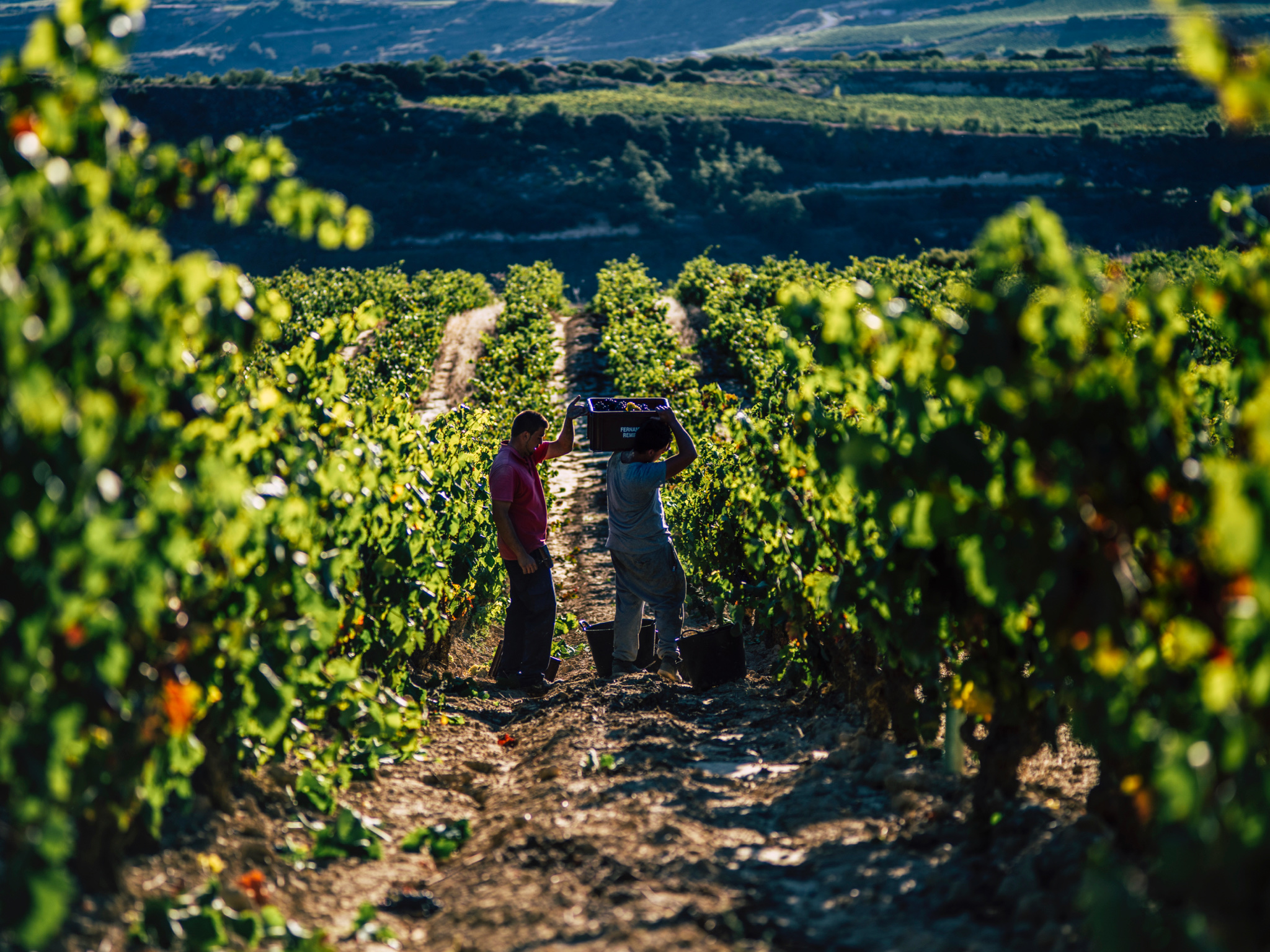




Eighty percent of Rioja’s wine production is red, but a growing zest for refreshing whites among young consumers is fuelling a debate: should the region increase its focus on white wine? Some, like Ramón Bilbao technical director Rodolfo Bastida, think that would be a smart idea, but others, including Remírez de Ganuza winemaker José Urtasun, exercise caution, warning against ripping out precious old vines to make way for white varieties.
Well, Pérez Cuevas, as if stargazing, forecasts a “very bright future” for white wine, which is “certainly enjoying a bright present”. From those made with recovered indigenous varieties like Tempranillo Blanco, to wines crafted with traditional Viura, Garnacha Blanca and Malvasía grapes, to the reservas and gran reservas, Rioja’s white wines are “winning over critics, achieving high scores and increasing sales”.
But does the president think global wine consumption will ever pick back up? She takes a Heraclitus-like approach when she philosophises: “Like everything else, it will change.” She suggests the global trend of rebuffing wine could be linked to the fact that we’re living in times of economic and social uncertainty, claiming that “wine needs peace, it needs tranquillity; it is consumed when there is joy”. But there’s also the “misguided” idea that it’s “simply an alcohol, like distilled spirits, which have a much higher ABV”, and not a central component of the Mediterranean diet.
These beliefs are fuelling producers to “be more demanding than ever when it comes to quality”, seeking creative ways to connect with consumers, especially younger generations, without sacrificing identity, with Rioja DOCa approving an experimental programme for lower-ABV reds in August. “People may be drinking less, but they are drinking better,” Pérez Cuevas adds. “Rioja, with its quality and diversity, has a clear advantage”.
Time will tell. But Rioja doesn’t just need to engage today’s youth in drinking wine, but in making it too. “The generational transition is one of the most critical and pressing challenges for the long-term future of Rioja,” warns Pérez Cuevas. “It is absolutely vital to make agriculture and viticulture a real, attractive and, above all, profitable career option. We must ensure sufficient economic value throughout the entire chain so that young people see a viable future, with opportunities for growth and innovation in the wine sector.” This will ensure that the centuries-old legacy of the vineyards remains in expert hands.
When asked for her guidance for young people wanting to work in wine, Pérez Cuevas recommends that they seek multidisciplinary education in winemaking and business management, and that they balance a long-term vision with the wisdom needed in a sector so closely tied to nature’s cycles, while maintaining “unwavering passion and a high degree of self-discipline”. But she admits: “I’m not one for giving advice.”
But if anything could woo youth to the wine world’s wonders, it’s hearing Pérez Cuevas enthuse about how the industry has made her who she is. Her love letter to Rioja reads like an ode, but persuades like an ad. Here it is in full: “If wine and the work surrounding its production can be called a school of life, this is especially true in Rioja. Here, wine is part of our identity, not only for those of us who work in the sector, but for the entire community; wine permeates everything. It has taught us to celebrate the little things, the small daily triumphs. It has taught us gastronomy, the value of hard work, and the appreciation for things done well.
“It has taught us patience, because cycles are slow and require waiting. It reminds us of the importance of roots and the value of the land, while also compelling us to always look ahead, not just to the next harvest, but to the next 10. It demands meticulousness in the technical aspects and flexibility in strategy. Without a doubt, wine has shaped a large part of who I am – and who we are – as members of this denomination.”
Chances to Grow
Without citing the challenges, of course, it might all seem too good to be true. “Obstacles”, including market competitiveness, rapidly changing consumer habits, and maintaining profitability, as well as more personal hurdles such as balancing family life with a demanding career, “are constant”. But Pérez Cuevas doesn’t see challenges as barriers, but chances to grow.
Above all, Pérez Cuevas hopes to leave behind a stronger DOCa, one that recognises its potential, has successfully faced structural obstacles and has strengthened its international prestige. “I want everyone who makes up Rioja to remember that it is a treasure, a precious legacy handed down by previous generations, that will outlive us all; it is bigger than any of us,” she pledges.
Yes, bigger than the Brits on the bridge, bigger than the chuffed King and bigger than its 14,000 vintners and 600 wineries; bigger than its first female president, bigger than me, even, representing Gen Z and flying in the face of trends by drinking red wine on the regular (it’s honest work). Rioja is bigger than all of us, but a sum of our parts too, with no-one better than Pérez Cuevas to unite producers and consumers in holding Rioja’s flag high. Here’s to the next 100 years.
Related news
Estrella Galicia 0,0 announced as official beer of MotoGP
Juvé & Camps aims to redefine sparkling rosé
Age and beauty: why this Spanish producer is a favourite with the Spanish royal household


