



Vive la resistance! The db guide to hybrid grapes
From drought-tolerant to disease-resistant, hybrid grapes are leading the fight against climate change. Chris Losh explores the latest developments.

Unless you’ve ever worked as a naturalist, you probably haven’t heard of ‘range shift’. But it’s a phenomenon that the wine trade is experiencing – and is going to keep experiencing – whether we know the term or not.
It refers to the relocation of a species to new places as their habitat changes, and it’s something that’s become accelerated as the effects of climate change take hold. So: animals moving to cooler, higher terrain; fish moving towards the poles in search of colder water.
Now, substitute fish/animals for grapes. As temperatures rise and weather patterns become more dramatic, so growers are increasingly beginning to ask themselves whether the varieties that have been in their region for centuries are still those that are best-suited to the new reality. And, even more dramatically, whether they will be viable at all in 50-100 years’ time.
It’s an uncomfortable question, and it’s throwing up some interesting behaviours. We’re seeing once ignored varieties gain a new lease of life; brand-new, lab-created grapes bursting onto the scene; and varieties that made their name in one place popping up somewhere else entirely. It’s possible that, in the course of one or two generations, vineyards could look significantly different to how they did at the start of this millennium. It’s an exciting, confusing, somewhat nerve-wracking time – and frankly we’ve only just got started.
The heat is on
The most obvious trend is that of heat-and drought-resistant varieties moving into already established, hotter areas.
Australia has been at the forefront of this for some time, with plantings of Tempranillo first going in the ground 30 years ago. It remains the most widely-planted Mediterranean variety, but there is significant interest in other grapes too, with Touriga Nacional in Margaret River, Arinto in Riverland, Assyrtiko in the Clare Valley and Nero d’Avola in McLaren Vale, to name just a few.
Of the ‘new’ varieties, Touriga Nacional, Sangiovese, Nero d’Avola and (surprise, surprise) Nebbiolo attracted the highest average prices this year.
At his winery in the Yarra Valley, Luke Lambert is unequivocal that Mediterranean, rather than French, varieties are the way forward, with Pinot Noir the ‘canary in the coalmine’ to back up his thinking.
“Twenty years ago, [Yarra Pinot] was quite dark,’ he says. ‘Now it’s lighter because you get less hang time. The flavour and tannin accumulation is just too quick.” Varieties like Nebbiolo and Barbera, he says, are “the future… things that have a high acidity.”
Not that it’s easy. At La Prova in the Adelaide Hills, Sam Scott says that Sangiovese has been “one of the biggest journeys I’ve been on”. Despite its surliness, however, Scott says there’s real interest among growers, because “it’s early-budding and late-ripening – you pick it at the end of March”.
Australia might have the recent heritage, but some of the most fevered experimentation with non-French varieties seems to be taking place in South Africa. Across Swartland, the likes of Eben Sadie and Adi Badenhorst are grafting experimental alternative varieties at an astonishing rate. Badenhorst has tried 80, from Aleatico Nero to Zinfandel, and though he admits that “not all have taken”, it’s not unreasonable to expect that at least half a dozen of them will work and be in production in the next decade.
As Etienne Terblanche at industry body Vinpro explains, growers are either looking for varieties that ripen early, before the summer heat spikes, or that are generally drought-resistant. He cites the Portuguese white Verdelho as one to watch, though the Cape’s fortified wine heritage means Portuguese reds (and Sherry grape Palomino) have an established history too.
Most of these plantings are taking place outside of regions with established ‘classic’ styles, though in the Pinot/Chardonnay hub of Hemel-en-Aarde, Newton Johnson is approaching its 12th vintage of Albariño, while in Stellenbosch Jordan Wine Estates is on its third vintage of an eye-catching Assyrtiko and has a Xinomavro in the pipeline. Gary Jordan explains the thinking. Some varieties, he says, are “isohydric” – ie able to slow down their ripening or even close down altogether under drought conditions. Grenache and Cabernet are good examples. Others, such as Chardonnay and Syrah, exhibit higher vigour in conditions of water deficit.
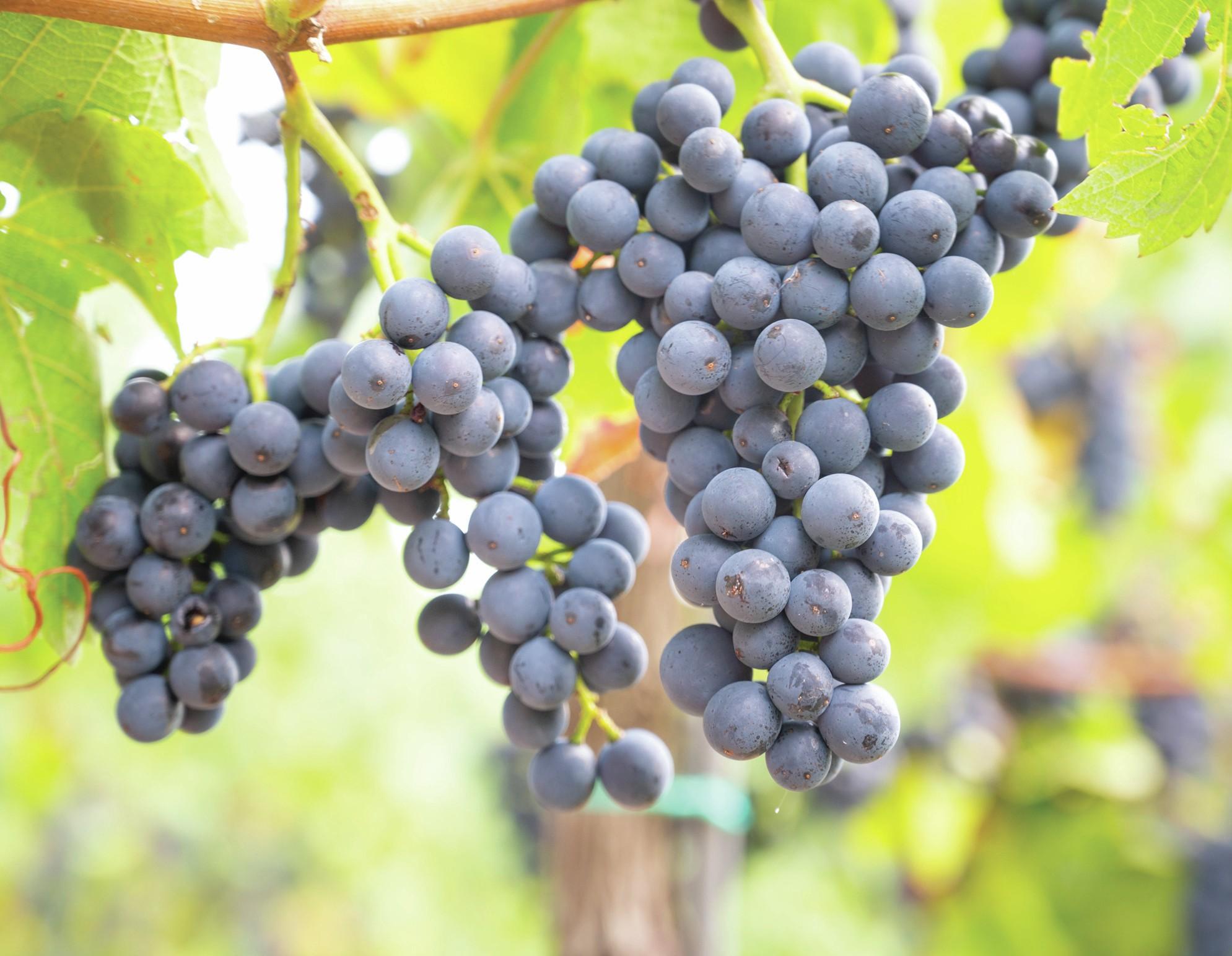
Hot property: Pinot Noir can be the ‘canary in the coalmine’ for climate change
In other words, isohydric (often Mediterranean) varieties are likely to cope better with a future where prolonged drought is not just possible, but likely. These new plantings don’t just better suit the existing climate; they also future-proof it over the next 100 years in a way that the existing French varieties largely do not.
Big in Bordeaux
This, certainly, is a live issue in France itself – and nowhere more so than in Bordeaux, where six new varieties have been sanctioned for use in AOC wines, including Cabernet/Grenache crossing Marselan, the obscure southwestern variety Castets, the hybrid white Liliorila and Douro star Touriga Nacional.
Uptake of these remains slow – the most widely planted remains Marselan at just 125 hectares – but that is likely to change, not least because Merlot cannot cope with the new realities of climate change. What used to be a bridgeable five-day gap between sugar ripeness and phenolic ripeness is now a yawning 10-15 days. The result is wines with either manageable alcohol and unripe tannins, or ripe tannins and Port-like levels of booze.
Cabernet Franc and Petit Verdot are growing in popularity, but the lower costs and better reliability of the newly-permitted varieties is likely to see their impact increase too.
Introducing new varieties takes time and can be something of a gamble, so the easiest strategy for many growers is to do more with what they already have. The revival of old-vine Grenache in Australia, for instance, is partly a recognition that making good Pinot Noir in Australia is, all too often, like trying to push overheated grape must uphill, and that Grenache – particularly old-vine Grenache – is probably a better bet.
“Grenache delivers what Pinot promises,” as Corrina Wright of Oliver’s Taranga puts it.
Palomino revival
One variety that was being pulled out 20 years ago is now back in demand. In the Swartland, Palomino – until recently a variety of negligible interest – is an established component of Eben Sadie’s much sought-after (and very expensive) Skerpioen white. Meanwhile, Adi Badenhorst makes an ethereal 100% Palomino from an old ‘Sherry’ vineyard, further up the west coast.
In its homeland of Jerez, the Vinos de Pasto trend – table wines made with Palomino – is creating genuine excitement. From top-quality Sherry vineyards, and often aged in old fino or manzanilla botas, the wines are complex and multi-layered, but are also sprightly and mineral, acquiring cult status among the sommelier community.
“It is still a tiny part of our business,” says Hidalgo general manager Fermín Hidalgo. “But we think it will keep growing, and it may become a significant part of our business in the future.”
Clairette – another ‘meh’ variety that has hitherto mostly been used as filler in blends – is also being used in the Cape and beyond to create whites that are making people sit up and take notice. Varieties that were once ignored are now getting a new lease of life.
These climate-tolerant varieties tend to have several things in common: they’re naturally drought-resistant, retain their acidity even in sun-filled climates and are often good value for money – all of which makes them attractive to growers, and even more so to sommeliers.
London’s upmarket Chiltern Firehouse is famous for its California list, but head sommelier Beatrice Bessi is actively looking for less common varieties like Trousseau and Ribolla Gialla. “In the regions that you want to keep stocking, you need to find lighter, more personal, different, original varieties that give you more personality and also lower prices, along with more freshness and acidity,” she says.
Back in time
The search for varieties that can naturally deliver zip and texture, rather than weight and sugar, might not just be about rebooting what’s there – it could even involve heading back in time.
In Spain, Familia Torres is engaged on an ancestral vine recovery programme. The project was instigated as a means of safeguarding obscure Catalan grape varieties in danger of dying out, but it’s increasingly also looking like a viable means of combating climate change.

Lab work: creating PiWi grape varieties is a slow process
Penedès is seeing 20% less rainfall than 20 years ago, and the varieties that have been resuscitated thus far tend to be largely drought-tolerant. They also give grapes with lower sugar levels and naturally higher acidity. A century ago, these latter characteristics would have made them unattractive to growers (and probably also to drinkers); now it’s exactly what is required.
Progress is understandably slow. The programme has been running for 40 years and has just half a dozen varieties in anything approaching a commercial programme. But Mireia Torres is excited by its potential.
“Perhaps 75% of Spain’s vineyard surface is planted with just 10 varieties,” she says. “That means there are a lot of varieties – maybe 150 – that could be interesting for the future.”
PiWi power
As well as resuscitating vines from the past, scientists are also creating a raft of new hybrid varieties which are increasingly exciting a new generation of growers.
In their most basic form, hybrids are a 50/50 crossing of ‘quality but finicky’ Vitis vinifera and ‘sturdy but workaday’ wild vine species to give – supposedly – vines that are the best of both worlds: producing good fruit and able to withstand diseases. Since 1992, labs in (predominantly) Germany and Switzerland have been repeatedly back-crossing their creations with the original Vitis vinifera strain to create varieties with genetics that are 90% Vitis vinifera.
Known as PiWis (a shortening of the German term Pilzwiderstandsfähig, meaning ‘fungus-resistant’) these varities have recently shown a marked increase in quality. Varieties such as Souvignier Gris, Solaris, Floreal and Cabernet Jura might not be on everyone’s lips yet, but they are proving popular with north European growers, who want to practise low-intervention viticulture.
Creating these PiWis is a slow process. Dr Florian Schwander, grapevine breeder at the Julius-Kühn Institut in Germany, estimates that it takes 20-30 years from initial experiments through breeding to trial and finally commercialisation. Calardis Blanc, which was approved in Germany in 2020, and then in France earlier this year, took 25 years.
This is one of the reasons why PiWis are not (yet) a weapon against water scarcity. Designed to combat mildew, they are essentially a way of making cool, damp regions viable. Thus far, no varieties have been developed to specifically address rising temperatures and drought – conditions which have shot to the top of the agenda in little more than 20 years.
“The issues of heat and drought are relatively new to our cool-climate growing region,” says Dr Schwander. “[They] have therefore become more prominent in our research and breeding considerations.” Which is basically a way of saying: “Watch this space – we’re working on it, but don’t have anything yet.”
While they might not be drought-resistant, PiWis can still be useful at combatting some of the other negative effects of climate change, such as erratic weather patterns.
In the Fronton region near Toulouse, Roman Tournier is dealing with vineyards that can see 30mm of rain one day, then temperatures in the 20s Celsius the next – perfect conditions for powdery mildew. But Tournier doesn’t want to spray his vines every time there’s a downpour – so PiWis are a good solution.
“Gen Z are looking for healthier products that are environmentally friendly, authentic and give new taste experiences,” he says. “Resistant varieties tick all these boxes.”
The other alternative to combat climate change, perhaps, could be summed up as “a bit of all of the above”, with growers planting more of everything to create super-diverse vineyards.
Matt Gant is a consultant winemaker with significant experience of both Australia and the Douro. The sheer variety of grapes on offer in the latter, he says, means that growers can more or less guarantee that some varieties will work every year, whatever the conditions. “We need to return to embracing blends,” he says. “Single-varietal wines obviously have their place, but blends offer the opportunity for more flexibility, complexity and interest.”
With old varieties, new varieties, rehomed varieties and a blending renaissance, climate change could be reshaping the make-up of the world’s vineyards for decades to come.
Related news
Moët employs historic plant cuttings and new PIWIS in climate change battle


