



Sofia Ricasoli: ‘history comes back over and over again’
At a central London masterclass marking the launch of Ricasoli’s 2022 Gran Selezione cru wines, db hears Sofia Ricasoli and Maria Bertelli reflect on the winery’s darkest days, and share how Italy’s oldest estate is fighting climate change.
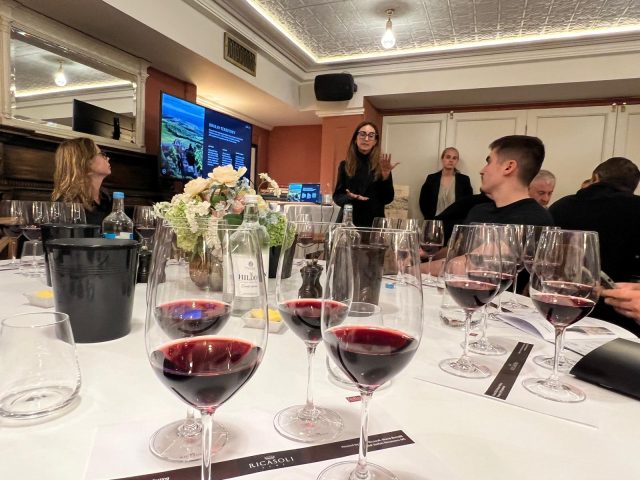
Ricasoli, Italy’s oldest winery and a benchmark for Chianti Classico, unveiled its 2022 Gran Selezione cru wines at a masterclass in central London on 15 September, hosted by the current president’s daughter, Sofia Ricasoli, at Bentley’s Oyster Bar.
The event offered insight into the storied past and ambitious future of the Tuscan estate, which dates back to 1141, as Sofia and European sales director Maria Bertelli, discussed the challenges of climate change, the evolution of viticulture in Tuscany and the winery’s continued push for research-led excellence.
At the tasting, Sofia paid homage to the winery’s famous ancestor, Baron Bettino Ricasoli, who lived in the 19th century and is credited with the formulation of Chianti Classico wine. “In 1872 he was struggling,” she said, with Tuscany in the throes of an economic crisis. “Because of those difficulties, he was trying to find how to create the perfect wine, to make this place successful and economically thriving.” And thus, he invented Chianti wine’s first ‘recipe’: 70% Sangiovese, 15% Canaiolo and 15% Malvasia bianca.
“But,” continued Sofia, “we also owe a lot to my father”. Francesco Ricasoli joined the winery in 1993. It was a “complex and difficult” period, said Sofia, but her dad “came from a situation of need and he managed to bring this winery back to a level of excellence.”
Sights set on sustainability
Francesco has led at the helm of the winery with a research-first approach. Now, the winery boasts its own laboratory, a technical department, with its owner collaborating with universities and research centres. Francesco was the first to implement zonings of the lands cultivated as vineyards in the Chianti Classico area, mapping 19 different soil types at Brolio.
Sofia sees parallels with Bettino’s tale of overcoming trials to triumph: “History comes back over and over again”.
Partner Content


With roots dating back to 1141, Ricasoli is often considered one of the five oldest wineries in the world and continues to shape the identity of Chianti Classico from its historic home at Brolio Castle.
And Sofia is gearing up to navigate the winery’s future. Having studied away from home in Milan and working in a completely different field, she made the “beautiful and strong” decision to return back to Brolio Castle, the winery’s “beating heart”. She said: “When you have always been producing something within the family that’s inherited through the generations, you always know that, sooner or later, you will end up in that place.”
‘Part of something bigger’
Maria Bertelli, sales director Europe at Ricasoli, added that, “when you work for a winery with a long history, you feel part of something bigger.”
Ricasoli is the most representative wine producer in the Chianti Classico wine area, with 1,200 hectares of property, including almost 240 hectares of vineyards and 26 olive groves.
Bertelli outlined how the winery is tackling sustainability: “If one day we used to say the most important role in a winery was the winemaker, today we face a totally different situation. With climate change, we are facing lots of extremes and rapid changes within the same vintage, so more and more, the agronomic part is the most important role.
“We have to be present in the vineyards every day on a regular basis, and act very differently from one vintage to the other; from one moment to the other.” The most important part, she added, is “being able to read a vintage and act accordingly”.
When Francesco came to govern the winery, the winemakers had to replant the entire vineyard, according to Bertelli. In the 90’s, it was vital to plant with high density to improve grape quality. But today, they’re reducing vines: “They’re quite stressed because of the climate, so we don’t need to create so much competition within the vineyards anymore.”
Related news
Italy minister vows to invest in Sicily's wine tourism
Italy about to start making domestically dealcoholised wine
ZONIN1821 shows where Italy is leading in winemaking innovation


