



From top to bottom: Chile’s quality revolution
Chile’s quality revolution, which has permeated the length and breadth of the country, has taken its wine industry to new heights, reports Arabella Mileham.
When Chilean winemaker Aurelio Montes Senior was considering starting his own wine business in 1987, his then boss apparently told him he was crazy. “Who’s going to buy premium wine from Chile? Who’s going to really recognise the quality from Chile?” he is reputed to have asked Montes Senior.
Fast-forward 38 years and the answer is, well, a hell of a lot of people. In a world where wine consumption is falling, Chile’s wines are known for their affordable quality, as well as a growing number of icon wines emerging at the top level.
According to data from Wines of Chile, around 70% of Chile’s wines are currently exported, making it the world’s fourth biggest wine exporter, representing around 8% of global wine exports.
There is, according to Wines of Chile commercial director Angélica Valenzuela, an opportunity to achieve an even greater market share at the premium end, by focusing on new consumers who may be drinking less, but are keen to drink better. For this, producers will focus on the priority markets of Brazil, Canada, Chile, China, the US and the UK.
One of the country’s most obvious success stories has been the distribution of some of Chile’s icon wines through La Place de Bordeaux, the exclusive Bordeaux-based distribution network with a capillarity that reaches premium markets across the world.
Montes Senior’s son, Aurelio Montes Junior, argues that the wineries focusing on premium positioning are opening the minds of consumers to Chile and the quality that it offers.
Examples of these most impressive wines include Concha y Toro’s Don Melchor (first vintage 1987) and Almaviva (a joint project between Concha y Toro and Baron Philippe de Rothschild), as well as Santa Rita’s Casa Real (1989), Seña by Eduardo Chadwick & Robert Mondavi, and Clos Apalta from Casa Lapostolle, as well as Montes’ own wines, Montes Alpha M, Wings, Folly and Montes Muse.
“We’re getting the support of people that used to drink French, Italian and Spanish wines, and now they’re opening their minds to Chile,” Montes Junior explains. “It’s amazing how the image of Chile – which used to be about the big bottles, the cheap bottles – has changed.”
Growing Maturity
However, it may be foolhardy to ascribe Chile’s success purely to its most famous icon wines, which by definition are rare and exclusive. Since Chile’s explosion onto the international market 40 or so years ago, there has been an inexorable building of momentum around Chile’s terroir, and an exploration of its capabilities and uniqueness.
Sebastián Ríos Dempster, corporate manager of oenology at Viña San Pedro, points out that, although Chile was “always a wine country”, when exports started in the 1980s there was a huge amount of French influence – but this is something that has changed. “Now we’re mature in terms of understanding what we have here, and that each area has its own typicity, and we want to showcase that difference,” he explains.
Viviana Navarrete, chief winemaker of Viña Leyda, part of the VSPT Wine Group, agrees that it is “a good time” for Chile in terms of understanding which grape varieties grow best in its soils. “Most winemakers are more confident and prouder of the results that we are getting now, whereas years ago we were ashamed,” she says.
Joaquín Bravo, winemaker at Via Wines, argues that the growing maturity of recent years is partly due to a better grip on the country and its terroir. “Years ago, you could try to make the best Carmenere in Itata or Casablanca, but now we know you go to Cachapoal or this part of Maule,” he explains.
However, many producers report that, while quality has undoubtedly risen across the board, the market itself has evolved down two parallel roads.
According to Montes Junior, this apparent divergence provides opportunities. “There’s still the same image of 20 years ago, of cheap, good-value wine – and there’s nothing wrong about that; it’s one line.”
But it’s not the only story. Chile’s premium producers are coming on in leaps and bounds, not only in terms of the quality of their wines, but in learning how to market them.
As global consumption goes down, Montes Junior says, Chile’s wine industry “is going to be reorganised”, and it may be that only strong brands survive.
This is due to a recent contraction in the area under vine, which between the boom of the 1980s and the 1990s exploded from around 46,000 hectares of vines to about 142,000ha.
Now, however, this vineyard area has progressively shrunk, thanks to low prices and falling global wine consumption. Although the numbers have yet to be released, many producers fear this vineyard contraction may be as much as 40%. There will doubtless be casualties, but it might also be an opportunity for Chilean producers to develop their brand further, having established a reputation for quality.
“We know that the lower-priced wines compete – it’s a commodity where Chile competes with South Africa and with Spain, and at the end of the day the buyers take the cheapest one. But when you build a brand, they buy the brand,” Montes Junior argues. “So there’s going to be more space for us to build our brand and to really push the quality up with a lot of responsibility.”
Regionality and immense diversity
Viviana Navarrete argues that more education is needed around regionality and the immense diversity that can be found in Chile. “I think that’s the key, because people think Chile is all about Central Valley reds and that’s it,” she says. “Years ago, we were trying to make friendly wines that consumers enjoy, but now wineries are specialising in their own terroir.”
As such, winemakers are exploring the furthest ends of the country – both north and south – to unearth the treasures of its soils. This push began around 10 years ago, Navarrete says, “because we knew that that was the way to improve the wines”, and this knowledge has also required a gentler approach both in the vineyard and in the cellar.
“It doesn’t make sense that you find a soil polygon [part of a vineyard soil map] with a super-interesting composition, but then in the cellar you make an extraction and ferment at high temperature,” Navarrete explains.
“When you understand the soil and the climate, and the potential that a place has, then you go to the next level, and say: ‘Ok, Pinot Noir shouldn’t be over-oaked. We have to do something more elegant, more finessed, with the sinewy palate that we are obsessed with.’ And then you start building step by step towards that profile.”
At Viña Leyda, rather than using constant, regular irrigation, viticulturist Tomás Rivera simulates a more natural rain pattern throughout the year to encourage the vines’ roots to go deeper. Meanwhile, producers everywhere highlight the focus on intra-parcel selection and more precise picking.
In the cellar, there is an overall trend to dial back the oak and use low toasting levels in order to allow the true expression of the fruit to shine through. Increasingly, producers are looking at alternative vessels that aim to help the wines retain their freshness and tension, particularly for certain varieties.
Maule-based TerraNoble, for example, has been looking at how wines grown in granitic soils evolve when aged in granite amphorae, as well as granite eggs.
“Since the beginning, the philosophy has been to respect the grape – hence a new type of ageing to transmit the origin of the grape,” winemaker Marcelo García explains. He has installed more ceramic amphorae, which are sealed with beeswax, as their more precise porosity (ie smaller holes) provides an interesting evolution to the wine.
Meanwhile, Viña San Pedro is using what it claims is the first 360-degree rotating egg in Chile for a small proportion (around 5%) of the Cabernet Sauvignon that goes into its icon wine, Altaïr. “You can feel the impact in the mouthfeel and the roundness,” winemaker Ignacio Díaz Plaza says.
Varietal interest
With this diversifying of grape varieties, where do producers feel there is most excitement to be found? Cabernet Sauvignon still reigns supreme, accounting for 35% of production, and although Merlot is next, at 12% of production, Carmenere is often seen as the emblematic variety of Chile, even though it only accounts for 9% of total production.
Jaime Valderrama, managing director of Viña Miguel Torres Chile, explains that Cabernet Sauvignon opens the market and can offer layers, while Carmenere is great for showing diversity, boosted further by the “niche”, even “risky” Pais and Carignan, which can each offer a point of difference.
According to Santa Ema’s chief winemaker, Rodrigo Blázquez, Carmenere is becoming “more popular every day” and, as a variety that is almost unique to Chile (although there are small quantities grown in California and in Europe), “it’s becoming the second wine of Chile”.
TerraNoble’s García argues that Chile now has 30 years’ experience of growing Carmenere – after the variety was rediscovered by chance – and winemakers now have a far clearer idea of where it thrives.
With a “huge” future ahead for Carmenere in Chile, TerraNoble has launched two wines, CA1 Andes and CA2 Costa, that “express the learning process about Carmenere and show the different expressions from the Andes to the coast”, García says.
“Carmenere from the Andes has a more classical, spicy yet soft style – not too sweet, not too much tannin – whereas Carmenere from the coast has more red fruit,” he explains. “Five years ago, I’d say Cabernet Franc from Chile had more potential, but I’m now convinced that coastal Carmenere wins out.”
However, García notes that producers need to keep communicating the fact that Chilean Carmenere no longer shows any of the green aromas or pyrazines it once had. Not unlike the challenge with South African Pinotage 20 years ago, “it’s a lot of work to communicate and show that”. Montes Junior argues that, although many people are talking about Carmenere, it is taken for granted that it is well-known, “but I don’t agree about that – there’s still a lot of people that don’t know anything about Carmenere”.
But what of Cabernet Franc? According to Vik winemaker Priscilla Fernández, the conditions, temperature and diverse soil characteristics in Chile, between the coastal range and the Andes, provide a diversity of Cabernet Franc wines that is unparalleled elsewhere.
As a grape, it has “evolved” over time with better handling, she says. Since 2021, Vik’s Milla Cala wine has been driven by Cabernet Franc, having been introduced to the assemblage in 2014, before gradually overtaking Cabernet Sauvignon to take centre-stage in the blend
“It’s a long process to define the best blend; the vineyards are managed focused on the labels, as a wine starts its life in the field,” Fernández explains. “The idea of Cabernet Franc, for us, is to provide many results. It’s a diverse variety with different characteristics – minerality, linearity. Depending on the area, the wine, the Cabernet Franc might introduce itself differently.”
Still learning
Meanwhile, some producers are experimenting with varieties not normally associated with Chile. Take Albariño, for example – long associated with Spanish region Rías Baixas, the variety isn’t one that immediately springs to mind for Chile. However, Viña MontGras winemaker Cristián Correa argues that Albariño has great potential in Chile, not just in white blends (it is already used in a blend by “three or four producers”, he says), but also as a varietal wine in its own right. “We’re still learning about it, but I think in the future you will hear more about Chilean Albariño,” he says – certainly more so than Riesling, even if that is more widely planted. “It is too early to talk about a typicity for Chilean Albariño, but I think it’s less ‘straight’ than in Rías Baixas,” Correa adds.
The coastal range in Chile is, he argues, an ideal location for Albariño due to its granitic soils and cool climate, and the MontGras team is already doubling its Albariño vineyards from 3ha to 6ha, with plans to treble production to 10,000–12,000 litres by 2026. “Cabernet Sauvignon will always be the star from Chile because of the quality and the quantity, but in terms of other varieties, in 20 years, I think maybe Albariño will be something to talk about,” says Correa.
Montes also produces an Albariño, and Cono Sur’s winemaker Matías Ríos hints that his team is looking at an Albariño, possibly from Bío-Bío.
This taps into the increased demand for white wine, Ríos says – Cono Sur, which traditionally had a bigger focus on white wines than many of its competitors, used to split its production 70% red and 30% white, but this is more like 50/50 now.
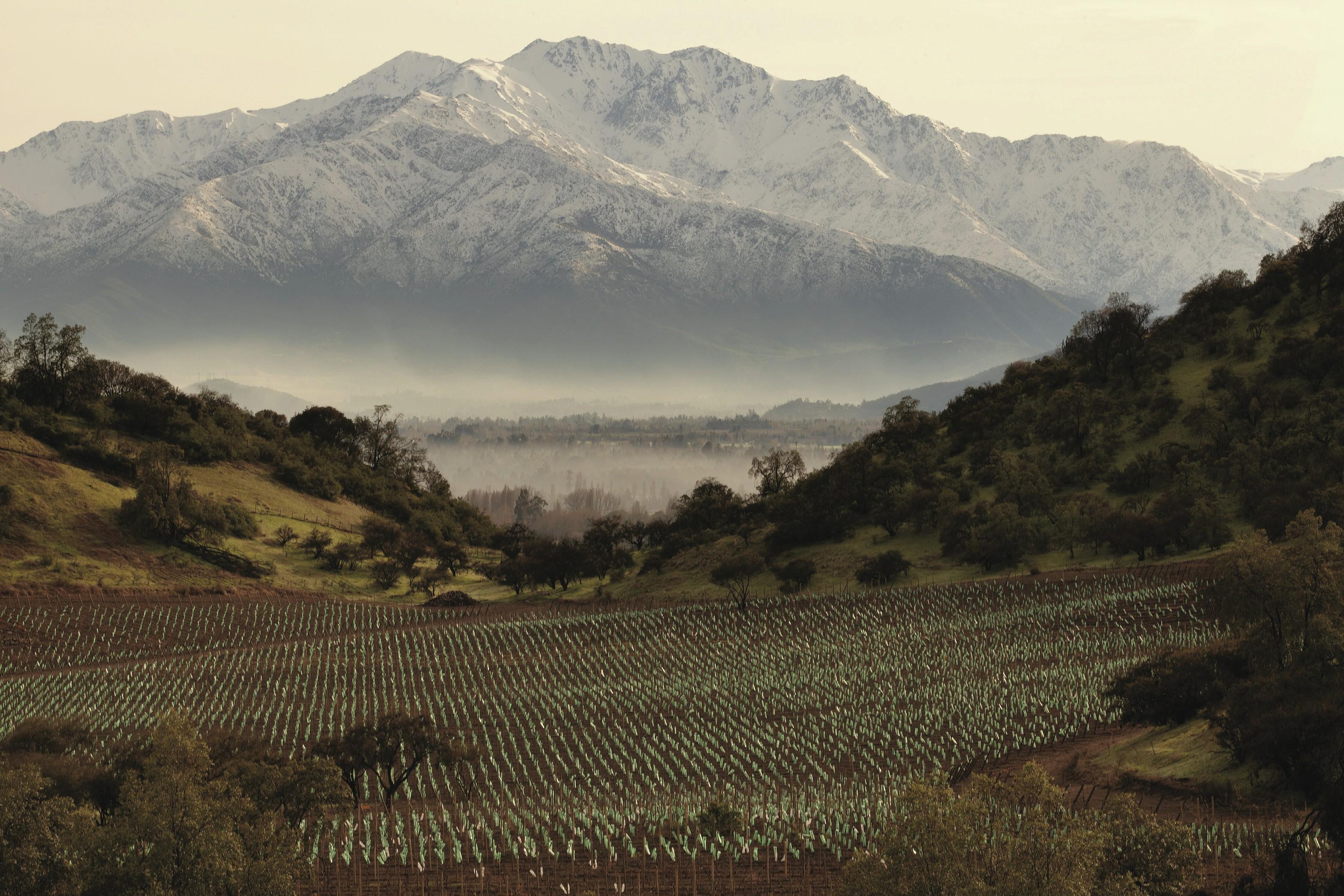
“The world is drinking more white wine and, in Chile, we’ve discovered cold valleys,” says Ríos. “We started to develop Casablanca in 1990, then it was San Antonio, then Limarí and Bío-Bío, where we have a lot of influence.
“But we started to use more extreme valleys, all of them developed for the cool-climate and white varieties. The classic varieties from Chile were the reds, but now we develop a lot of whites.” And it’s not only whites that are getting a look-in. Marselan, the offspring of Cabernet Sauvignon and Grenache that was developed in France in the early 1960s, has attracted the attention of producers. Although it is included in some blends by a handful of wineries, Santa Ema is experimenting with a 1.5ha plot for a varietal wine under its Amplus One range.
“It is a Mediterranean climate and warm, so it should perform well,” winemaker Rodrigo Blázquez says. “I have seen it grown as far away as China and Uruguay, so I’m not sure if there is a ‘typical’ Marselan, but the comments so far have been very good.”
Meanwhile one of Montes’ newest plantings is Touriga Nacional, which the company is hoping to launch as a varietal expression “depending on the wine” in the next few years. “We need to investigate and to research it for at least 10 years – and this is one we have been working with for eight years. I think we’re very close to being confident enough to release a new wine,” says Montes Junior.
And this is the nub of Chile – the country’s willingness to experiment and take risks, to develop and grow, and to be open to change and exciting developments, in pursuit of ever-increasing quality. It’s no wonder that the wine world is sitting up and taking notice.
Related news


