



Why sake deserves a place next to wine in the beverage world
As sake develops a stronger following, are we doing enough to make sake understandable to the new consumer? Nimmi Malhotra attended a sake masterclass in Singapore to investigate.
Sake culture in Asia is thriving. It stems from our fascination with Japanese culture, starting from food to fashion to a growing appreciation of Japanese beverages, from Japanese whisky to sake.
As a result, consumption is on the rise. The Japan Sake and Shochu Makers Association (JSS) reveals that 2024 exports to key Asian markets have nearly doubled from 2023. Indeed, among the global top 10 destinations, Hong Kong ranks third in exports by value – behind only China and the US – followed by Korea, Taiwan and Singapore.
In terms of volume, the US and China again lead, but Korea jumps to third place, followed by Taiwan, Hong Kong, Singapore and Thailand. Singapore may have ranked 6th in 2024, but the growth, notes the JSS’s director, Hitoshi Utsunomiya, has been exponential. “Singapore’s export value has grown by 282.22% in the 10 years from 2015 to 2024.” That surge is no coincidence.
Sean Ou, founder of The Beverage Clique Academy, has noticed a steady expansion of sake listings beyond Japanese establishments. “Wine lists from three-star Michelin restaurants like Odette, to wine bars like 67 Pall Mall, feature a selection of top-tier sakes because people are asking for it,” he shares.
The koji culture
At JSS, Utsunomiya is intent on broadening sake awareness even further. The non-profit organisation’s partnership with the Association de la Sommellerie Internationale (ASI) is set to achieve just that through beverage education among sommeliers, in a bid to promote sake alongside wine and spirits.
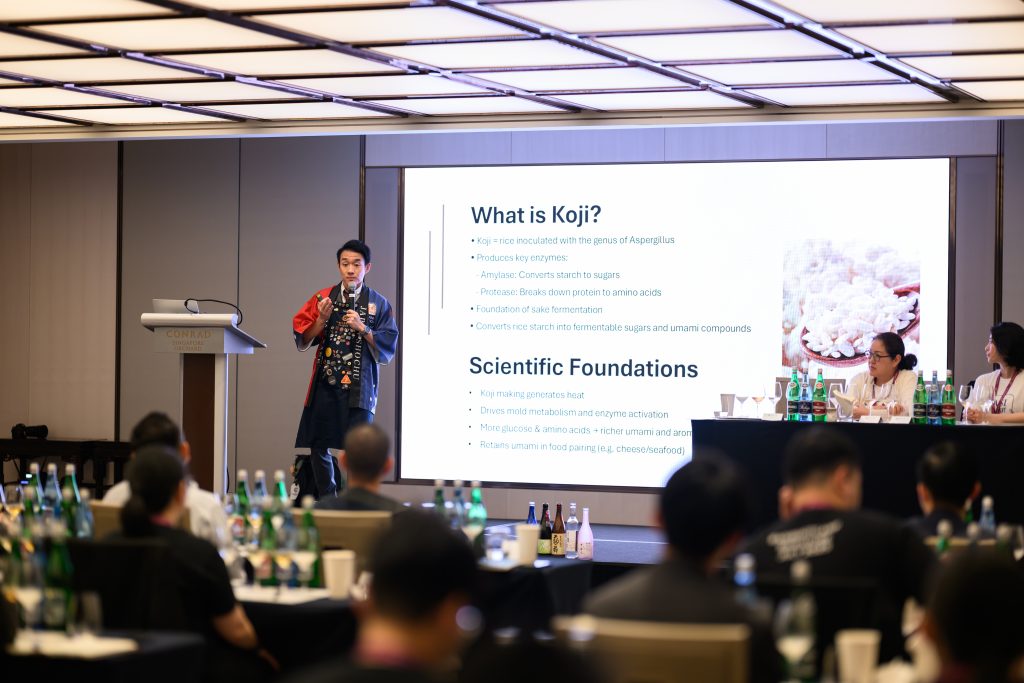
At a recent ASI Bootcamp held in Singapore, Ou led a masterclass on sake’s fermentation process. He specifically focused on koji mould, the crucial component that sets sake apart, continuing the JSS’s series of deep dives into sake’s production and potential.
This advanced session went beyond the rice varietals and polishing ratios, zooming in on koji’s function in the brewing process. “Koji’s role is to produce enzymes that break down the protein and starch in the rice,” explained Ou.
Enzymes such as amylase and protease are key players: they convert rice starch into fermentable sugars and produce amino acids that impact mouthfeel, texture, and the signature umami that defines sake.
Ou then explored the three main koji strains – white, black, and yellow – each contributing to Japan’s unique fermentation culture. Yellow koji is the strain primarily used in sake brewing. By controlling the temperature and humidity during the koji-making process and adjusting the degree of haze-komi (koji propagation), brewers can express a wide range of flavour profiles – from rich umami, nutty and creamy to clean and fruity – highlighting the individuality of each brewery.
Conscious of his audience, Ou drew measurable comparisons between sake and wine. “When we’re talking about sake vs wine, we are talking about 1/5th of the acidity,” he said, noting that sake relies on amino acids rather than the tartaric acid dominant in wine, which can significantly alter food-pairing dynamics.
Why umami needs a new playbook
Soren Polonious, ASI Education & Exam Committee co-director and ASI Bootcamp content co-director, argues that sommeliers need to be on a “higher level” of awareness and education, at a time when consumer knowledge across Europe, let alone Asia, is increasing.
“We see the understanding and sake has gone from being an esoteric, weird drink to something that you are going to encounter in a restaurant, “he says. “Sake is such a complex beverage; it deserves a position in the beverage world.”
A firm advocate of sake’s ability to pair with food, Polonius shared his thoughts on the subject. “When pairing wine, it’s like putting out fire with water,” he says, highlighting examples of wines that may appear metallic when paired with a rich umami dish. Sake pairing, he argues, is an entirely different paradigm. “Sake doesn’t rely on acidity, but on amino acids. It’s pure umami, and you fight fire with fire. It can create the most beautiful pairings.”
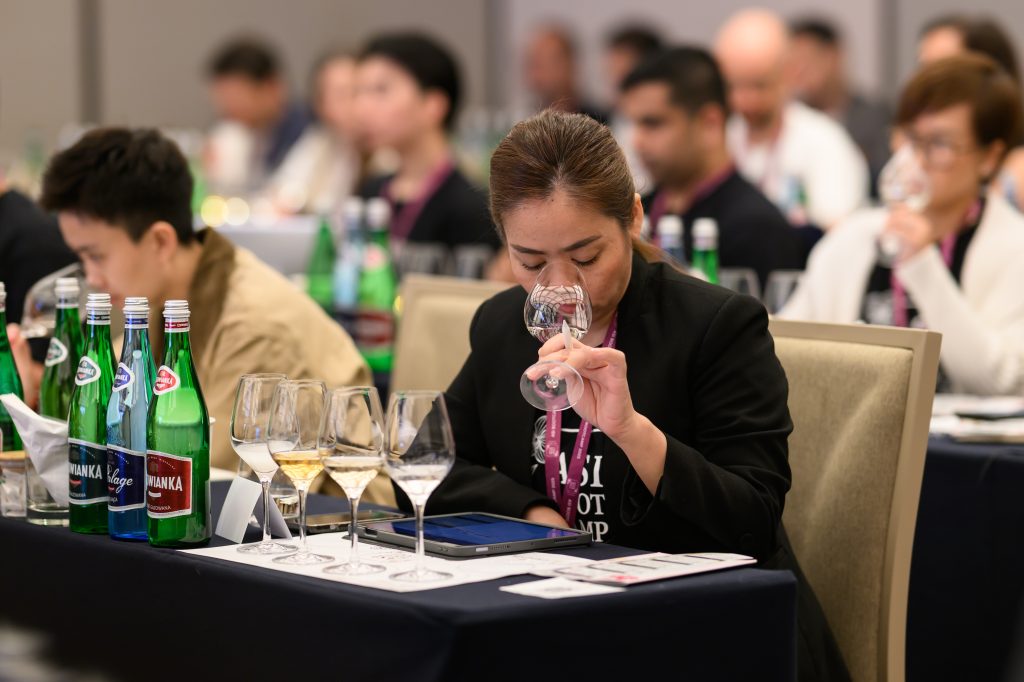
To further aid sommeliers in understanding sake, ASI and Polonius have launched a comprehensive sake tasting grid in the ASI booklet to decipher sake, much like wine, by sight, palate and taste and intensity indicators.
Related news
Bordeaux and Hong Kong toast a five-year future
Sicilia DOC to capitalise on 'The White Lotus effect'
China is rebuilding its on-trade around a new kind of drinker


