



Clout of Africa: the innovations taking South Africa by storm
Set against a backdrop of economic instability and Covid-induced challenges, a real spirit of innovation prevails among South Africa’s winemakers, as Eloise Feilden discovers.
Prohibition is a word we associate with the past. A bygone era in American history that conjures up images of men dressed in trilby hats and three piece suits, and women flaunting sequined flapper dresses and feathered headbands. Or at least that’s what Hollywood would have us think.
For South Africa, memories of Prohibition are far more contemporary.
In some countries, alcohol was classified as an essential item during the Covid-19 pandemic. In South Africa, on the other hand, the sale and transport of alcohol were outlawed for 161 days over four separate periods from March 2020.
The final ban was lifted by the government on 25 July 2021, but as the industry continues to recover from these Covid-induced woes, the backdrop of ongoing challenges is difficult to ignore.
Threats to the nation’s wine trade have centred around concerns of “financial sustainability”, says Siobhan Thompson, CEO of Wines of South Africa (WoSA).
Although the challenges caused by the pandemic are “not unique to South Africa”, there is a “double whammy” for the country, due to the fact that “South Africa’s economy is also faltering”.
“We’ve got the challenges of war [in Ukraine], of freighting issues, and accelerating costs, but we’ve also got issues in our own country of inflation and lack of electricity supply,” she says.
South Africans have experienced ‘loadshedding’ — successive rounds of national blackouts as electricity supply falls behind demand — since 2007, continuing to this day. These blackouts have been regulated to specific times each day, but in these moments, as traffic lights falter, leaving cars to navigate crossroads with a ‘first come, first go’ approach, they are a constant reminder of the country’s enduring economic instability.
The availability of containers and “astronomically” inflated shipping costs have also hit the country hard, “putting a lot of pressure on our exports and our lead times”, and putting strain on profitability, Thompson says.
“Other countries do have the same issues, but ours are heightened because of the distance where we are, and our own economy,” Thompson says.
South Africa, with its 1,770 miles of coastline, is in a uniquely isolated position, putting pressures not only on exports, but also on sustainability.
“I’ve heard people say ‘We’d rather get Spanish or Italian or French wine, because the emissions will be far lower than putting it onto a ship and bringing it from South Africa’. How do we lessen that footprint, but at the same time keep our economy going?” Thompson asks.
FOCUS ON SUSTAINABILITY
The theme of this year’s CapeWine trade fair was Sustainability 360. A theme that the WoSA boss hopes will put the focus on “people, place and prosperity” in light of a gruelling past few years for the region’s wine trade.
Financial concerns, as well as green issues, fall under this sustainability banner. Balancing these aspects against one another is a constant challenge, and producers have to be careful about tipping the scales too far one way.
Johan Reyneke, owner and viticulturist at Reyneke Wines, spoke about the “three-legged chair” of sustainability in a seminar on regenerative farming at the CapeWine trade show this year.
“You have to live off nature, you have to live off people, but you also have to live off money,” he said. “If we’re honest about it, we can exploit nature the longest, and people the second longest, but if we run out of money, the business stops immediately.”
Shipping in bulk and bottling in Europe provides a potential solution to the issue of environmental sustainability, and Thompson is keen to stress that exporting in bulk by no means translates to lower quality. “The word ‘bulk’ is a very dangerous one, because it’s about unpackaged wine, and unpackaged wine doesn’t have to be low quality,” she says.
Getting the quality message across to consumers is vital. South Africa has typically held a legacy in the UK for entry-level wines, but that view is changing. “We’re starting to see highertier wines being listed and supported,” Thompson says.
“That’s critically important because for a consumer, you need to create a ladder of experience.”
The ‘value for money’ legacy is one many producers are desperate to shake. Mike Ratcliffe is the chairman of Stellenbosch Wine Routes, and founder of Wine Business Advisors.
New innovations
New varieties are making their way onto South Africa’s roster of grapes. Robertson’s Springfield Estate now produces an Albariño, following in the footsteps of Hemel-en-Aarde producer Newton Johnson, which released the country’s first commercial Albariño in 2014.
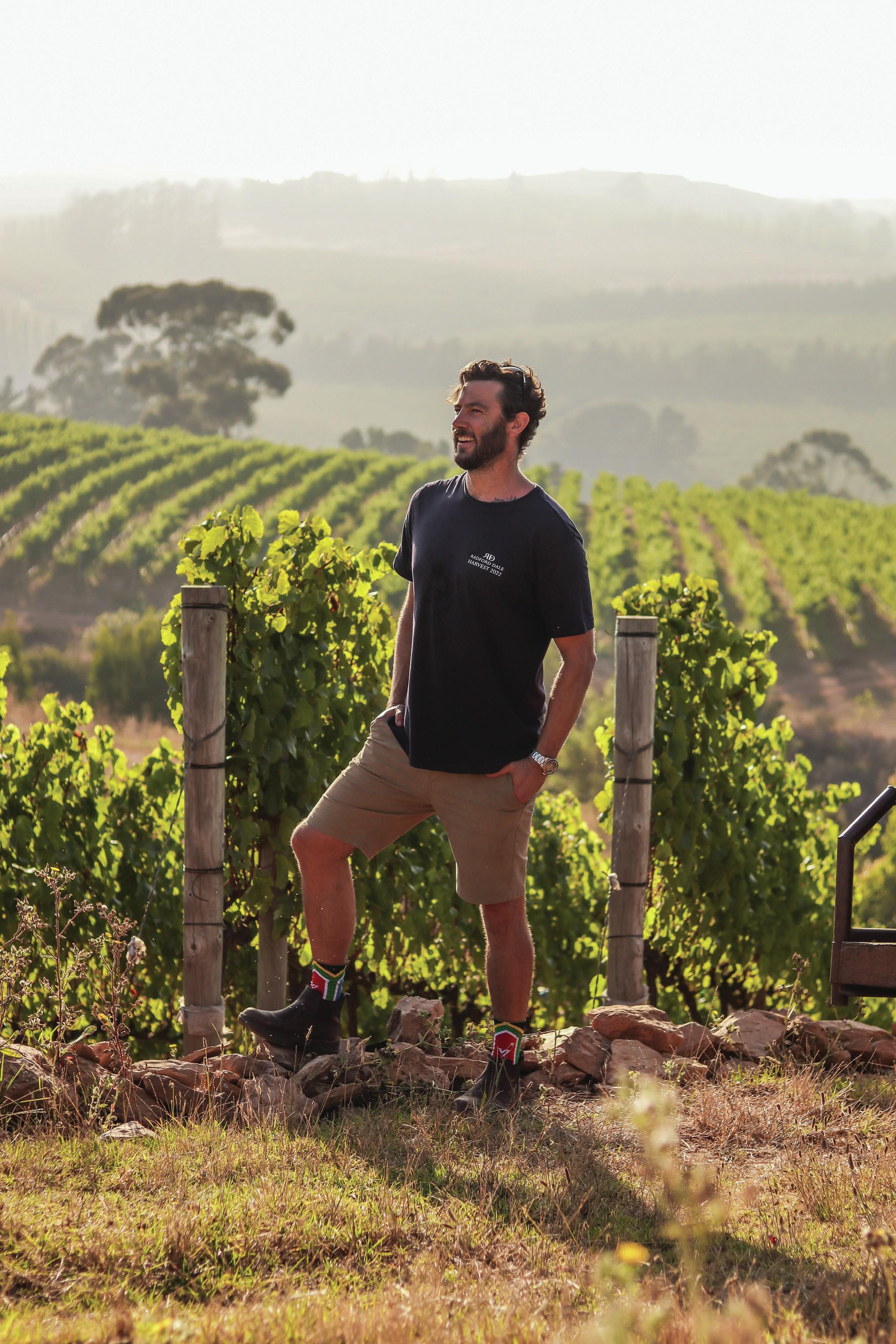
Other innovations come in the form of Saurwein’s Chi Riesling, launched in 2018, and Radford Dale’s range of three Gamay wines spanning multiple price tiers, which winemaker and viticulturist Jacques de Klerk sees as a lighter, more easy-drinking “alternative to Cinsault”.
Many of the country’s winemakers are also going back to their roots in order to innovate, building on South Africa’s traditional grape varieties to carve out its future.
Kaapzicht Wine Estate’s lighter-bodied Pinotage is the perfect example of this – a“more fresh and energetic” style of Pinotage than tradition dictates, at 13.5% ABV, according to fourth-generation winemaker Danie Steytler Jr.
A new generation of Black winemakers is also making waves in the industry. The economic hurdles of buying land make it near impossible to compete on size with producers whose lands have been in the family for generations, but the Cape’s Black winemakers are determined to “compete on quality”, says Paul Siguqa, owner of boutique winery Klein Goederust.
“In South Africa, everywhere you look it’s all about premiumisation,” he says. Producers are constantly “gunning for a higher price”, in a bid to move away from this legacy of affordability, and for some at least, it seems to be working.
“The top end of the South African line has never been more buoyant, and, dare I say it, profitable,” Ratcliffe says.
In the UK, this upward trajectory is being reflected in value sales growth, which has continually outstripped volume growth over the past few years, continuing into 2022. Coupled with the increase in prices, this growth indicates that we’re seeing more exports of higher priced wines to the UK market.
EXPORT VALUE
Export value to the UK increased by 20% in 2021, with the Rand per litre (RPL) up by 7%, WoSA figures show. This increase follows on from a trend established in the previous year, which saw export value increase by 23%, coupled with a 15% rise in the RPL of South African wines.
Value sales may be increasing at a faster rate than volume, but volume sales do still continue to rise, with export volume to the UK up by 12% last year, following a 7% jump in 2020.
Rollo Gabb, managing director at Journeys End Vineyards, thinks South African wine brands should be embracing the value message. “I don’t think we should be frightened of using the ‘value’ word,” he says. “It’s always good to try to take the price point north, but we also need to get people buying into our category. We’re better off trying to operate where the market is at, then steadily try to take people up the ladder step by step.”
European investors appear keenly aware of South Africa’s value for money, when it comes to land as well as wine sales, and an increasing number of them are cashing in.

Foreign investment coming into the South African winelands is arriving in two waves, distinguished on a basis of scale.
Last month, news of Les Grands Chais de France’s international expansion with the acquisition of a South African property hit the UK press. The wine group, which owns 68 properties in France, from Calvet to Klipfel, and the JP Chenet wine brand, has bought the Neethlingshof winery in Stellenbosch, with plans to expand its 100 hectares of vineyard land.
Investment from France’s biggest private winemaker is not in isolation. Last November Heineken revealed plans to buy Distell Group Holdings in a €2.2 billion (£1.93bn) deal, a move that was finally approved in September of this year.
A second wave of smaller-scale acquisitions – something Ratcliffe likes to call “lifestyle investments” – are also travelling south from Europe.
Hasher Family Estate in the Hemel-en-Aarde Valley, for one, released its maiden vintage in 2022 after its acquisition by Belgian couple Frederik Herten and Céline Haspeslagh.
Herten – atrained sommelier and former commercial lawyer – bought the estate with his wife in 2021, moving the couple’s three young children Ernest, Héloise, and Emile over to the town of Hermanus that same year.
Haspeslagh, whose father is one of the founders of Ardo, Europe’s largest producer of frozen vegetables, says the decision to buy the estate was entirely Covid-led.
The ban on wine sales during the pandemic reduced the rush to release the estate’s first vintage, giving the couple freedom from immediate time restraints. The farm, which spans 180ha, 50ha of which are under vine, is now undergoing a replanting programme, with plans to place the remaining 130ha of land under conservation.
As well as new faces, new grapes are also making their way onto the South African roster. Robertson’s Springfield Estate now produces an Albariño, following in the footsteps of Hemel-en-Aarde producer Newton Johnson, which released the country’s first commercial Albariño in 2014.
Other innovations come in the form of Saurwein’s Chi Riesling, the first vintage of which was launched in 2018, and Radford Dale’s range of Gamay wines, which winemaker and viticulturist Jacques de Klerk sees as a lighter, more easy-drinking “alternative to Cinsault”.
CARVING OUT A FUTURE
But many of the country’s winemakers are going back to their roots to innovate, building on South Africa’s traditional grape varieties to carve out its future.
Kaapzicht Wine Estate’s lighter-bodied Pinotage is the perfect example of this – a“more fresh and energetic” style of wine than tradition dictates, according to fourth-generation winemaker Danie Steytler Jr, but still something inherently South African.
Radford Dale’s de Klerk, although guilty of dabbling in European varieties such as Gamay, is just as passionate about defining the nation’s wines through its flagship varieties.
“Even if it has to be my life’s goal, I want to be able to put a Pinotage and a Chenin Blanc on the table and say ‘Here, this is South Africa’,” he says.
Could European investment pose a threat to this sense of national identity?
As foreign newbies buying into the region, Hasher Family Estate’s Haspeslagh is keen to reassure her neighbors that the couple have no intention of “coming here as foreigners to change the narrative” of South African wine.
Carolyn Miller, a South African native who looks after sales and marketing for the company, describes foreign investments as being a “bright light” for the region’s future on the international stage. Indeed, WoSA’s Siobhan Thompson believes that foreigners are buying in” for our sense of identity”.
“They’re bringing investment and they’re bringing learning, but they’re investing in those properties because they are South African; they’re not eroding that heritage,” she says.
‘Alone we can do so little; together we can do so much’. This is the slogan with which a group of five German investors released a South African wine into the German market in February 2021.
Imvini Wethu, the name of said wine brand, was developed as a result of stringent lockdown regulations and blanket bans on alcohol sales, which threatened the livelihoods of many depending on the wine industry for their only income.
The brand was spearheaded by German wine label specialist Vollherbst Labels, importers Capreo, Linke, and Pellegrini, and wine consultant Petra Mayer; “a group of Germans who are having a long lasting relationship with South Africa”, Mayer says.
Imvini Wethu – meaning “our wine” – was conceived to provide “sustainable support” for an industry in crisis. “We wanted to give back to the farmers who are on the ground,” Mayer says.
Sales proceeds from the label help fund the country’s Old Vine Project, as well as the Cape Winemakers Guild Protégé Programme, a mentorship initiative for young winemakers, highlighting the good that can come from foreign investment, particularly that which is aimed at empowering domestic workers.
“We wanted this industry not only to survive, but also to feel encouraged that there is light at the end of the tunnel,” Mayer explains; a goal that may prove invaluable to South Africa’s longevity in the years to come.
Related news
All the medal-winning wines from the Global Organic and Vegan Masters 2022
All the medal-winning wines from the 2022 Global Malbec Masters


