



Golf club sinkhole reveals century-old wine cellar
The shock of a sinkhole appearing on a popular Manchester golf course was tempered by the elation of finding an underground cellar containing the remnants of historic wine and Port bottles. Sarah Neish reports.

When a sinkhole collapsed underneath the 13th hole at the Davyhulme Park Golf Club in Manchester last week, there was little cause for celebration. Until, that is, the gaping hole on the course revealed an exciting discovery.
The greens team uncovered “what appears to be an old cellar, believed to date back to the original manor house,” the club announced.
“Over 100 years old and filled with historic wine and Port bottles – what an incredible piece of our club’s history,” Davyhulme Park posted on Instagram.
Mystery bottles
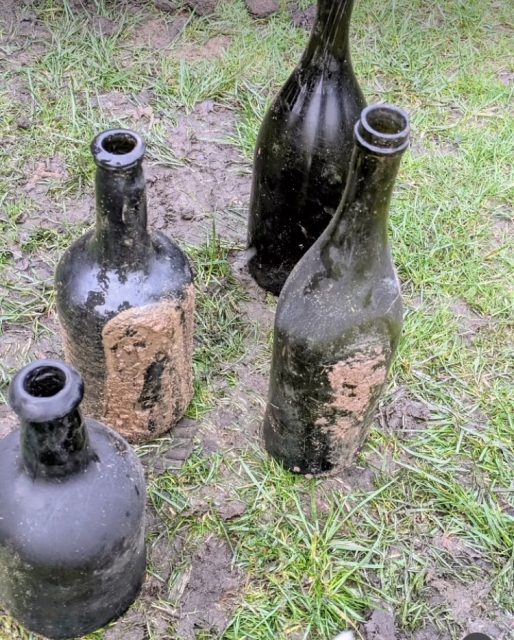
A video taken by one of the groundsmen who ventured inside the cellar shows a brick tunnel with earth-encrusted bottles lining the floor. The team were able to remove some of the bottles (pictured below), which do not appear to have labels or other clues which could indicate specific wine brands, but the different bottle shapes suggest that some are table wines and others fortified, likely Port.
The drinks business has contacted Davyhulme Park Golf Club for details on the total number of bottles found and whether any still contain viable liquid, and will update this article accordingly. However, a line in the golf club’s ‘Local Rules’, published on its website, suggest it may have known about or suspected the presence of a sinkhole before it collapsed, revealing the cellar.
“During play of the 13th hole, the right side of the hole, defined by the white marker posts is out of bounds,” the rules clearly warn players. “These white posts are boundary objects during the play of the 13th hole.”
Below, db looks at some of the popular wines amidst English landowners at the time the Davyhulme cellar may have been built.
Golden age for golf and Port
The introduction of golf in England, and its growing popularity as a sport, coincided with what is often described as the ‘golden era’ for Port, and Davyhulme was arguably in the thick of both. Set in 99 acres of parkland, Davyhulme Park Golf Club traces its history back to 1154 when its land was part of Davyhulme Hall, seat of John de Hulme in the reign of Henry II in 1154.
His descendant, William de Hulme, was High Sheriff of Lancashire in 1701 and according to the club’s history, it is probable that he built the lake (found on the modern-day 2nd and 6th hole) around the year 1690.
However, it was Robert Henry Norreys, who inherited Davyhulme Hall and its estates in 1844, who first introduced golf to the area.
Partner Content
“Sporting bachelor”
Known affectionately as ‘Squire Bob’, Norreys is described as “a sporting bachelor” who occupied the Hall during a time where interest in golf was developing rapidly in England. He is thought to have established the original nine-hole golf course at Davyhulme in the 1860s, which also happens to have been the ‘golden age’ of Port in Britain, with the 1860s marking a shift towards improved quality control for Port wines.
According to Taylor’s Port, owned today by the Fladgate Partnership, the 1860s also saw a “growing taste for more mature Vintage Ports and a tendency to keep them for longer in the cellar.”
The mid-19th century was, according to Taylor’s, “endowed with some legendary Vintage Ports such as 1863 and 1868. It was during this period that the custom of ‘declaring’ the finest vintages was adopted.”
As an English aristocrat, Norreys would likely have been an enthusiastic Port drinker and collector, and may well have established a cellar at Davyhulme after inheriting the manor house. It would not, therefore, be out of the question for the stash of sinkhole bottles to contain Port vintages from this ‘golden’ period, possibly even from English-owned Port houses who were already well-established at the time, including Taylors, Warre’s, Graham’s, Cockburn’s and Croft and Sandeman.
Bordeaux’s ascent
Bordeaux wines, too, would likely have graced Norreys’ cellar, for two important reasons. Firstly, in 1860, the British government under Lord Palmerston reduced the tax on imported wines by a staggering 83% (a far cry from today’s ever-climbing tariffs). This, combined with a Free Trade agreement with France, allowed French wines to compete with fortified wines, which had previously dominated the English market.
Also paving the way for Bordeaux’s success in the 1860s was the introduction of the legendary 1855 Classification, which ranked the top châteaux in the Médoc, allowing consumers and merchants to distinguish quality, and helping to foster a more brand-driven market.
Among the First-Growths / Premières Crus in the classification were Château Lafite Rothschild, Château Latour, Château Margaux and Château Haut-Brion.
Claret jug
Norreys may have forged a connection between his newfound love for golf and the wines of Bordeaux, but the relationship between the sport and French region continues today. As db reported, former US Open champion Brian Harman revealed he has used the tournament’s famous Claret Jug for drinking…claret — and many other drinks. The Open’s 2013 champion, Phil Mickelson, has also confessed to drinking a US$40,000 1990 bottle of Romanee-Conti out of the jug.
“There’s been nothing in there that is sub-par,” Mickelson claimed.
Related news
Sotheby's to offer wine cellar of New York sculptor Joel Shapiro
Sergio Ramos raids fine wine cellar to watch Real Madrid game


