



The sweet spot: Sauternes at auction
Sauternes occupies a singular place in the world of fine wine: universally admired, yet seldom consumed. Nearly a decade after its first in-depth analysis, iDealwine revisits the auction market for these sweet wines, particularly Château d’Yquem.
Few wines demand as much patience (and as much risk), as Sauternes. Grapes must remain on the vine far beyond normal harvest dates, awaiting the precise convergence of humidity, sunshine and airflow that allows Botrytis cinerea to work its magic. Entire harvests can be lost to the whims of nature, and some years yield no wine at all. At Château d’Yquem, 10 vintages have not been made since 1900, most recently in 2012.
Across the 2,200 hectares of Sauternes and Barsac, yields remain extremely low. Officially capped at 25hl/ha, they often fall below 15hl/ha among the 26 grands crus classés. Yet despite these modest volumes, global demand still struggles to keep pace with supply, partly thanks to the reductive “dessert wine” label, which continues to weigh on consumption.
This imbalance remains visible on the secondary market. For most Sauternes, prices remain remarkably accessible relative to quality. Regular resales by collectors ensure a steady flow of mature bottles at auction. In iDealwine’s always-on rolling online auctions, where 200 to 300 bottles of Sauternes are typically offered, buyers continue to uncover exceptional value across a wide range of vintages and estates.
At auction, Château d’Yquem remains in a category of its own, the estate’s reputation the result of centuries of uncompromising standards. From the meticulous care of its 150 individual vineyard plots to harvests conducted in multiple passes (seven in the famously selective 1997 vintage), everything at Yquem is designed to aid longevity. The late Alexandre de Lur-Saluces, custodian and winemaker of Yquem for 36 years, captured this philosophy succinctly: one vine, one glass of wine.
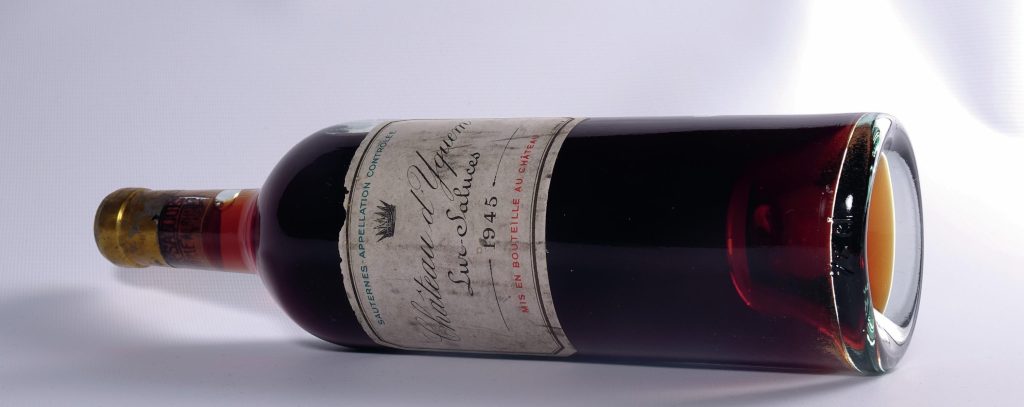
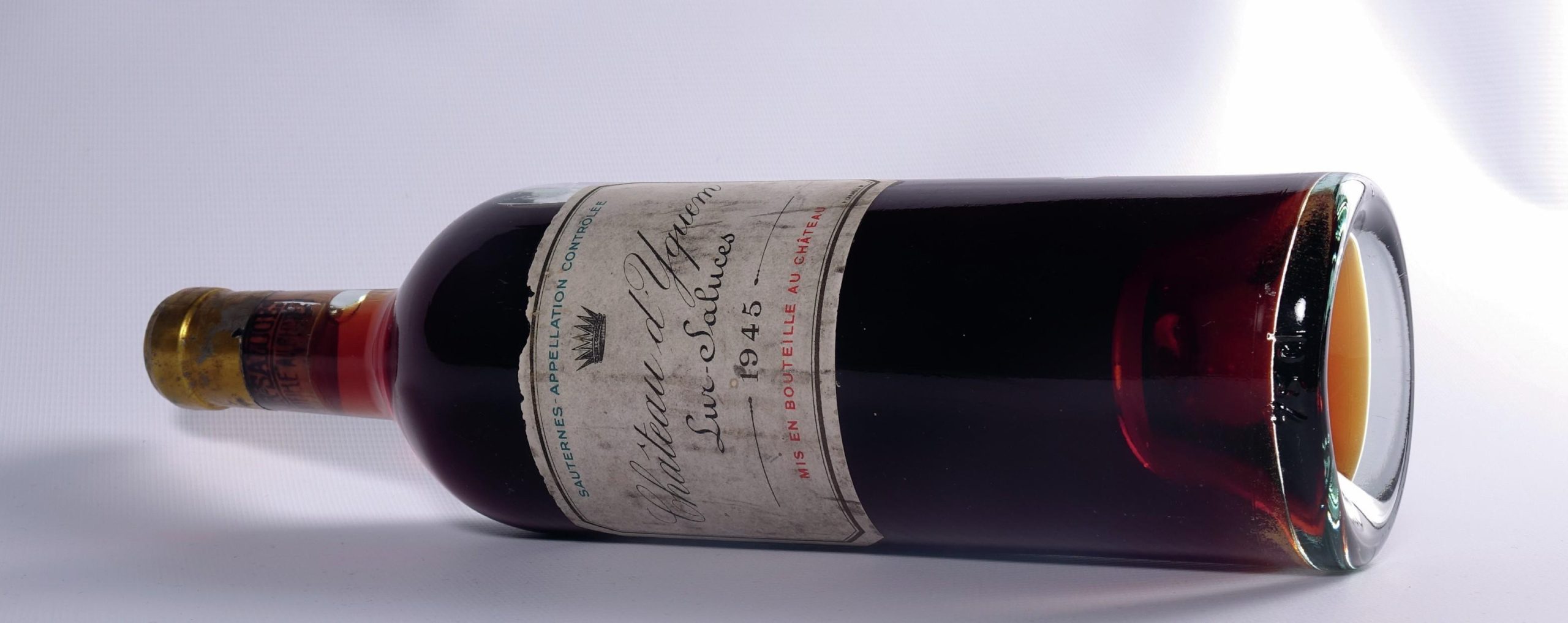
This approach has translated into extraordinary resilience at auction. When it comes to Bordeaux vintages, few years carry the same mystique as 1945.
The importance of provenance
Appearing at auction at most once a year, prices vary dramatically depending on provenance and condition. In March 2025, an impeccably preserved bottle – with excellent fill and a well-preserved label – sold for €4,256. By contrast, another bottle of the same vintage, sold just as this article was going to press in January 2026, but with a lower level, fetched €3,192, just below its €3,500 estimate. Condition sensitivity has never been more acute, particularly for wines approaching their 80th birthday.
The 1947 vintage, less politically historic but equally revered among Sauternes collectors, is estimated at about €1,866 today. Its scarcity is striking; it hasn’t appeared at auction in nearly three years, and only a handful of times over the past decade, when values hovered closer to €1,500.
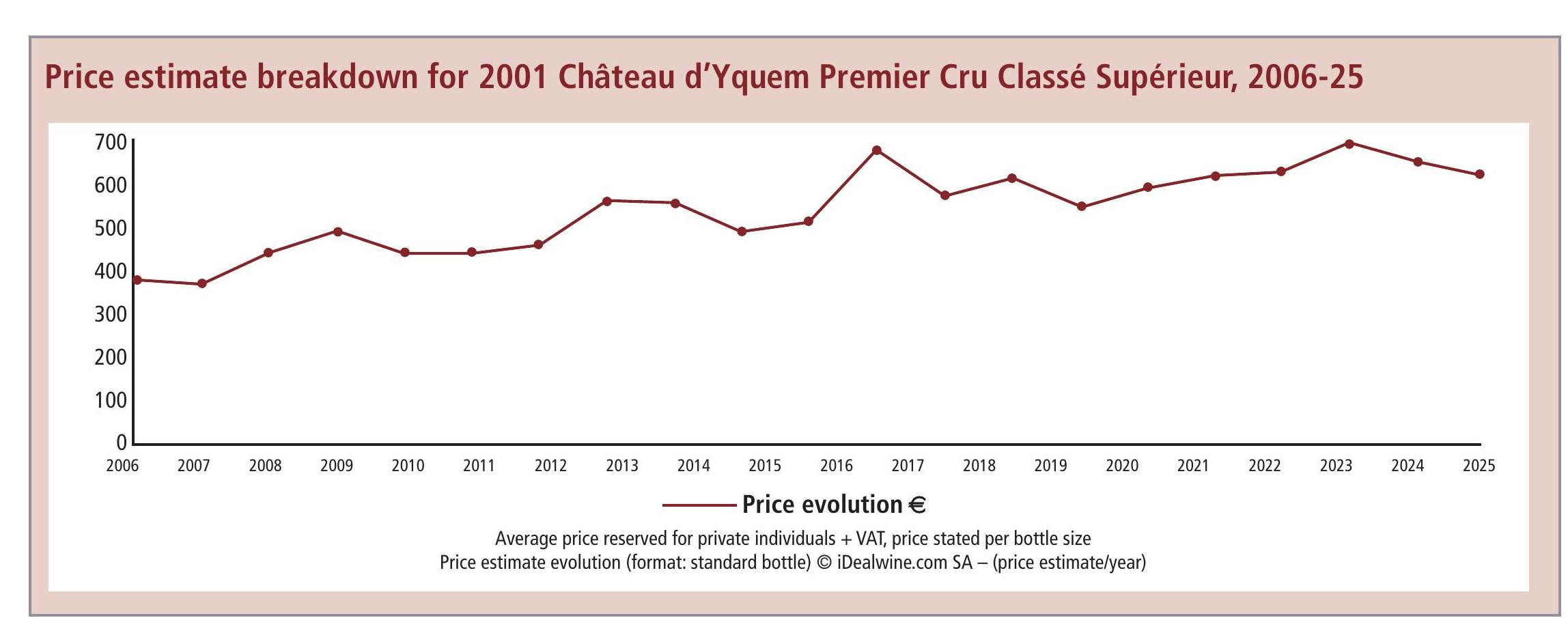
Looking to the 21st century, Château d’Yquem 2001 is increasingly viewed as a modern benchmark. Universally acclaimed – with perfect scores from all major critics – it first appeared on the secondary market in 2006 at €377. Twenty years later, it is expected to fetch around €613 at auction. This steady, patient rise (see chart opposite) perfectly illustrates the Yquem price curve: values tend to remain stable for many years before appreciating gradually over two or three decades, mirroring the wine’s extraordinary drinking window, which can extend well beyond a century.
In fact, longevity defines the entire category. Taking the top 20 highest-priced Bordeaux bottles sold at auction in 2025, the average age is 75 years. Over the past 12 months, the oldest Bordeaux wines sold were all sweet wines: a 1906 Sauternes Château d’Arche (€2,191), Yquem 1945 (€4,357), Suduiraut 1929 (€1,628) and Climens 1926 (€1,127) ranked among the highest hammer prices of 2025.
A recent summer visit to Château d’Yquem for an iDealwine client dinner reinforced the point that these wines are designed for the table as much as for the cellar. Following a tour of the winery, the evening opened with 2021 Château d’Yquem as an aperitif, tasted young to illustrate the estate’s current focus on balance and freshness from the outset. Alongside Y d’Yquem 2016 (the estate’s dry white), two vintages of the grand vin were served: the youthful and energetic 2016, and a deeply complex, fully evolved 1986.
Partner Content


Perception is key
The tasting, which included several vintages both old and young, highlighted the versatility of Sauternes, when given a little breathing space, that goes beyond an indulgent festive lunch. As sun set over the vines, the experience reminds us of simple truth: these wines are meant to be shared, not merely cellared.
The fundamental issue facing Sauternes in 2026 is not quality or price, but perception. It is hard to think of a fine wine that comes with as many preconceived ideas. Beyond the rarest bottles of Yquem, price appreciation for recent vintages is likely to remain limited in the short to medium term. Yet for wine lovers seeking profound, mature wines at reasonable prices, Sauternes remains one of the most compelling opportunities in the fine wine market.
These are wines that reward patience, both in the cellar and at the table. Their values may rise slowly, but their ability to transcend time remains unmatched. In an era obsessed with immediacy, Sauternes stands as a quiet reminder that some of the greatest pleasures in wine unfold at their own pace.
Top vintages: 1900, 1921, 1937, 1945, 1947, 1955, 1959, 1975, 1983, 1989, 1990, 1996, 1997, 2001, 2005, 2021.
auction update – in association with iDealwine

About iDealwine.com
• Founded in 2000, iDealwine is France’s top wine auctioneer and leading online wine auction house worldwide.
• Fine Spirits Auction (FSA) is iDealwine’s dedicated spirits platform, launched in partnership with La Maison du Whisky, a French specialist in high-end spirits since 1956.
• Based in Paris, with offices in Bordeaux and Beaune, and internationally in Hong Kong, Singapore and New York, iDealwine sources rare bottles from European cellars, private collections and direct from producers before meticulously authenticating and shipping to enthusiasts, collectors and trade customers worldwide.
• If you are keen to sell your wines or spirits, check out idealwine.com.
Related news
Brooklyn Beckham and Nicola Peltz dine with a 1811 Château d'Yquem
19 March 2025: the Yquem Day that nearly wasn’t
Chateau Yquem to release ‘hothouse’ Y 2022 and unveils historic release from its cellars


