



Rift grows in regenerative viticulture movement
Regenerative viticulture risks becoming “a small, fancy club” if it is tied too closely to organic certification, according to wine writer Jamie Goode, as producers push for a more flexible approach. Andrew Neather reports from Domaine Lafage in France.
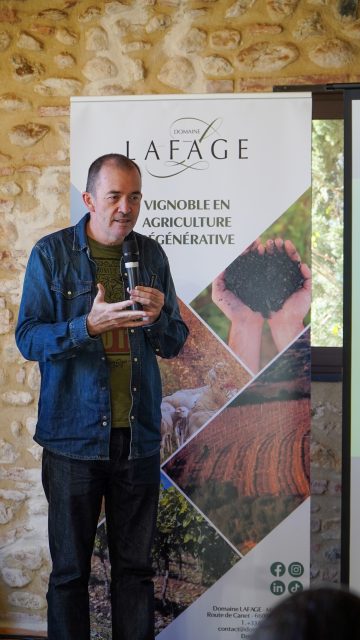
Leading viticulture authority Jamie Goode has slammed the insistence of some regenerative bodies on growers also being organic. Speaking this week in Roussillon at a forum hosted by regenerative winemaker Domaine Lafage, Goode said, “If we tie regenerative viticulture to organics, it’s finished… It will be a small, fancy club for people to feel good about themselves. It’s bullshit. The ROC [Regenerative Organic Certification] approach is nonsense.”
His comments highlight a growing rift in the fledgling regenerative movement between the biggest US certification body, ROC, and others over the issue of whether producers need to be certified organic first (as under ROC rules) before being regenerative. Domaine Lafage is the latest prominent producer to have instead chosen regenerative certification via non-profit A Greener World, which does not require growers to be certified organic. Other bodies including Regenified and Napa Green similarly to do not demand organic conversion.
Regenerative viticulture has attracted huge interest over recent years, especially in California. It focusses on improving soil health and the soil’s level of organic matter, using methods including cover crops, mulching, integrating of grazing animals in the vineyards, and not tilling the soil.
In January 2025 the Viticulture Foundation (RVF) launched its One Block Challenge in Paso Robles, where growers try farming just one block or row regeneratively to see how it works. That has attracted significant interest, with around 50 local growers taking part in the trials. The RVF has set a target of 10 per cent of viticulture becoming regenerative by 2035.
Last week’s forum was addressed by RVF trustee Justin Howard-Sneyd MW. The RVF is agnostic on the role of organic certification, though Howard-Sneyd told attendees that “In some regions organic makes sense, in others it just doesn’t.”
“We need local adaptation,” said Goode.
Wayne Copp, Executive Director of A Greener World, takes a similar view. Copp is a career organic farmer from Devon but argues that the urgency of environmental threats means that farmers need a more flexible response than that allowed by organic regimes. His organisation works out detailed five-year plans with growers for them to adopt key regenerative methods, followed up by inspections.
“The climate crisis needs action now – we need to move the needle at scale,” Copp told DB: “It’s important to be inclusive, so that the perfect isn’t the enemy of the good.” He says that A Greener World’s approach is rigorous but not rigidly prescriptive. The organisation is now working with growers supplying Provence’s Maison Mirabeau, France’s only ROC-certified producer, and California’s O’Neill, the largest ROC-certified winery.
Domaine Lafage illustrates the challenges with its own adoption of organic and regenerative principles. It has previously won organic certification for a substantial portion – 66 hectares – of its vineyards, but has now abandoned efforts to certify more plots.
Partner Content


Owner Jean-Marc Lafage told DB: “we can’t be organic everywhere.” He says that he lost two vintages in a Grenache vineyard close to the sea that is prone to mildew while trying to convert it to organic production. But, he added, “we feel comfortable working in regenerative.” Domaine Lafage is also certified regenerative by the Regenerative Viticulture Alliance, the body in 2023 founded by Spanish wine grandee Miguel Torres.
Nevertheless, going regenerative has involved considerable investment for Lafage – in changing drainage systems, buying in biochar, a carbon-rich form of charcoal used in preparing soil, and building a new facility to treat winery waste water though vermiposting (using worms). “It’s a huge investment in the soil”, Domaine Lafage’s R&D director, Antoine Lespès, told the forum as he set out the costs per hectare in detail. “It’s really about the reconstruction of ecosystems.”
Nevertheless, regenerative viticulture is attracting growing attention in France: a Lafage open day dedicated to the subject last year attracted around 80 growers, some from as far away as Champagne.
Regenerative farming is particularly relevant in Roussillon because of the region’s severe recent water shortages, an issues addressed at the forum by Alain Deloire, Professor of Viticulture at Montpellier research institute SupAgro. In 2025 the region saw no rain from mid-June to mid-October. But regenerative methods have been shown to improve soils’ water-holding capacity: Lafage says that this can postpone the start of vine stress during drought by a month. There are also local problems with soil erosion, which can be addressed by “regenerative hydrology” to change the ways vineyards drain.
Increased interest in regenerative farming comes as French organic producers are still digesting the likely impact of last September’s decision by food safety authority Anses to ban most powdered copper-based pesticides in France, on the grounds of worker safety. Copper-based fungicides are organic growers’ main defence against downy mildew in particular. Howard-Sneyd told the forum that he believes France’s lead on the issue is a pointer to the direction of future EU policy. He argues that “regenerative is getting ahead of the curve” in terms of vineyard health by having a much more holistic approach than by concentrating on inputs as organic certification regimes do.
About the event
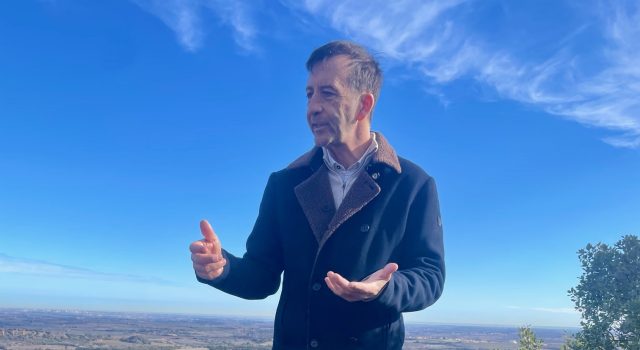
Domaine Lafage Regenerative Viticulture event took place at Mas Miraflors, Perpignan, on Wednesday 28 January 2026 (9.30am–5pm) – just at the end of Millésime Bio.
It was a one-day symposium exploring “How to adapt Mediterranean viticulture to climate change” – presenting five years of research in regenerative agriculture at Lafage, with contributions from Prof. Alain Deloire, Dr Jamie Goode, Justin Howard-Sneyd MW, and Jean-Marc and Eliane Lafage.
Read more
‘It’s the Wild West for regenerative viticulture right now’
Related news
Inside Perrier-Jouët’s regenerative push
Maison Telmont becomes the first Champagne House to be Regenerative Organic Certified
Why regenerative viticulture could be key to fine wine's future


