



Crop thinning key to quality in 2023 from Domaine de la Romanée-Conti
London this week played host to the first showing of Domaine de la Romanée-Conti’s wines from the 2023 vintage – a year in which cutting back the crop proved key to the quality.
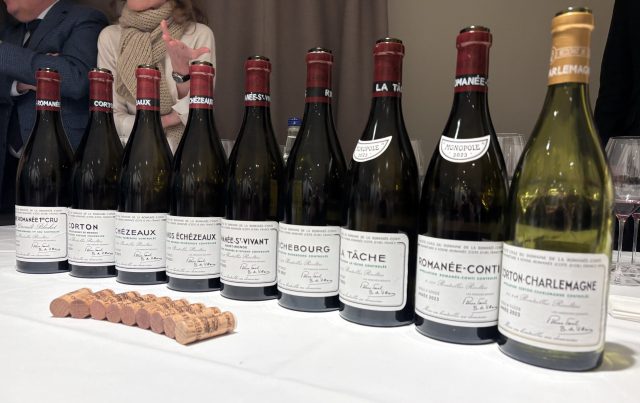
When one considers that this Burgundy estate is the source of the most expensive wine in the world – a place where every bunch is treated with the utmost care to yield the ultimate expression of Pinot Noir – the idea of discarding grapes before the harvest begins seems painfully wasteful.
But that is precisely what the co-directors of the Domaine, Perrine Fenal and Bertrand de Villaine, chose to do in 2023. And, it was a move they stressed at a tasting on Tuesday was vital to the quality of the resulting wines from a vintage that was abundant, yet challenging – both in terms of weather conditions and disease pressure.
Fenal explained at the launch event, held at the estate’s UK importer Corney & Barrow, that the wines would have been very different had the team not intervened to reduce yields via a ‘green harvest’, which involves removing some bunches before they are fully ripe.
“Due to the green harvest, we had a better maturity than if we had kept all the quantity,” she said, adding that without such intervention, the same results would not have been achieved.
So why was a crop-removal desirable? For a start, 2023 was a generous vintage, with both a high number of bunches and unusually large berries. This was the result of a “very successful flowering from May 20 to June 10,” Fenal explained. This was followed by “summer rainfall and then a short warm period, which allowed good fruit set and favourable berry growth.”
With July and August proving “rather humid”, she said that “berry size increased, and there was botrytis in certain areas”. Consequently, “a high crop and large berries meant that green harvesting was necessary.”
Another factor was the delayed development of colour in the grapes, known as véraison, during what was a relatively cool summer. The domaine’s directors were concerned that not all bunches would reach “sufficient phenological ripeness and balance.”
At the end of August, however, the first of two heatwaves arrived, “causing sugar levels to rise rapidly,” Fenal noted. Despite this, she and de Villaine held their nerve, waiting until 5 September to begin harvesting, starting with a parcel of Grands Echézeaux. This took place during a second period of “intense” heat, when temperatures reached 40°C.
Speaking of those conditions, Fenal said: “It was almost unbearable. We had to bring water to the pickers, while the grapes were becoming heavy and hot like us – sometimes shrivelled from dehydration, even a little sunburned.”
Partner Content
Such high temperatures at the end of summer and during harvest have led some to believe that the 2023 vintage resembles 2022, which was very hot and exceptionally dry. However, Fenal warned against drawing “hasty conclusions”, adding that the two years produced “very different wines”, while emphasising that 2022 “was much more extreme”.
De Villaine agreed, commenting that both should be classed as “unusual vintages” but not the same, adding: “We moved from the exuberant 2022 to this one, which is more serene.”
What the two years do share is the size of the yields, with de Villaine noting that 2022 and 2023 were the two largest crops the domaine had ever experienced.
However, thanks to the decision to thin the crop – and to harvest either during or after the second heatwave – the grapes in 2023 achieved “a high level of natural maturity,” according to de Villaine. He later added that it was “higher than we have ever had, and all the wines are over 14% [abv], before commenting, “That is exceptional.”
The overall quality of the bunches in 2023 was very high, largely due to vineyard management at this biodynamically run domaine.
This was because the viticultural team spent the growing season repeatedly passing through the vines, “cutting out grapes that were not going to ripen or were affected by disease,” Fenal explained.
De Villaine added: “We worked in the vineyard to get the best vegetal material nature can give. What we could humbly call a success was the decision to undertake a green harvest, leaving fewer grapes and allowing us to manage maturation more precisely.”
Following this, careful sorting by the pickers at harvest time ensured that nothing entered the fermentation vats that was neither under nor overripe.
More generally, de Villaine commented on the difficulty of managing the domaine during a modern period of increasingly erratic weather conditions. He said, “We have sun when we don’t need it, and rain when we don’t want it.”
Related news
Domaine de la Romanée-Conti delivers “beauty and abundance” with 2022s
Domaine de la Romanée-Conti 2021: elegance in the face of adversity


