



The alchemy of Auvenay
No name enlivens a discussion of Burgundy quite like Lalou Bize-Leroy. Her smallest property, Domaine d’Auvenay, has moved from cult status to near-myth in the fine wine auction market, with prices soaring over the past five years.
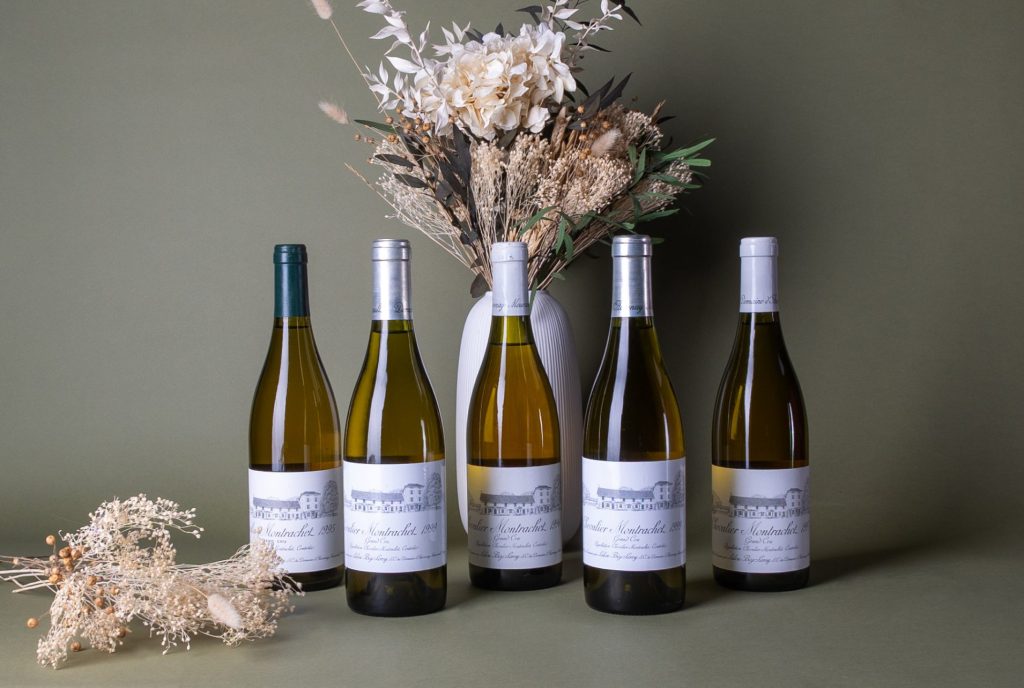
Anyone who has visited the Côte d’Or will recognise the vineyards belonging to Lalou Bize-Leroy instantly. Whether under the banner of Domaine Leroy, Maison Leroy or the tiny Domaine d’Auvenay, they stand out as tumbling gardens of Eden. From these plots come some of the world’s most sought-after Chardonnays (as well as highly coveted Pinot Noir and Aligoté), whose scarcity and quality have propelled them to the very summit of the fine wine market.
Bize-Leroy, now in her 90s, is the daughter of winemerchant Henri Leroy, who famously acquired half of Domaine de la Romanée-Conti (DRC) in 1942. She took over Maison Leroy in the 1950s, launched Domaine Leroy in 1988, and for two decades jointly-managed DRC alongside her cousin, Aubert de Villaine, retaining a 25% share to this day. While building up the Leroy domaine with other quality parcels, she bought a secluded farm perched in the hills above Saint-Romain; this would become Domaine d’Auvenay, later including inherited plots acquired between 1989 and 1995.
Today, Domaine d’Auvenay covers just 3.87 hectares of vineyard, spread across no fewer than 16 appellations, including grands crus in both the Côte de Nuits and the Côte de Beaune.
Of this disparate patchwork of microscopic vineyards, some of the smallest are the most prestigious, including the postage stamp-sized 0.064ha of Criots-Bâtard-Montrachet Grand Cru and 0.163ha in Chevalier Montrachet. Production is correspondingly tiny, with only a few hundred bottles produced from some parcels.
Biodynamic focus
A force of nature in Burgundy, Bize-Leroy is known above all as a fervent subscriber to biodynamics. She is no stranger to experimenting, every year refining technique both in vineyard and cellar. Vines are painstakingly debudded. No green harvesting or pruning is done, as this would be tantamount to “amputating” the plant for Leroy.
Maintaining the top branch of each vine (with weaving) serves to draw energy away from grapes, resulting in small, intensely aromatic berries. Leroy was the first to roll her canopies this way, rather than pruning, thereby curtailing the vine’s vigour naturally.
Yields are kept deliberately and exceptionally low – around 15 hectolitres per hectare, compared with a regional average closer to 40hl/ha. Long derided by sceptical winemaking neighbours, her pioneering approach has since inspired a generation of producers.
In the cellar, practices mirror those at Domaine Leroy. Chardonnay is harvested at full ripeness, rigorously sorted and fermented naturally in oak barrels. Red wines are vinified without destemming and aged in new oak. The results are wines of remarkable energy, density and precision, often requiring two decades or more to reach their full expression. Even modest appellations such as Auxey-Duresses achieve an almost transcendent quality.
Another Gear
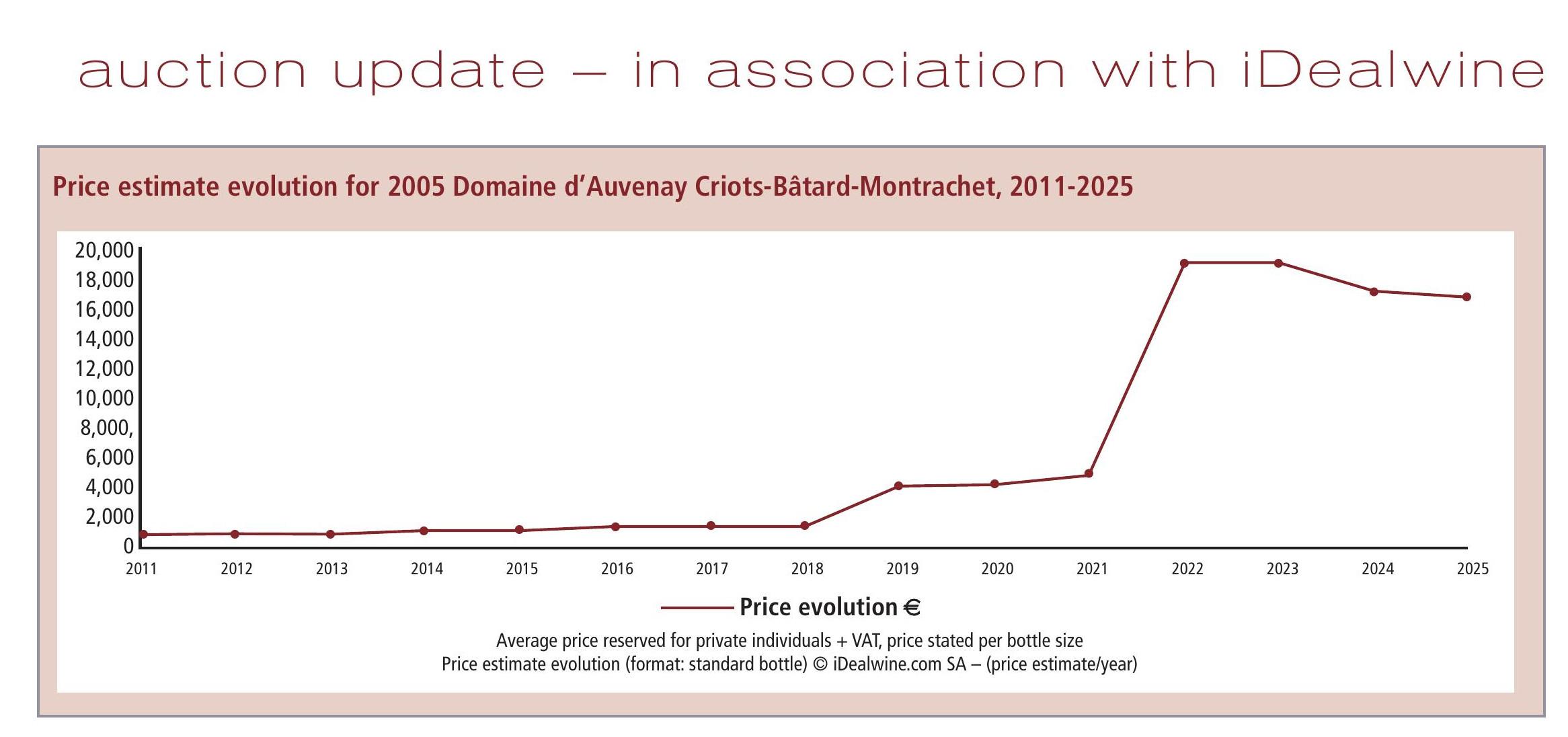
Five years ago, Domaine d’Auvenay was already making headlines for its “exploding” auction prices. Since then, the market has shifted into another gear altogether. Criots-Bâtard-Montrachet Grand Cru may now be the fastest-rising fine wine in the world. In 2020, a 2005 vintage fetched €5,403 on iDealwine (which was noted as a remarkable price at the time). In late 2024, the same wine, from the same vintage, sold for €16,875 on the French auction website, to a Polish collector. Ultra-rare, the same wine did not feature in any 2025 auctions on iDealwine.
Demand at auction continues to intensify, at every level. In 2024 (final 2025 figures unavailable at the time of writing), Domaine d’Auvenay ranked second on iDealwine for average hammer prices, behind only Domaine de la Romanée-Conti. Top results included several grands crus, but also “simple” Meursault village wines from the 2002 vintage, which fetched a dizzying €4,500 in 2024 and a staggering €5,250 in 2025.
Early indications from 2025 suggest that the upward trajectory is continuing. Scarcity, coupled with insatiable demand, has produced auction figures to match. Two bottles of 2002 Chevalier-Montrachet Grand Cru sold for over €14,000 each, and average prices for Domaine d’Auvenay rose by almost €300 in early 2025. With the busiest auction season just wrapped up, further records seem not just possible, but likely.
The estate’s reds remain equally elusive. Bonnes-Mares and Mazis-Chambertin regularly command more than €10,000. Even the often-snubbed Aligoté variety inspires awe: 2010 Sous Châtelet sold for €921 in 2020, a famous price at the time. In 2025, several auction lots went under the hammer, with an average hammer price of €2,250.
The trailblazing Lalou Bize-Leroy has undoubtedly earned her place in the fine wine hall of fame as a pioneer of biodynamic Burgundy. She considers herself not the creator of her wines, but their guardian. Should you be lucky enough to acquire a bottle of Domaine d’Auvenay, guard it carefully in your cellar – and for at least a decade or two.
About iDealwine.com
• Founded in 2000, iDealwine is France’s top wine auctioneer and leading online wine auction house worldwide.
• Fine Spirits Auction (FSA) is iDealwine’s dedicated spirits platform, launched in partnership with La Maison du Whisky, a French specialist in high-end spirits since 1956.
• Based in Paris, with offices in Bordeaux and Beaune, and internationally in Hong Kong, Singapore and New York, iDealwine sources rare bottles from European cellars, private collections and direct from producers before meticulously authenticating and shipping to enthusiasts, collectors and trade customers worldwide.
• If you are keen to sell your wines or spirits, check out idealwine.com.

Related news
Garcés Silva: fresh thinking from Leyda
Christie's to sell Burgundies from renowned British collector Ian Mill KC


