



Beer Hour: Derek Prentice MBE
Derek Prentice MBE is known widely across the industry as one of London’s most experienced brewers. Decorated with lifetime achievement awards, he is, as many will attest, a bit of a legend. In a new series, Jessica Mason reports.
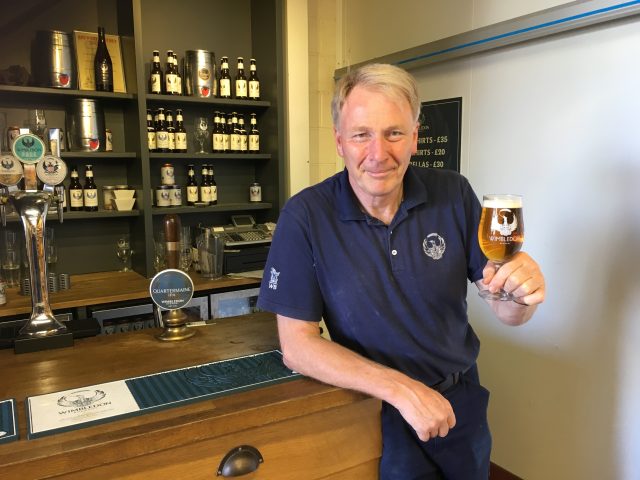
In 1968 and still a teenager, Prentice joined the beer sector, first taking a job with Truman Breweries which was based on Brick lane in London’s east end and from there he worked his way up from lab technician right through to brewer.
Skillset
But there are possibly few brewers who are also former luge champions. In fact, his MBE is for his services to the sport, which he received as part of the British Royal Family’s annual New Year’s honours list last year.
He explains: “I enjoy sports. Sadly, nowadays, mainly as a spectator and I very much enjoy going down to watch my local rugby team. I have been involved in the winter sport of luge for many years, initially as an athlete and then in training and organisational positions both within our national and international federations.”
By the seventies, Grand Metropolitan acquired Truman and Prentice absorbed a role to oversee other sides of the brewery. No longer a brewing novice, he oversaw the production process from all sides, from packaging to brewing operations.
In the 1980 Olympic Games, Prentice raced at the Lake Placid where he finished 22nd in the men’s singles and 14th in the men’s doubles with Christopher Dyason.
London calling
Still brewing, his adventures continued and further into the eighties Prentice joined breweries like Young’s in Wandsworth and was there until it closed in 2006 – a situation that many Young’s beer fans lamented and yet saw him move again, this time being snapped up by Fuller’s in Chiswick. London just kept calling. Good brewers who had learned the ropes from the ground up were rare. But Prentice’s reputation continued to flourish.
By the mid noughties. Prentice got to know Mark Gordon and the two of them worked together to create what is now known as Wimbledon Brewery, a project that revived brewing in the area around 125 years after the site’s original brewery burned down.
From this point there seemed to be, in so many ways, a sense of returning London to its roots. Prentice, by this time, had truly had a hand in making some of London’s most famed beers. But, self-deprecating as he was, often shrugged off the big names as simply “experience”.
Speaking about his position within the beer sector, Prentice explains: “It was a privilege to brew very established beer brands such as Young’s Bitter and Fuller’s London Pride.”
He also reflects on how it was all not just a “privilege” but also an “opportunity” and seems to assess much of his career this way.
Cask champion
“I was also very fortunate to have the opportunity to introduce some new beers over the years,” he remarks.
Prentice looks back and remembers that “in the middle of the 1980’s, cask beers were re-introduced into Grand Met brewing and I was a member of the team that brought Truman Bitter, Truman, Best Bitter and Samson into the portfolio”.
Then, looking back at the beers that he made and what he really has had a hand in creating, he recalls: “At Young’s I was instrumental in the introduction of Special London Ale as a bottle-conditioned British style IPA and Young’s Double Chocolate Stout.”
Career development
Reflecting on his time in Chiswick, he adds: “Again, while brewing manager at Fuller’s, I developed another British style IPA for the export market which was then launched in the UK as Fuller’s Bengal Lancer.”:
Each achievement trips off the tongue, casually. He remembers brewing cask Gales Seafarers and admits “It was a new recipe I was particularly pleased with”.
All of it a pleasant memory of a job well done. No ego, no pomp, just a little personal pride in having a hand in creating something good.
Still brewing, Prentice reveals that he “first became involved in Wimbledon brewery early in its conception in 2014”.
At the time, the beginnings of Wimbledon Brewery possibly seemed like quite the project. After all, being a lead consultant for a new brewery and being so integral to its set-up was not something he had ever done before. Sure, he had enjoyed “a fairly long career in mainstream brewing” but was he the right person to introduce new beers to the capital? It turns out, he was. In London especially, it could be said that he was the best person for the job.
‘A more integral role’
Look at Prentice’s curriculum vitae and you’ll read him as a London brewing aficionado: “Truman’s, Grand Met, Young’s, Fuller’s”, he muses were all the experience any London brewer might require. Looking forward, always, he explains: “Then, I met with Mark Gordon, the founder of Wimbledon Brewery.”
Did he immediately want to get involved in building a new brewery in London from the ground up?
Partner Content

“I consulted for a while and then took a more integral role in the business which opened in 2015,” he says. Really, Prentice was one of the most qualified people in existence for the role.
At Wimbledon Brewery, Prentice “had a guiding hand only with most of the beers” and, reveals that instead, he really likes to “put the recipes in the hands of the brew team there”.
Recommendations
His recommendations for beers to try within the Wimbledon range are many. He insists: “I feel the Copper Leaf, Common Pale Ale, Quartermaine IPA, Gold Lager and XXXK Barley Wine all give me great pleasure when I drink them.”
Plus, he adds that there is one in particular that shines very brightly and points out that the Gold Lager is “outstanding in its category”.
Additionally, Prentice highlights how “on behalf of the brand owner Interbrau, Italy, for what is generally agreed to be one of the world’s most iconic beers, I advise on the brewing of Thomas Hardy Ale here in the UK.”
The beer was originally created as a nod to the “strong ale” described by the British writer and poet Thomas Hardy in his novel The Trumpet Major. It’s an historic feat to recreate it.
Shaping tastes
When you think of the London beer scene, it’s hard to not think that Prentice has helped shape its style. Not just in what we’ve been drinking, but which kinds of beers are lodged in the nostalgic parts of our minds.
What would Prentice brew wherever he laid his hat? He’s essentially an expert in traditional styles. Look to where he feels his brewing identity has really shone and you’ll find styles like “a traditional cask bitter, a British style IPA, a strong ale or barley wine and a well-brewed lager”.
Never has a brewer been so adept at looking backwards to look forwards. But, really, while many were religiously close to the beer, Prentice always made time for people. He really enjoyed connecting with others. With that, he dispenses some advice along with his gratitude for his career.
A team player
“Being able to enjoy one’s work or profession has been a real privilege but whatever work environment you are in, try to develop a strong team ethos and help to develop those within the team,” he says. This he is immoveable on. People matter.
With this in mind, he touches on the topic of the pubs that reflect similar people-centric values. There is that sense, once again, that he sees how much it takes a team of skilled hardworking people to make it all look easy.
“I live in South West London so I am fortunate to have half a dozen or so pubs within relatively easy walking distance including a specialist cask ale pub. I am also pleased to say that I make fairly good use of them. For me, a great pub is run by a licensee or manager and team who have a desire to make your visit there a pleasure with good, friendly service, beer in good condition which is well presented and good quality food even if it is only snacks that are on offer,” says Prentice, reiterating that core belief that doing a job well isn’t always about creating a fanfare, but gathering people who work hard to create the best that they can for the enjoyment of others.
Guidance
Looking at the beer industry in Britain right now, Prentice considers its pitfalls and notes how so many are struggling. It feels like it is across the board and is not avoiding big or small breweries, he suggests. After all, as a collective industry, “we are continuing to experience falling beer sales across the industry, tastes change and there are continuing financial and behavioural challenges affecting us all”.
But there is some solace and guidance that he offers – to see things as a fluctuation, but to find your place within it. That, he suggests, is a form of stability.
He explains that what happened with the brewing industry when so many were introducing “craft” gave it a bit of a shake up. It made it exciting again and hints that had been “welcome”. Especially for an industry that had otherwise been quite “closed” to anything new.
Indeed, as he observes, “the growth of the craft brewery sector over the last 30 years has been an exciting and welcome development to what had become a very closed and relatively mundane sector”. But, he admits: “With continuing falling volumes the number of breweries are unsustainably high, I fear there will be continuing brewery closures”.
‘Quality and consistency’
Are there ways to avoid this? Prentice considers and reflects on what has been and what is the current situation now. Knowing where you fit within the scene seems to win as the best way to roll with it. Reassuringly good beer never fails, it seems.
“I believe quality and consistency are hugely important for any brewer to survive,” he says.
The art of garnering attention remains a mainstay of the new and the brave, and Prentice understands that too.
In his own words, he believes that “innovation has a role, as does brand image and presentation, but he says he still has faith that “there continues to be a place though for balanced well brewed traditional styles”.
“I think for any business if you are able to exceed your customers expectations in terms of service, product, providing good value for the money — which is not necessarily the cheapest — then you stand a good chance of having a successful business.”
Related news
Germany’s Bitburger overhaul taps into movement for ‘cleaner' beer


