



WSET’s Simon McMurtrie: ‘I hope to be an enthusiastic cheerleader’
In a wide-ranging discussion with Michael Huband, the outgoing chair of trustees at WSET discusses cultivating the right culture, the Covid crisis and life both before and after WSET.

Interviews in the drinks trade often take place on international calls, in large open board rooms or – regrettably – in too loud cafés. So receiving an invitation to speak with Simon McMurtrie, the outgoing chair of the board of trustees at WSET, at London’s 67 Pall Mall is a welcome change of pace.
I’m curious, however, as to why he’s chosen the venue for our meeting. It could be the view of St. James’s Park, a vista sufficiently prized that a royal palace sits practically next door. It could be the oysters – bracingly briny, as they should be. And, of course, it could be the wine list: he opts for white Burgundy and I am persuaded – not that it takes much – to pick a Saumur Chenin Blanc.
All make sense, and the sheer joy of wine is a refrain McMurtrie returns to again and again, whether through the lens of drinking, reading or study. Yet the real reason is somewhat simpler, and reassuringly on-brand.
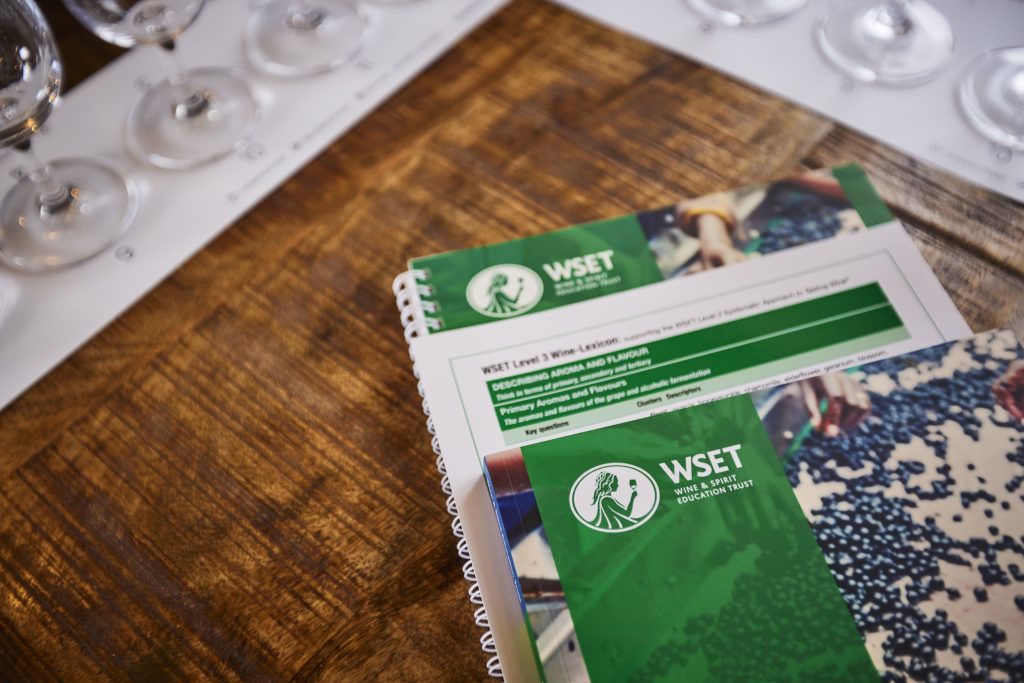
It transpires that WSET has a partnership with 67 Pall Mall, enabling members to study some of their courses there. That is, not unreasonably, a chance for Simon to wax lyrical as to the breadth and depth of WSET’s Approved Programme Providers (APPs) right across the globe offering wine, spirits, sake and beer courses to students – both consumers and people working in the trade.
While the venue has a touch of luxury, it serves a practical purpose to demonstrate just how far WSET has come. That says something of McMurtrie too; for all the speeches and public-facing appearances, Simon seems just as happy to get on with the practicalities without fanfare. He approaches his impressive CV with both modesty and clarity. Even in discussing his role chairing the trustees – a vital role in the organisation and governance of the charity – he is quick to share achievements among his team.
As the diligent man in the background, perhaps that is why his tenure at WSET has been such a success.
A life in education
To understand McMurtrie’s approach to the role, it warrants looking at his experience. Although there is no direct path to the role of trustee, McMurtrie’s appointment is a fitting continuation of his career.
His first major role in the world of wine was in publishing. In 1991, he became publisher and managing director of Mitchell Beazley, the imprint that brought the likes of Hugh Johnson, Jancis Robinson MW, Oz Clarke and Steven Spurrier to bookshelves.
It was, in its way, wine education, particularly given that WSET, at the time, still had a somewhat old-fashioned, traditional education sensibility.
“At the time, WSET’s materials were somewhat dry and academic,” he explains. “Mitchell Beazley fulfilled the critical role for people in the wine trade and general consumers, to provide engaging and informative wine content.”
His first serious brush with the education charity, however, came in his work with Direct Wines, the parent company of Laithwaites, from 2007 onwards.
“When managing director for international expansion at Direct Wines, I could see that under the then relatively new CEO, Ian Harris, WSET had evolved considerably,” he explains. “I decided that I should study WSET’s Level 3 Award in Wines and Spirits, both to help me do a better job in my role at Direct Wines, but also to understand how wine education had evolved since my time at Mitchell Beazley over 10 years earlier.”
It soon became more than a brush with the institution. On being made CEO of the Direct Wines group in 2008, he reinstated it as a Gold Patron of WSET (now referred to as partners). He encouraged hundreds of employees in the UK and further afield to take the courses: not just the wine or marketing teams, but also warehouse staff, the IT teams, finance professionals and more.
“At its peak, 345 students globally across the company were taking WSET exams in the year,’ he says. It is seemingly a point of pride, rooted in his longstanding interest in training and development. “Open education for all should be a company benefit.”

The job of the trustee
Evidently, McMurtrie had an interest in WSET before he joined it. Yet it is undeniable that his tenure as a trustee, and particularly as its Chair, has been his most significant impact on the organisation.
At first, the proposition seemed quite a simple one, as he was selected according to specific criteria.
“I was invited to join the board of trustees in 2015 with a start date of December 2017. The then CEO, Ian Harris, was keen to have someone experienced in international business available so as to be a candidate to succeed Nick Hyde as Chair in December 2020. Among other things I would have the responsibility to lead the process for recruiting a successor to Ian, as CEO, and have appropriate experience to manage a smooth transition on Ian’s retirement from WSET.”
That process of managing transitions and contributing to a smooth operation has been a hallmark of McMurtrie’s time. Quite aside from finding that suitable candidate – Michelle Brampton has been in post since 2022 – he has also been instrumental in finding his own successor as chair of the board of trustees. Tamara Roberts’ appointment was revealed last month; “Tamara has exactly the right experience, personality and integrity” is McMurtrie’s succinct assessment.
Much of his work at WSET has built on the same skills he developed outside the charity sector. His guiding principles have been to help WSET to focus on what is important (rather than necessarily urgent) and to develop a leadership team that both encompasses talent and can work effectively together.
He has also had to adapt to the peculiarities of running a charity. Clarity has been key: he has sought to delineate the separate but interlinked bodies of leadership team and trustees, thus eliminating friction.
Partner Content


In particular, as chair, he has tried to make use of his experience while understanding the limits of his role. “The business must be run by the CEO,” he advises. “You need to be there as a sounding board.”
But, again, there is an easy smile bookending his assessment. “In both business and the charitable sector, it is critically important that you create a culture so that people can have fun, however hard an economic backdrop might be.”
Into action
That is not to say, of course, that McMurtrie’s time as a trustee has been solely mellow meditations on the nature of leadership. With varying degrees of urgency, control and stress, he has helped WSET take decisive action in recent years.
“There’s always something blowing up at any moment in the wine industry,” he reasons. Others, you suspect, would put it less politely.
During his time at WSET, he has faced a number of unexpected challenges. Regulatory hurdles in China, for instance, forced quick thinking. Having expanded successfully into the country, a change in regulations meant that WSET quickly had to install a team on the ground. McMurtrie’s years of fast-paced business certainly came in handy.
And, of course, Covid-19 presented arguably the greatest challenge to WSET’s established existence in its history. Suddenly, WSET could not conduct the in-person education and assessment that had previously defined its existence.
“We had to shift online as fast as possible, and, to be honest, we pivoted extremely quickly,” he recounts. “In fact, it taught us that we could do a lot more – for instance, taking exams online through remote invigilation.”
Nobody would wish for a pandemic, but it did provoke WSET to develop. Indeed, McMurtrie’s philosophy points to a cheery pragmatism in such circumstances: “Whenever there is a crisis, a good chair asks not just about solving a problem, but how it can be a solution for the future.”
Luckily, not all of his actions have been born of urgent necessity. For example, he was an early supporter of the WSET introducing the role of WSET honorary president, a position created in 2008.
“I’m really proud of my support of evolving the concept of honorary president, including making the switch from the great wine writers to the movers and shakers among wine producers being appointed,” he says. That saw a transition from the icons of wine literature – the likes of Michael Broadbent, Hugh Johnson, Jancis Robinson MW and Steven Spurrier – to a more international selection. During his time as a trustee, WSET has welcomed Paul Symington and Dr Laura Catena (the incumbent) to the role.
Looking back – and forward
This is not, it should be stressed, McMurtrie riding off into the sunset. As a liveryman of the Vintners’ Company, one of WSET’s four founding organisations, he will continue to support WSET in a less direct capacity.
Moreover, given his experience, WSET’s leaders would be foolish not to save his number for sage advice. It is a role he is perfectly content to play – should he be needed.
“I hope to continue to be available as a sounding board to the new chair,” he explains, “and to be a passionate cheerleader for the board of trustees and for the CEO and her leadership team.”
Still, with that distinctive mix of modesty and clarity, he is happy to let Roberts and her team get on with the job. Though he does, of course, have advice for her as she takes on the role.
“Be there for the CEO and their team as and when needed – both planned and ad hoc; draw on the tremendous skills and experience of your fellow trustees to support the leadership team and the overall charity as and when needed. And foster a culture of enjoyment, so that everyone – non-executive and executive – can enjoy as well as be proud of the part they play in contributing to the WSET’s global leadership in drinks education.”
As for his own tenure, he allows himself to look back with a modicum of pride.
“The quality, depth and breadth of experience and diversity of both the trustees and the leadership team has all never been greater,” he says. “I am also incredibly proud that we recruited a first rate CEO – Michelle Brampton has done and continues to do an outstanding job as leader of the WSET team.
“I’ve played a small part in cementing the WSET’s global leadership and achieving the quality, not just the quantity, of what we offer. I certainly hope that I’ve played my role in the WSET story – I look forward to being able to follow that story in years to come.”
As WSET’s 17th chair, he has been one of many to guide the institution. Nonetheless, describing it as ‘a small part’ is likely understating the experience, insight and efficiency McMurtrie has brought to the organisation.
This is a man, after all, whose choice of lunch venue is a considered decision to illustrate WSET’s position in the drinks trade. After eight years on the board of trustees, such decisions have placed the WSET in a better place than ever.
Related news
IWSR: 2035 will be 'vastly different' for the global drinks sector


