



New Year traditions from around the world
the drinks business takes a look at how countries around the world toast the old year goodbye and welcome the new.
New Year’s Eve in the UK has recently earned the reputation for being overrated, promising half-hearted countdowns, lukewarm prosecco and the annual commitment to finally start running. In other parts of the world people celebrate in very different ways. Some leap over waves, others eat grapes by the dozen and some toast with a spiced medicinal sake. Here’s a look at how different places ring in the new year – and of course, the drinks they toast with.
Scotland: first footing and whisky
Scotland’s Hogmanay is one of Europe’s most distinctive New Year celebrations. It is believed to have roots stretching back hundreds of years to pagan festivals that marked the end of the harvest and the turning of the year. At the heart of it all is first footing: the belief that whoever crosses your threshold first after midnight decides how your year’s going to go. Ideally, this person is a dark-haired man – a superstition often linked to historic fears of fair-haired Viking raiders.
A proper first footer doesn’t come empty-handed either. Traditional offerings include coal for warmth, a spiced fruit cake known as black bun, and occasionally salt or silver. In return, they’re rewarded with good company and generous pours of whisky.
First footing might not be quite as rigorously observed these days, but a wee dram of whisky known as ‘uisge beatha’, meaning ‘water of life’, is still very much non-negotiable when the bells ring. Often, it’s followed by a rendition of Auld Lang Syne, as partygoers join hands in a circle to bid farewell to the old year.
Spain: 12 grapes and a glass of Cava
In Spain, the tradition is simple: eat one grape with each chime of the clock at midnight. These ‘uvas de la suerte’, meaning ‘grapes of luck’, are usually washed down with a glass of Cava, promising good fortune for the year ahead.
The custom goes back centuries. Legend has it that an especially abundant grape harvest in the early 18th century left growers with more fruit than they could sell. To make the surplus appealing, they packaged the grapes in small bags and encouraged people to eat them at the New Year.
Today, the tradition has taken on a new life on TikTok, where people film themselves eating grapes under tables for a little extra luck in love.
Japan: medicinal sake and year-passing noodles
In Japan, New Year’s Shogatsu is one of the country’s most important holidays, with preparations beginning weeks in advance. From January 1st to 3rd, most businesses close, allowing people to focus on setting the tone for the months ahead. Central to the festivities is ‘o-toso’, a spiced medicinal sake traditionally drunk to ward off illness and evil spirits. Made by steeping rice wine with a blend of herbs, it’s served in a ritual order – vessels arranged by size, with the youngest family member drinking first. While the tradition has waned in some areas, for many it still represents good health and luck.
On New Year’s Eve, families also enjoy dishes of toshikoshi soba, known as ‘year-passing noodles’, a custom believed to date back 800 years when a Buddhist temple distributed soba to those in need.
Partner Content
Homes are decorated with different charms, including a display of the iconic ‘kagami mochi’ on the ‘tokonoma’, the family’s Shinto altar space. Two soft rice cakes are stacked neatly and topped with a small, bitter orange called a ‘daidai’.
Once festivities wind down, people gather at local shrines and toss their symbols into a ceremonial bonfire. Keeping last year’s charms at home is considered clinging to the past but chucking them in your household bin risks bad luck. Best to let the fire handle things.
In Tokyo, the Meiji Jingu Shrine in Shibuya and Sensoji Temple in Asakusa attract huge crowds.
Brazil: white clothes and seven waves
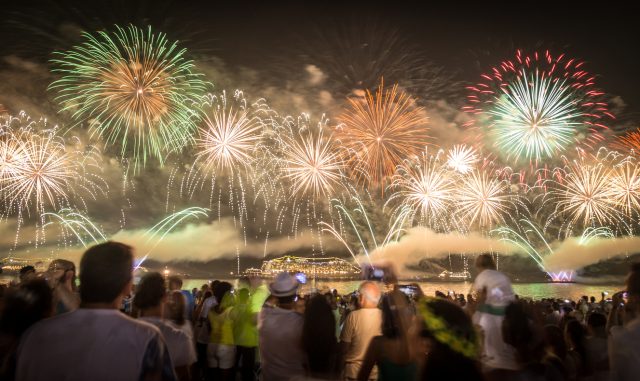
In Brazil, millions of people flock to the famous Copacabana shoreline in Rio dressed in white – a colour believed to bring good luck for the coming year. As the sun sets, the beach transforms into a sea of twinkling lights, fireworks, and music.
When the clock strikes midnight, many rush into the waves. Jumping over seven waves is a key ritual, with each wave representing a wish for the year ahead. People whisper their hopes and give offerings to Iemanja – the Afro-Brazilian goddess of the sea.
There are also Caipirinha stalls everywhere serving Brazil’s national cocktail, made with cachaça, lime, sugar, and ice. They are bright, punchy and dangerously potent.
Denmark: smashing plates
If Brazil is all about flowing waves and spiritual wishes, Denmark sits at the other end of the spectrum.
There is the tradition of smashing plates and old crockery on friends’ doorsteps – less common now, but still legendary. The bigger the pile, the better your friendships.
Danes also jump off chairs at the stroke of midnight, literally leaping into the new year. It’s a symbolic shedding of the old.
Toasts are made with bubbly and kransekage – a towering almond-ring cake. Champagne is the classic companion, while some families serve Akvavit, the spicy Scandinavian spirit known for warming up even the frostiest night.
Related news
China's baijiu makers battle slump as New Year sales approach


