



Where are they now? Malcolm Gluck – apostle of plonk
Malcolm Gluck, once the most provocative voice in British wine writing, remains as sharp and irrepressible as ever, writes Anthony Rose. Approaching 84, he reflects on a life of words, rebellion and unfiltered opinion.
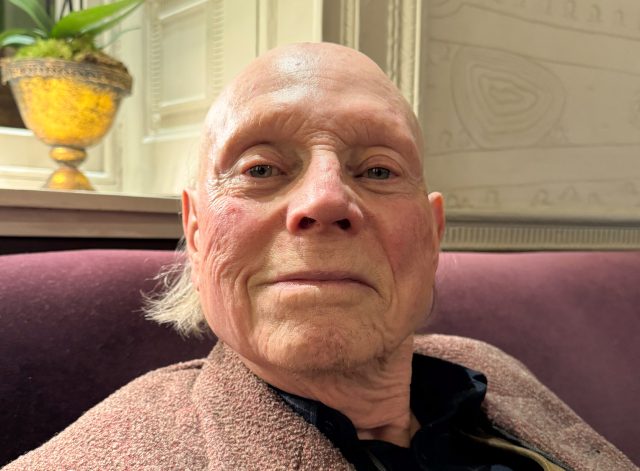
‘According to AI,’ Malcolm Gluck says when we meet, ‘I died in 2023.’ Despite wishful thinking doubtless generated by his detractors, news of his demise is greatly exaggerated. His body may look frail as he hobbles in on a crutch after a recent knee replacement, but his mind remains pin sharp — impressively so for a man nearing 84.
He’s taken the day off for our interview, but afterward he’s heading to a chess club in Hammersmith. What drives him? ‘Words, writing, the English language,’ he says. ‘Balayage.’ ’Balayage?’ ‘A French word for an arty hairbrushing technique — now in every British hair salon. I only discovered it last week.’ The word, not the actual technique, that is (see photo).
Surprisingly, when shown the wine list, Malcolm asks for tap water. A few years earlier, a three-day hangover after a family celebration had pushed him to detox. He felt so much better that he stayed alcohol-free for 18 months, and even when he returned to tastings, he found he preferred nosing wine to drinking it. Three years ago, he stopped altogether.
‘Too much alcohol dulls sensitivity to spiritual experience. Once you’re open to it, you realise life is extraordinarily spiritual — but most people are blind, deaf, and dumb to it. Alcohol blocks one of the great truths of human existence. And I feel much better in the morning.’ He has no cravings; when out with friends he’ll accept a splash in his glass to nose and discuss.
Born in Romford in January 1942, his earliest memory is seeing one of the last V2 rockets pass over his home at age three — a huge, black-finned shape with a flaming tail. Armed with a toy tommygun his father had made, he aimed at it before his father and older brother grabbed him and flung him into the air-raid shelter moments before the explosion.
He attended the local primary school and was placed on the grammar-school track, but he loathed uniforms and deliberately failed the 11-plus. The first book he remembers receiving was Stuart Little at age five; the one that truly hooked him was Man the World Over, a geography book whose picture captions taught him to read.
His Jewish father had run off with his non-Jewish mother after they met at a holiday camp in the 1930s. Once a printer with his own business, his father brought home ex libris, and young Malcolm devoured his parents’ thriller-club books — Agatha Christie, Leslie Charteris (The Saint), Berkley Gray, Francis Gerard, and Edgar Allan Poe. He started writing at nine or ten; at eighteen he finished his first novel, Finger of a Rhubarb Omelette, about eight pub drinkers killed by an IRA bomb whose merging souls reveal their intertwined lives. ‘Everyone said it was preposterous — quite right. Utter rubbish.’
He drifted through jobs — a hospital, a pet-food office, a waste-paper mill — before spotting an advert for Britain’s first advertising copywriting course at Watford College of Art. He lacked the required qualifications but applied anyway, completing a test that included persuading a Martian who never washes why soap is useful. He was accepted and adored the place, including the comic local football team.
‘The University of Life began when I became a copywriter. Not just solving problems and writing — the people. They introduced me to Soho, art, foreign literature, serious music, conversation.’ Early on he worked at what he calls ‘mediocre’ agencies, but he was fascinated by this world he’d improbably entered. ‘Many copywriters were ex-Oxbridge, failed novelists and poets. But I wanted to write advertising. In the early ’60s, UK advertising became professional-literate show business.’
At 22 he holidayed with his parents, driving through France to Barcelona. On 29 May 1964, in a Gaillac hotel restaurant, he noticed a glamorous French couple eating, drinking, and utterly absorbed in each other. ‘It was theatre,’ he recalls. His mother murmured that they’d sleep ‘like angels.’ They did not. Later, Malcolm watched them on the balcony, nearly naked, still entwined. ‘I didn’t realise human coupling could be so loquacious, gastronomic, vinous. I thought: this is the life I want!’
That same year, Marshall McLuhan published ‘The Medium is the Message’ — a phrase that would echo through Malcolm’s career. Bill Bernbach arrived in London in 1964, revolutionising the industry by pairing copywriters with art directors. Malcolm, unaware of Bernbach’s agency, noticed an Avis Rentacar ad in The Evening Standard: ‘Someone had written an ad the way I wanted to.’
In 1966, Doyle Dane Bernbach (DDB) offered him a job, confirming the path he’d glimpsed two years earlier. Another turning point followed: DDB’s creative director, a wine fanatic, took him to Henekeys and ordered a 1947 Château Cheval Blanc. ‘I said: it costs 75 shillings!’ But when he copied the sniff-and-swirl ritual, he was thunderstruck. ‘The perfume — unbelievable.’ A week later: a 1947 Château Margaux, equally extraordinary — the colour, the complexity, how it changed over two hours. A multi-sensual experience.’ He discovered Bordeaux-style Riojas at Cullens, and in the Whistler Room at the Tate in the early ’70s he and colleagues drank amazing yet affordable wines.
He read every book on wine he could find and discovered Oddbins in Covent Garden. His first purchase — three half-bottles of 1933 Smith Haut Lafitte — yielded ‘two bottles of vinegar and one that smelled like a distant sewer; an expensive lesson.’ Wine bargains were plentiful then: on his honeymoon in 1969, The Miners Arms in Somerset listed a 1949 Pétrus for £4. The owner insisted Malcolm wear a tie; Malcolm refused and stormed out with his new bride. No Pétrus.
That year DDB sent him to New York. ‘We sailed to the Big Apple on the QE2. I had the largest wine bill on the ship.’ In New York he ‘just about qualified as a 1960s Mad Man,’ though his British humour sometimes got him into trouble. ‘New Yorkers were often coruscatingly brilliant but didn’t get irony.’ Once a bouncer threw him out of an English club for not wearing a tie. ‘I said, ‘Hang on, I’m English!’’ ‘No joy.
Returning to London, he bought a Georgian house in Highgate for £19,333. At DDB he created the Sicilian wine brand Tonino. Filmed with Newsnight in mind, the Scottish TV journalist Fyfe Robertson interviewed the producer, Antonio Curatolo, via a translator. It was meant to be shot in the Sicilian sun, but it was March, there was no sun, and the scripts had to be rewritten.
By 1971 he was chief copywriter, but by 1973 the agency was declining; he left to join his brother in launching Intellect Games. Realising he wasn’t suited to the business, he fled to Spain to write a novel. His publisher, hailing him as ‘the new John le Carré,’ wanted pharmaceutical intrigue. Malcolm delivered The Cure, a love story. ‘A load of tosh.’ That ended the relationship.
He wrote film scripts, freelanced, then returned to full -time copywriting at Abbott Mead Davis Vickers (later AMV — BBDO), producing award-winning work for Volvo and the Jamaica Tourist Board. For Paul Masson he wrote a script set during the Reign of Terror: a condemned aristocrat en route to the guillotine requests a final glass — of Paul Masson. ‘Bunkum — but sometimes great ads spring from bunkum. Not this one.’
In 1980 he joined Collett Dickenson Pearce (CDP). On arrival, a portly gentleman greeted him in the car park, welcomed him, and presented two cases of 1966 and 1969 Bollinger RD. The man, he later learned, was Guy Ritchie’s father.
Partner Content



His wine expertise won him invitations to lavish lunches — record: £875 on wine for three at Tante Claire. ‘All the account men seemed to have gone to Eton or Harrow. We copywriters were oiks. CDP’s democratic extravagance was astonishing.’ It was the agency that launched Ridley Scott, Alan Parker, Tony Scott, and Hugh Hudson. Malcolm wrote ads for Stella Artois, Olympus, Trebor Mints, Fiat Lancia, and Shredded Wheat, including the famous Ian Botham TV ad: ‘Bet You Can’t Eat Three.’
After four years — and surprisingly little weight gain thanks to tennis — he joined Ogilvy & Mather, eventually fired, he suspects, for being ungracious to David Ogilvy, the ‘father of advertising’. Seeking stability with his second child on the way, he accepted a major job at Lintas, the giant agency behind Unilever. ‘I was asked to turn an oil tanker into a racing yacht — transform a stuffy agency into a sleek creative one. It was my first taste of absolute power. I didn’t entirely like it, though I came close to a miracle.’
Around this time, Campaign ran a series on how ad people spent their Sundays. Malcolm wrote that he loved entertaining, cooking, and opening interesting wines, mentioning coq au vin learned in France. He added that ‘the only place in London you can find live chickens is on the account executive floor at Ogilvy & Mather — staffed exclusively with chickens.’ Months later, fate intervened: at the ENO, a man approached him. ‘You’re Malcolm Gluck — I’m Matthew Fort, the new Guardian food and drink editor. I loved your Campaign piece. Would you review food and wine books?’ Malcolm agreed.
Soon, Fort and Guardian supplement editor Alan Rusbridger took him to lunch. ‘They said, ‘Write a wine column no one has written before.’ I said, “Has anyone written one entirely about supermarket wine?” Eton looked at Shrewsbury (or wherever Rusbridger went to school) and they asked, “do supermarkets sell drinkable wine?” They mulled it over and returned with a yes — and Superplonk was born. Even Tim Atkin and I, who co-wrote Grapevine, had to admire the name.
Superplonk launched in March 1989. ‘Within weeks my postbag was enormous. People like Allan Cheesman were calling to ask why I hadn’t warned Sainsbury’s — they were rushing trucks to Romania for its pinot noir.’ Publishers and then the BBC came calling. It consumed his life. Penguin wanted a wine guide but couldn’t meet his Christmas deadline; Faber stepped in and published Superplonk, which became a No. 1 bestseller, outselling even the Guinness Book of Records and Delia. Annual editions followed until 2005.
The first Guardian columns were handwritten, typed, cut, pasted, and faxed; email arrived only in 1996. ‘I saw myself as a writer, not a journalist. My column wasn’t just about wine — it was about life.’ He felt obliged to cover any retailer selling drinkable bottles. He aimed to praise cheap wines worth drinking.
He defined superplonk as ‘great value, not low price: £2.99 spent on a mediocre wine is a failure; £29.99 wasted is a scandal. What counts is the depth of the fruit versus the size of the price tag.’ Once he praised a £50 Bin 169 Penfolds Cabernet; a single mother on invalidity benefit, saving for room curtains, wrote to say she blew it on the Coonawarra Cabernet: — ’and every drop was worth it.’
He was outspoken against corks: ‘Putting bark in a 1999 wine is like making a modern car with a starting handle.’ ’Bass Phillip is one of the greatest pinots I have ever drunk. But after three corked half-bottles which the sommelier returned to Bass Phillip, he later went to dinner with the owner, Philip Jones. Jones complained that ‘some wanker’ had sent bottles back. Malcolm replied, ‘I was that wanker.’ Dinner did not improve.
A louder crusade was that ‘in essence, terroir is bullshit — a real-estate ruse’. When he came across great Pinot Noirs from the likes of Bass Phillip, Neudorf, the Russian River Valley and Central Otago, he concluded that winemakers mattered more than soil. His beef was in fact not so much terroir itself but the metaphysical aura around it. He dismissed the claims of Nicolas Joly because ‘the wines weren’t any good’ and argued that Bulgarian Cabernet Sauvignon or Romanian Pinot Noir often outperformed more vaunted rivals. Yet he concedes terroir is real in places like the Côte de Nuits — when vineyards are biodynamic or have deep winemaking traditions.
Ironically, Superplonk became a victim of its own success. The wine version of Superplonk began at a Tesco tasting in 1995. Malcolm boasted that he had blended three supermarket wines including Tesco’s Chilean Merlot for neighbours, who’d loved the result and asked where to buy it. When buyer Helen McGinn suggested he blend his own wine, Malcolm said it would be a conflict of interest — unless it were The Guardian’s wine.
The paper agreed, with proceeds going to the paper. A Valencian producer was chosen; Malcolm helped blend and design the label. The wine sold exclusively at Tesco and became its fifth-best seller. The first royalty cheque — £20,000 — went unclaimed by the paper. ‘They said I should take it.’ The brand expanded, he was threatened with re-possession of his house for late payment on his mortgage, and he accepted royalties.
In Decamber 2000, The Sunday Times ran a piece calling him a crook. He’d foolishly joked to a reporter that he ‘enjoyed conflicts of interest.’ He shut the brand down, fearing reputational harm, and ultimately donated the royalties to Kids Company. It wasn’t his only conflict: he was also consultant wine editor at Sainsbury’s Magazine, a job offered by Delia Smith that prompted an ex–head of BWS to say, ‘He may be a twat, but at least he’s our twat.’
He consulted for Cosmopolitan, wrote for the Sunday Express, Hello!, and the Travel Trade Gazette. He left The Guardian in 2005 when the paper wanted the column expanded to cocktails and beer. Superplonk.com thrived for a time, but would-be buyers wanted him to act like a salesman; he refused and shut the site down.
His jaundiced view of the wine world led to The Great Wine Swindle (2008), inspired by Andrew Barr’s Wine Snobbery. Malcolm’s opening broadside — calling the wine world ‘a den of liars, scroungers, cheats, and mountebanks’ — shocked even him in print but reflected his anger at fraud and pretension. He mocked appellation contrôlée as a ‘French real-estate scam.’ ‘Maybe I exaggerated,’ he admits, ‘but I wanted to knock iconic wines off their perches.’ He once called wine merchants and wine writers ‘twin cheeks of the same backside,’ himself included.
Controversy followed him. In Channel 4’s Dispatches (2008), he said many wines were ‘no better than alcoholic cola,’ sparking outrage. He insists he meant industrial wines with no personality. That same year he teased Salman Rushdie — another ex–Ogilvy copywriter — over who signed books faster, while calling Midnight’s Children a work of genius.
In 2009 he declared, ‘Beer is only drunk by losers and sadsacks — unsexy people, terrible lovers, awful husbands, untidy flatmates.’ Predictably, CAMRA and beer drinkers revolted. ‘Once a year I have a non-alcoholic Guinness,’ he jokes. He later refused an editor’s demand at Condé Nast Traveller to recommend a champagne advertiser and was fired. He wrote for The Oldie until 2011, when a ‘foolish row’ ended that too.
Where is he now? Since leaving The Guardian, he has written 25 novels, 50 short stories, and half-a-dozen novellas — several wine-related — none yet published. That changes in 2026. Earlier this year he founded The Glassfull Press, a remote-run publishing house. Six novels — three with Bacchic themes — will launch under the slogan Fiction That Refreshes. Among them: What’s Wrong with George?, about a wine writer shaken by a spiritual experience; Random Oxidation, about a wealthy man who discovers wine is a fraud; and Vineyob, a 70-chapter life story of a gifted, intellectual from 1942–2012, each year reflecting British history and wine culture. Any resemblance to actual persons is, of course, entirely coincidental.
Is Malcolm the Auberon Waugh, the Yossarian, or the Don Quixote of wine? He’s certainly fearless in pursuit of a point. With next to no diplomacy but a strong instinct for self-promotion, he has rubbed many up the wrong way. Yet his barbs aren’t empty contrarianism: they grow from a loathing of snobbery, hype, bureaucratic nonsense, and ‘experts’ who mislead ordinary drinkers. His crusades may be quixotic, but they spring from a desire to defend the people whose interests he believes he serves — even if some of the windmills he tilts at may not always be quite as villainous as they seem.
Related news
Where are they now? Neville Abraham
Where are they now? Peter Stafford-Bow: the wine buyer who survived
Where are they now? María José Sevilla : La Decana of Spanish food and wine in Britain



Brilliant piece Anthony what a great idea to write about Malcolm