



Flor power: Taiwan’s yeast-driven wine movement
High in Taiwan’s subtropical hills, floating yeast is quietly reshaping natural wine. Leona De Pasquale finds out who is driving the trend in flor-influenced expressions, and why.
Flor, long associated with Sherry and Jura, is now attracting attention worldwide. Samuel Tinon and Royal Tokaji in Hungary have explored it for years, while Sandridge Barton in Devon, England, has won Wine GB’s Best Innovative Wine Award this year for its Don’t Feed the Ponies Sonny 2022 – a single-barrel Pinot Blanc left under flor in old oak for over two years.
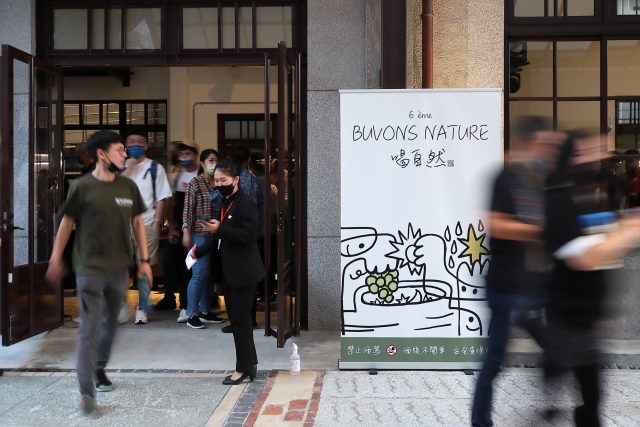
Across the globe, Taiwan is emerging as one of its most inventive hubs. Since 2019, producers have been testing how floating yeasts behave in the island’s humid subtropical climate through the Buvons Nature wine fair.
The fair runs a dedicated B&W winemaking project that brings together Weightstone, Sunmai Brewery and even small indigenous winemaking initiatives. What began as a fair-based exploration has grown into a broader inquiry into how Taiwan’s climate, hybrid grapes and clay vessels shape natural fermentation.
At the centre of this movement is Yusen Lin, widely regarded as Taiwan’s most respected wine expert and the organiser of Buvons Nature, which is now approaching its ninth edition. The 2025 fair will focus entirely on floating yeasts, a theme Lin considers long overdue.
“It is time to recognise the real winemakers,” he says; “the yeasts and bacteria that transform grape juice into wine. Every natural wine is a living ecosystem, a microbial terroir telling its own story.”
Lin’s perspective reflects the global shift toward low-intervention winemaking, yet Taiwan’s approach is different because it focuses on learning through experimentation. For Lin, natural wine is not only an agricultural expression but an intellectual project, made possible by the island’s climate, cellar culture and eagerness to experiment.
The modern Taiwanese wine industry, revived after the end of the government monopoly in 2002, offers unusual freedom for this kind of work.
Flor, in Lin’s view, naturally follows. Taiwan’s humid conditions and growing interest in clay vessels provide a distinctive environment for floating yeasts. Producers such as Weightstone are, he believes, especially well positioned to explore how flor behaves outside its classic European settings.
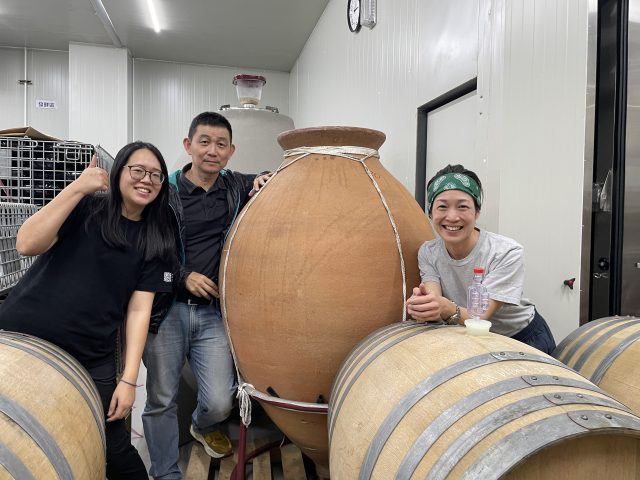
Unlike Sherry or Jura cellars, where flor forms across the broad surface of barrels, Taiwanese winemakers have been trialling a range of vessels from oak and ceramic to clay. Georgian qvevri have proven the most effective; their deep bodies and narrow necks allowing a stable surface film to form while maintaining a substantial layer of lees at the bottom. “In fact, it is the lees that shape the wine far more than the thin film above. The wines often remain reductive, not oxidative,” Lin says.
Lin has become a steady guide for Weightstone, Taiwan’s pioneering estate known for its commitment to experimentation. His role is not to dictate style but to expand how the team thinks.
Vivian Yang, the estate’s director, has worked with Lin on the B&W natural wine projects created each year for Buvons Nature. In both 2019 and 2021, the wines matured under flor. Weightstone’s conditions appear unusually hospitable to film formation; Yang notes that as long as the vessels are not topped up, the flor develops easily.

These collaborative wines are not meant to be commercially appealing. Lin emphasises that while they must still taste good, their true value lies in the learning process. The B&W project uses Taiwan’s hybrid grapes — Musann Blanc and Black Queen — kept in qvevri for long without topping up. Under these conditions flor emerges frequently, reinforcing Lin’s belief that floating yeasts are not anomalies but overlooked expressions of natural fermentation.
Partner Content

This curiosity extends well beyond wine. For Lin, flor belongs to a wider microbial world that winemakers and brewers are only beginning to understand. Even at Weightstone, the true identity of these surface yeasts remains unknown. This uncertainty helped inspire Taiwan’s emerging wine-beer category, where grape skins, must and lees co-ferment with beer wort.
Marcie Chan, director of operations at Sunmai Brewery, has collaborated with Lin on several of these B&W experiments. Her interest began in 2019 after tasting a wine-beer in Berlin, striking for its fruit depth and vinous structure, closer to Belgian kriek than conventional craft beer.
Chan describes Taiwan’s versions as unpredictable and vivid. “The grape elements interact with the wort in ways that create fruit intensity and a structure that ordinary sour ales never have. Each year is different.” Flor often appears spontaneously during maturation in clay vessels, and Chan believes these films, frequently misunderstood as faults, add acidity, texture and complexity.
Interestingly, as Lin points out, under the microscope, however, these films are not layers of Saccharomyces cerevisiae (brewer’s yeast) but lactic bacteria, similar to those found at Aymeric Tissot’s Brasserie Levain in the Jura.
Chan’s recent judging role at the International Beer Cup in Osaka underscored the category’s potential: out of more than 1,000 entries, the Korean wine-beer Funky Magic, co-fermented with the Cheongsu grape and aged in Sherry casks, won Gold for its tension and vitality.
Despite these promising signs, Taiwan’s major breweries have yet to engage. Grape sourcing is difficult, and the beer and wine communities rarely overlap. Yet among natural wine drinkers and sour beer fans, wine-beer has found an enthusiastic cross-audience, a distinctly Taiwanese expression of fermentation culture driven by small producers rather than major brands.
This openness may help explain why Taiwan’s Master Sommelier, Kevin Lu, believes the domestic palate is especially suited to flor-driven wines. Taiwanese cuisine is rich in umami, aromatics and savoury depth, flavours that pair naturally with the nutty and oxidative notes associated with flor. Many drinkers, he says, find the style reminiscent of Shaoxing wine. Lu expects the category to grow, especially through by-the-glass pours in bistros and natural-wine bars where customers can explore without committing to a full bottle.
These ideas will come together at the Buvons Nature fair on 29 November 2025, where more than 300 natural wines and a focused selection from visiting producers, including rare sous-voile bottles, will be poured.
Lin sees the fair as a chance to deepen understanding beyond simplistic narratives. “Natural wine is not magic. It is the work of microbial ecosystems. To protect that ecosystem, to avoid excessive sulphite, aggressive filtration or homogenised commercial yeasts, is to preserve terroir itself.”
Taiwan’s rise as a centre of flor exploration may surprise those who typically look to Europe for innovation. But with experimental winemakers, clay vessels, hybrid grapes and a curator who frames microbial life as terroir, the island, perhaps, has become one of the most dynamic places to study flor today.
As Lin puts it: “From start to finish, yeast writes the story of the wine. Our job is simply to listen.”
Related news
How do people under 40 find their way into fine wine?
‘Bonkers’ rosé sales in UK driven by four wine brands
How a visit to California convinced Mirabeau to sell to Concha y Toro


