



Crus Bourgeois launch new comms and hints at simplification of next classification
The Crus Bourgeois were in London last week to showcase the latest vintage. Arabella Mileham spoke to Anne-Sophie Pagès about the need to stay positive despite the challenges of the market, the alliance’s new comms campaign and why the 2030 classification might be simplified.
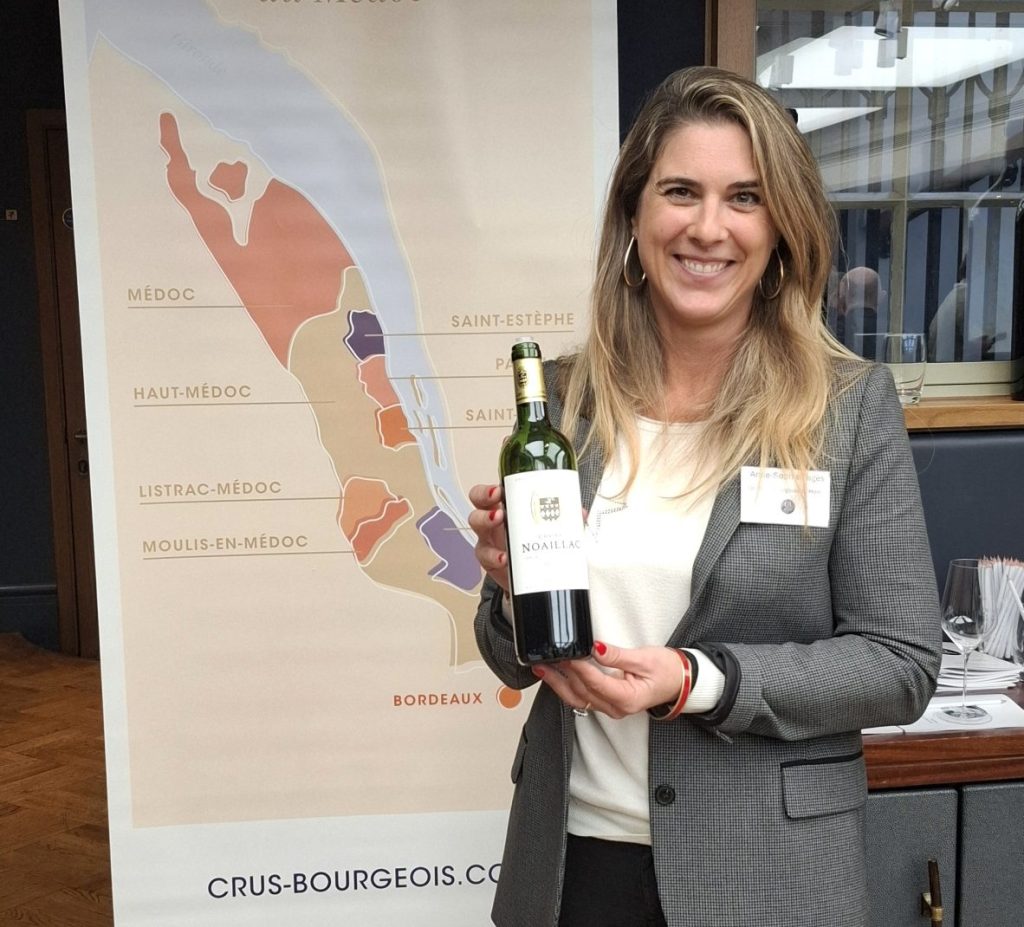
Anne-Sophie Pagès of Château Noaillac and a member of the Board of the Crus Bourgeois du Médoc was in London for the presentation of the 2023 vintage to the trade and press – the first vintage in the 2025 classification that was launched in February to cover vintages from 2023 to 2027.
It coincides with the launch of a new comms campaign that focuses on Cru Bourgeois wines as “wines [that] are for everyone.”
“It’s affordable and you can have it when you want, sharing good moments,” she explains. “There’s a Cru Bourgeois for everyone, whatever the occasion.”
The campaign will include a media campaign in France and key international markets, “a key moment” at the Wine Paris event, plus an email and a digital campaign using ambassadors selected from among its members.
Jennifer Mathieu, director of the Alliance des Crus Bourgeois said the “powerful and differentiating campaign” would not only support the Classification launch, “but also break with the traditional codes of Bordeaux wine”, by tapping into new consumer trends and developing a younger target market.
“Our aim is to create awareness and desirability around the Crus Bourgeois wines, which embody more than just a Classification label. Behind the labels are passionate winemakers, top-quality wines and the guarantee of a pleasurable moment, whatever the occasion,” she said.
Lack of market visibility
The launch comes at a time when the market is increasingly complicated due to the lack of visibility, Pagès said. “The more complex thing is that we don’t know where we’re going – no visibility. Before we knew we could invest. We have it for the week or the month, but not longer, so the market is not easy.”
Partner Content

This lack of visibility was seeing some producers holding back “a little bit” from investment, she said, but there is still investment and “people still willing to go for it.”
In terms of the Crus Bourgeois’ key markets, although there has been a reduction in the UK market, which Pagès said was “always a good market for Bordeaux”, “it is a market that we try to fight a lot to keep.” Other markets that continue to be promising include India, Japan and Asia, although mainland China has always been a bit “tricky”, she said in part due to its size and cultural differences and also because as the Chinese increasingly produce their own wine, potential consumers are drinking more locally grown wine.
Simplification in the pipeline?
However, as she points out, the Crus Bourgeois are fighting back with the new comms campaign and it is already working on the next classification, which will cover vintages from 2028 – 32.
This has involved gaining feedback from wineries. “We are hearing what every winery says, and we are looking for maybe less complexities in the day-to-day work, for example, regarding all the controls,” she explained. As a result, it is likely that the next classification will have fewer papers for producers to fill. Although the “simplification of the rules” has to be approved by the French government, Pagès says this will be set up in the next two years – with people submitting the dossiers in 2028.
As part of the 2025 classification, wineries had to present five vintages for a tasting to ascertain consistency, and enhancements to the scheme included mandatory environmental certification and stricter technical, viticultural and commercial standards. However, as highlighted in db’s analysis of the new classification when it was first unveiled. db’s Bordeaux correspondent Colin Hay noted that the number of wineries who are part of the new Crus Bourgeois has fallen from 249 separate châteaux in 2020, to 170 in the new 2025 classification – with the alliance representing 22% of the Médoc’s total wine production, down from 31% in the last classification. He argued that this was only partly caused by the stricter criteria for admission, which resulted in a higher competitive attrition rate, and partly because “too many of its former members no longer want to belong to the club that would wish to readmit them”, something he called “the Groucho Marx problem”.
Pagès said that the fall in numbers wasn’t due to one particular reason, even though potentially it was “a bit harder” for some wineries to access the [Cru Bourgeois ] family with the [new] tasting part, as well as needing to have a level 2 or level 3 natural certification. “So some people didn’t want to be part of the family again, some couldn’t,” she told db.
Related news
Brane Cantenac unveils label celebrating 100 years of Lurton family ownership
‘A warrior variety’ – Cabernet’s resilience from the Maipo to Margaux
French vineyards battle extreme heat as climate pressures mount


