



Ancient winepress and Canaanite shrine unearthed near Megiddo
Archaeologists in northern Israel have uncovered what may be the country’s oldest winepress alongside a miniature Canaanite shrine and votive ram figurine.
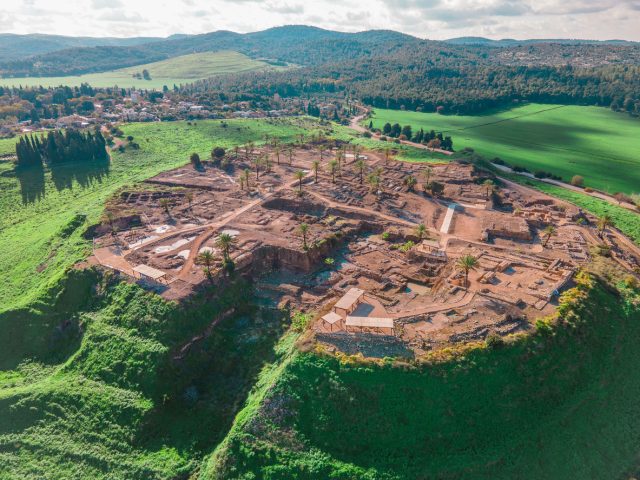
As reported by Haaretz, the discoveries were made during salvage excavations ahead of a project to reroute a dangerous section of Highway 66 between Megiddo Intersection and Yokne’am. The work, led by Amir Golani and Barak Tzin of the Israel Antiquities Authority (IAA), revealed a 5,000-year-old winepress carved directly into bedrock and, nearby, ritual vessels including a miniature shrine and a ram-shaped juglet.
The archaeologists say these findings may show that Early Bronze Age Megiddo was not merely a large settlement but a regional cultic centre. According to the IAA, the discoveries are “unprecedented” and shed new light on the relationship between Canaanite domestic life, urbanisation and religion.
The ‘smoking gun’ of ancient winemaking
The winepress was hewn into an outcrop within a residential zone rather than a field, suggesting its role extended beyond simple production. Golani described it as the “smoking gun of actual production,” confirming that wine was not only consumed but made in situ during the Early Bronze Age.
Archaeologists found the treading floor sloping to a collecting vat, surrounded by stone-based houses built with mudbrick walls. The central placement of the press hints that it may have had communal or ritual importance, possibly tied to Megiddo’s emergence as a proto-urban hub.
While evidence of winemaking elsewhere in the Levant has been circumstantial, from jars containing grape residue or seeds, this installation provides direct proof of local production around 3000 BC.
Drinking with the gods
Some 1,700 years later, during the Late Bronze Age, the same area yielded an extraordinary Canaanite assemblage: a zoomorphic ram juglet, a small cup and two clay bowls deliberately buried together in a pit. The juglet’s design allowed liquid to be poured in through an opening on its back and out through the ram’s mouth. The small cup, wedged and slightly broken to fit, likely acted as a funnel.
Partner Content


Golani told Haaretz the find resembled “a Canaanite tea set from 3,300 years ago”, perhaps used for libations of wine, milk or another intoxicating drink offered to the gods. The artefacts were, in his words, “ritually killed” and buried, providing a rare glimpse into ceremonial practice among the Canaanite populace.
Nearby, the team uncovered a clay model of a small shrine. Cruder than other known examples, it may have been made not by priestly elites but by ordinary worshippers offering devotion from outside the great temple of Megiddo.
Offerings from the ordinary
Golani suggested the miniature shrine “represents a schematic temple modelled after something known at that time,” possibly dedicated by “simple folk” who came to worship at the grand temple up the hill. Its deliberate placement in a pit alongside other vessels indicates it was a purposeful act of consecration rather than a casual discard.
The finds, taken together, point to a religious continuum spanning more than a millennium: from communal wine production to private acts of devotion. They also reaffirm Megiddo’s significance as a major centre of Canaanite ritual life, linking everyday industry with sacred practice.
Beer before wine
The discoveries contribute to the wider archaeological conversation about alcohol’s origins. As reported by the drinks business, the earliest known beer production dates back around 13,000 years to the Natufian culture in what is now Israel, while evidence of deliberate grape winemaking appears later in Neolithic Georgia around 6000 BC.


