



Changing of the guard: Viña Carmen makes pivotal change in the UK
As Chilean producer Viña Carmen takes on a new UK distributor Sarah Neish talks to winemaker Ana Maria Cumsille about the “very fresh” 2025 vintage and her relentless quest to find the perfect barrel for Maipo Valley Cabernet.
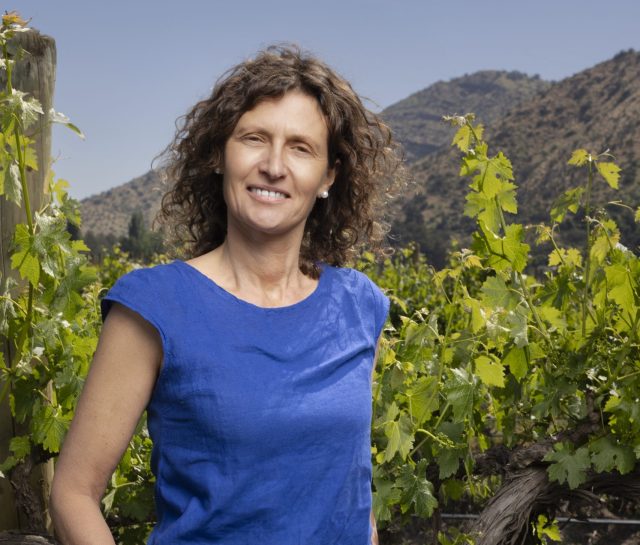
When db last sat down with Ana Maria Cumsille, she was just two weeks into her new role as winemaker for Chilean producer Viña Carmen. Two years later, what changes has she managed to implement at the historical winery and how does she plan to take the wines forward? Cumsille says that while she has “started to make small tweaks”, including picking earlier, extracting less, and trying different oak, much of the period has been spent adjusting to the visceral shock of returning “from expert to student”.
“It’s been a very busy time,” she tells the drinks business. “When you start a new project it’s a lot of work. Every place is different and learning about Cabernet in Maipo is totally different to Cabernet in Cachapoal. You need at least four or five years to really feel comfortable in a new place.”
She will be hoping that the familiarisation process is somewhat quicker for new distributor Schenk Family, which this month takes over from Bibendum in managing Carmen’s portfolio across both the on- and off-trade in the UK. According to the winery, the move is about reinforcing Carmen’s ambition “to accelerate growth” and “strengthen its position in one of the world’s most competitive wine markets.”
Crucially, Carmen will be the only Chilean wine on Schenk Family UK’s books, enabling the distributor to really hone in on its Maipo expertise and the typicity of this exceptional terroir, which births premium wines such as Carmen Gran Reserva, Carmen Delanz and Carmen Gold Reserve. The move also represents a turning point for Carmen’s relationship with the UK, and the timing of the recalibration should enable Cumsille to work hand-in-hand with Schenk as she chaperones Carmen’s wines into their next chapter.
Barrel of laughs
Cumsille is both meticulous and methodical in terms of researching the Maipo terroir. Having spent 12 years working with [top Chilean Cabernet blend] Altair, whose vineyards are located in the Cachapoal Valley, she is regimented about going back to basics and figuring out what works best in her new professional home. This includes everything from how the vines are grown to the vessels they are stored in. While Viña Carmen previously used “two or three barrel suppliers”, Cumsille is keen to change that.
“I’m currently trialling 12 different coopers, storing the same wine in each of their barrels for a period of 12-14 months in order to determine the best oak for Maipo Cabernet,” she tells db.
It sounds like The X-Factor for coopers, with Cumsille adopting Simon Cowell’s straight down the (ahem) barrel persona. “I’m trying to find the best way for the wines,” she laughs. “Sometimes a good supplier’s barrel works for one wine and not for another. I always say to them ‘it’s not a problem with your barrel, it’s just not right for my wine’.”
Island fizz
New product innovations, too, are afoot. Last year, Carmen launched DO Punta Chilen, the first sparkling wine ever to be made on Chiloe Island, with only 50 bottles produced. The island vineyard is “just 0.2ha in size, with 300 vines planted in 2018,” Cumsille says. The wine was never intended to be a sparkling but rather a still Pinot Noir, with Viña Carmen having to think fast when the grapes failed to ripen sufficiently, and pivot to a sparkling instead. ”
The problem is the light,” Cumsille reveals. “It’s a very southerly region with few daylight hours”. Compounding matters is the “very low PH in the soils”, which makes reaching the required 11.5% alcohol threshold in order to include the word ‘wine’ on the label, challenging.
The resulting wine is a lighter alcohol Chiloe fizz with an ABV of about 9%. Has Carmen accidentally hit upon a hot trend? After all, low alcohol fizz is having a moment.
Cumsille describes the flavour profile of Punta Chilen as “very impressive”.
“It’s a little vegetal, very citric, and vertical with not a lot of volume in the middle palate.”
Partner Content



With volumes so low, who was lucky enough to get hold of a bottle? Of the 50 bottles produced, Cumsille says that about a third was kept by Carmen’s CEO and chairman, another third held back for tasting purposes in the winery and a final third went to Carmen’s cellar door to be sold to quick-off-the-mark consumers, though Cumsille is at pains to point out that “it was never meant to be a commercial project.”
Vintage 2025
In May, Carmen’s 2025 harvest was revealed to be about 20% down on last year, as is the case with winemakers across Chile, but Cumsille insists that the quality is excellent.
“We are very happy. It’s looking much better than 2024, in fact”, she says, with Cabernet Sauvignon from Maipo expected to be the stand-out variety. “It’s more concentrated, very fresh, the tannins a little silkier, and with very good balance and alcohol levels around 13.5%.”
The wines are currently ageing in barrel following malolactic fermentation, and Cumsille describes this as “a quiet moment for the wines”, other than drawing samples for tasting once a month or so.
Strangely, in Itata, that famously dry-farmed Chilean region, which has experienced one of its driest years of all time, volumes haven’t dipped all that drastically. Cumsille’s own wine brand, Ana Maria, which she works on alongside Carmen’s wines, is centred there. “The problem in Itata is that we don’t have any irrigation, so when it doesn’t rain in summer then it’s a problem.” Despite this, she says she has still been able to procure the same volume of grapes for her wine range as in previous years. “The cost per kilo went up, but I was able to buy the same number of kilos.”

Double act
Speaking of balancing her winemaking responsibilities for the two businesses, Cumsille previously told db, “there is no conflict of interest” because her Ana Maria wines – made from Pais, Cinsault, Carignan and Malbec, all grown in Itata, “don’t compete with Carmen wines.” She juggles both by allocating three days per month “to work on my own project”.
Furthermore, Carmen also grants her a total of 10 travel days per year to promote her own wines, “but I rarely use them all up.” Cumsille does not use Carmen’s winery or equipment for her Ana Maria project, instead renting “a small place in Itata”, but regularly travelling the long distance is starting to take its toll and she tells db she is looking to move her production closer to Santiago, where Carmen is based.
“Last harvest was very intense. I was at my limit, very stressed, really a little crazy,” she says.
It’s hardly surprising given that she was driving five hours south from Santiago to Itata to taste the wines, followed by five hours on the return leg to make it back for Carmen the next day. One positive change since we last spoke is that Cumsille has secured a UK distributer for her Ana Maria range, and again she refuses to piggyback on Carmen’s route to market, choosing to go her own way with Scottish importer WoodWinters, which opened its London branch in 2017.
Prior to this, she told db: “I really work alone. I produce, sell, distribute and market my wines by myself.”
Chomping at the bit
For its part, Schenk Family UK is chomping at the bit to get going with Viña Carmen, with Cumsille calling the outfit “the perfect platform for us” due to both companies being family-owned and sharing similar values.
“Schenk Family UK are delighted to begin our partnership with Viña Carmen,” says managing director Helena Martin. “Their commitment to producing authentic, sustainable, and high-quality wines aligns perfectly with our own values. We share a common vision of bringing brands to life through compelling storytelling and genuine passion. We look forward to building a strong and successful relationship together.”
Schenk, founded in 1893 in Rolle, Switzerland, has built a reputation over the years for being able to scale up premium wine sales in different markets. With Carmen known for rediscovering the forgotten grape variety Carmenere back in 1994, one wonders what truths might yet be uncovered in the coming months and years.
Related news
Viña Santa Rita appoints Schenk Family
Santa Rita Winery appoints José Jerez Fuentes as corporate marketing director


