



Royal Navy Rum Store to get £22million transformation
A heritage rum house that served Great Britain’s Royal Navy between 1828 and 1832 is set to be transformed into a hub for maritime businesses, complete with rooftop bar. Building work is expected to start “within days”.
The Grade II listed rum house located on the waterfront in Gosport, Portsmouth Harbour, dished out tots of rum to thirsty sailors during Queen Victoria’s reign, but was written off as ‘out of action’ after it was bombed in 1940.
The building, which was also used to house beer and dry goods like sugar in the 1800s, as well as rum, was finally decommissioned in 1991. But the landmark site is getting a £22 million investment and new sense of purpose, with building work due to start “within days”.
Government funding has gone towards renovating the Royal Navy Rum Store in the heart of Royal Clarence Yard, with the vision being to turn the property and its grounds into a 7,000 square metre area for maritime businesses like yacht brokers and naval architects, as well as shops and leisure activities.
“It was important that the site was protected and enhanced,” said Gosport Borough Council at a meeting held on 10 September. “Members welcomed the development and could see the vision and passion the developer had for the site.”
According to the council, the refurbishment could create “up to 200 jobs” and the project is due to be completed by summer 2026.
Naval history
The Rum House was originally established by a private brewery to store alcohol for sailors at the Portsmouth Naval Base. However, due to beer requiring large areas on board ships for storage, and not keeping well in hot weather, the store’s focus soon pivoted to rum for the sailor’s rations. During Queen Victoria’s reign, a new private Royal Railway station was built nearby to the store house to allow the monarch to travel more easily between London and Osborne House on the Isle of Wight.
Tragedy struck when in 1940 Royal Clarence Yard was bombed, and the Rum Store’s roof and contents went up in flames. After this the use of Royal Clarence Yard by the Navy declined and the site was finally closed in 1991. Specialist repairs to the building’s historic structure will be carried out as part of the plans for the modern-day renovation, and the second floor will be reconstructed, having been entirely demolished during the World War Two bombing.
Partner Content




The ‘grog’ ration
An anecdote recorded by a member of the Women’s Royal Navy Serice (the WRENs), and archived by the BBC, describes the rum rationing that took place for Royal Navy sailors in Portsmouth in 1940.
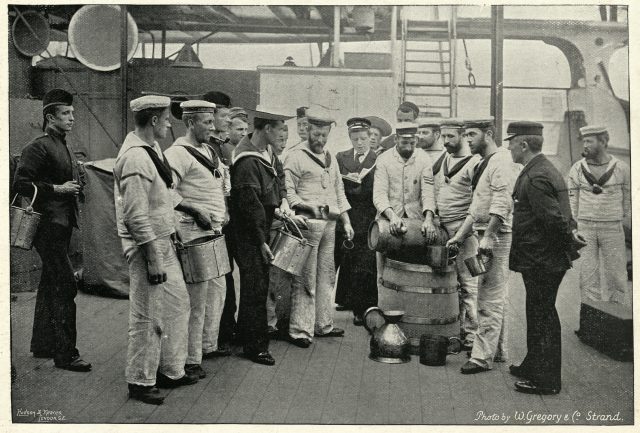
“Each day at mid-day the men’s rum issue, known in the Navy as Grog, took place on the ground floor of our House and the smell hung about for hours afterwards. In charge was the Regulating Petty Office, but whether he was there or not some men had more than their share. Some went to sleep for a couple of hours – many tried to hide the smell of rum by chewing cloves and one Petty Officer we worked with frequently became very unpleasant so we gave him a wide berth until he sobered up.
“A colleague of mine, Vi Sladen, worked in the Victualling Store dealing with the provision of food and rum for a complement of some 2,300 personnel which varied from day to day. A daily record was kept of the rum issue and against the names of men taking it she wrote “G” for Grog and U/A ( underage) for those too young and “T” for Temperance.
“Each morning the Duty Officer would officiate as the rum issue was prepared by adding two parts of water to one part of rum for the sailors’ issue. Petty Officers and Chief Petty Officers had neat rum and the Temperance men received threepence a day instead of rum.”
Rum, brown sauce and tobacco
The same WREN detailed how the sailors also shared a fondness for brown sauce.
“The canteen kitchens were staffed by wren cooks. On hand in the dining halls were bottles of sauces and it seemed to me that Naval men had two great likings. One of course was for rum and the other for brown sauce and it went on almost everything they ate,” she wrote.
Cigarettes, too, were an indispensable part of life in the Royal Navy.
“There were obviously some advantages to working in Stores,” the Wren recorded. “Of course most of us smoked – we were encouraged to do so in as much that in the Navy cigarettes were available on issue. The amount was 500 per month and they were called ‘ticklers’. If you wanted to roll your own you could have the equivalent weight in tobacco.”
Related news
NBA star Isiah Thomas slam dunks with two kosher Champagnes



Just missed out as I joined Navy in 1970 and the ration stopped that year!! Gus Holmes ex submariner.